


The Impact of Individual Mobility on Long-Term Exposure to Ambient PM2.5: Assessing Effect Modification by Travel Patterns and Spatial Variability of PM2.5
- PMID: 33672290
- PMCID: PMC7926665
- DOI: 10.3390/ijerph18042194
The Impact of Individual Mobility on Long-Term Exposure to Ambient PM2.5: Assessing Effect Modification by Travel Patterns and Spatial Variability of PM2.5
Abstract
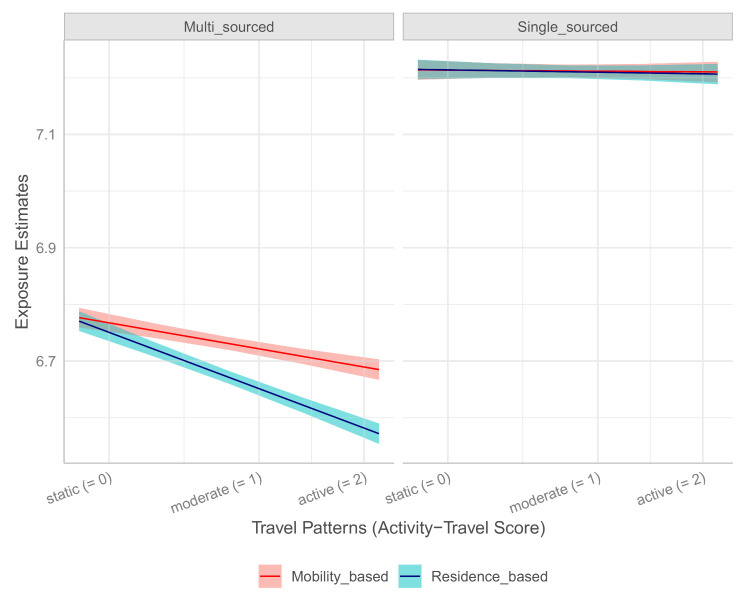
The impact of individuals' mobility on the degree of error in estimates of exposure to ambient PM2.5 concentrations is increasingly reported in the literature. However, the degree to which accounting for mobility reduces error likely varies as a function of two related factors-individuals' routine travel patterns and the local variations of air pollution fields. We investigated whether individuals' routine travel patterns moderate the impact of mobility on individual long-term exposure assessment. Here, we have used real-world time-activity data collected from 2013 participants in Erie/Niagara counties, New York, USA, matched with daily PM2.5 predictions obtained from two spatial exposure models. We further examined the role of the spatiotemporal representation of ambient PM2.5 as a second moderator in the relationship between an individual's mobility and the exposure measurement error using a random effect model. We found that the effect of mobility on the long-term exposure estimates was significant, but that this effect was modified by individuals' routine travel patterns. Further, this effect modification was pronounced when the local variations of ambient PM2.5 concentrations were captured from multiple sources of air pollution data ('a multi-sourced exposure model'). In contrast, the mobility effect and its modification were not detected when ambient PM2.5 concentration was estimated solely from sparse monitoring data ('a single-sourced exposure model'). This study showed that there was a significant association between individuals' mobility and the long-term exposure measurement error. However, the effect could be modified by individuals' routine travel patterns and the error-prone representation of spatiotemporal variability of PM2.5.
Keywords: long-term exposure to ambient PM2.5; mobility-based approach; routine travel patterns; spatial exposure models; uncertainty.
Conflict of interest statement
The authors declare no conflict of interest.
Figures
References
-
- Shaddick G., Zidek J.V. A case study in preferential sampling: Long term monitoring of air pollution in the UK. Spat. Stat. 2014;9:51–65. doi: 10.1016/j.spasta.2014.03.008. - DOI
-
- Yoo E.H., Zammit-Mangion A., Chipeta M.G. Adaptive spatial sampling design for environmental field prediction using low-cost sensing technologies. Atmos. Environ. 2020;221:117091. doi: 10.1016/j.atmosenv.2019.117091. - DOI
-
- Brauer M., Hoek G., Van Vliet P., Meliefste K., Fischer P.H., Wijga A., Koopman L.P., Neijens H.J., Gerritsen J., Kerkhof M., et al. Air pollution from traffic and the development of respiratory infections and asthmatic and allergic symptoms in children. Am. J. Respir. Crit. Care Med. 2002;166:1092–1098. doi: 10.1164/rccm.200108-007OC. - DOI - PubMed
Publication types
MeSH terms
Substances
Grants and funding
LinkOut - more resources
Full Text Sources
Other Literature Sources
Medical
