


Sarcopenia and Cognitive Function: Role of Myokines in Muscle Brain Cross-Talk
- PMID: 33672427
- PMCID: PMC7926334
- DOI: 10.3390/life11020173
Sarcopenia and Cognitive Function: Role of Myokines in Muscle Brain Cross-Talk
Abstract
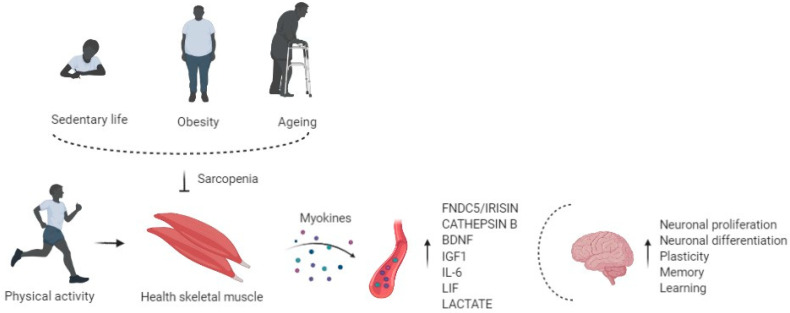
Sarcopenia is a geriatric syndrome characterized by the progressive degeneration of muscle mass and function, and it is associated with severe complications, which are falls, functional decline, frailty, and mortality. Sarcopenia is associated with cognitive impairment, defined as a decline in one or more cognitive domains as language, memory, reasoning, social cognition, planning, making decisions, and solving problems. Although the exact mechanism relating to sarcopenia and cognitive function has not yet been defined, several studies have shown that skeletal muscle produces and secrete molecules, called myokines, that regulate brain functions, including mood, learning, locomotor activity, and neuronal injury protection, showing the existence of muscle-brain cross-talk. Moreover, studies conducted on physical exercise supported the existence of muscle-brain cross-talk, showing how physical activity, changing myokines' circulating levels, exerts beneficial effects on the brain. The review mainly focuses on describing the role of myokines on brain function and their involvement in cognitive impairment in sarcopenia.
Keywords: cognitive impairment; exerkines; myokines; sarcopenic; skeletal muscle.
Conflict of interest statement
The authors declare no conflict of interest.
Figures
References
-
- Cruz-Jentoft A.J., Bahat G., Bauer J., Boirie Y., Bruyere O., Cederholm T., Cooper C., Landi F., Rolland Y., Sayer A.A., et al. Writing Group for the European Working Group on Sarcopenia in Older People 2 (EWGSOP2), and the Extended Group for EWGSOP2. Sarcopenia: revised European consensus on definition and diagnosis. Age Ageing. 2019;48:16–31. doi: 10.1093/ageing/afy169. - DOI - PMC - PubMed
Publication types
LinkOut - more resources
Full Text Sources
Other Literature Sources
