


A Review and Secondary Analysis of Competition-Related Impacts of Nonindigenous Aquatic Plants in the Laurentian Great Lakes
- PMID: 33672586
- PMCID: PMC7924059
- DOI: 10.3390/plants10020406
A Review and Secondary Analysis of Competition-Related Impacts of Nonindigenous Aquatic Plants in the Laurentian Great Lakes
Abstract
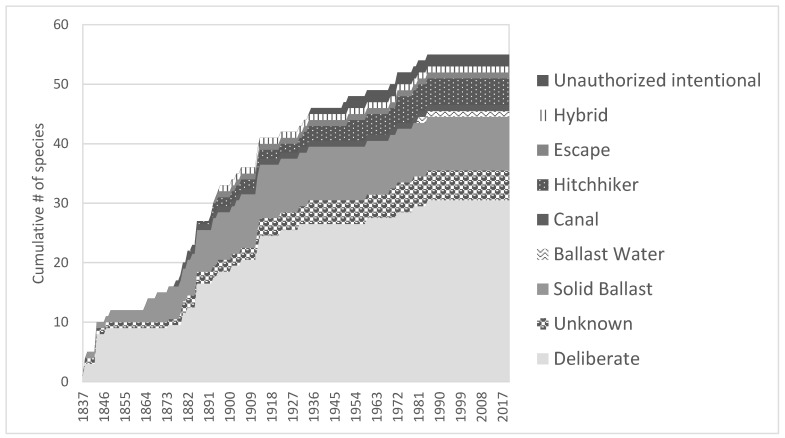
The Laurentian Great Lakes of North America are home to thousands of native fishes, invertebrates, plants, and other species that not only provide recreational and economic value to the region but also hold an important ecological value. However, there are also 55 nonindigenous species of aquatic plants that may be competing with native species and affecting this value. Here, we use a key regional database-the Great Lakes Aquatic Nonindigenous Species Information System (GLANSIS)-to describe the introduction of nonindigenous aquatic plants in the Great Lakes region and to examine patterns relating to their capacity to compete with native plants species. Specifically, we used an existing catalog of environmental impact assessments to qualitatively evaluate the potential for each nonindigenous plant species to outcompete native plant species for available resources. Despite an invasion record spanning nearly two centuries (1837-2020), a great deal remains unknown about the impact of competition by these species. Nonetheless, our synthesis of existing documentation reveals that many of these nonindigenous species have notable impacts on the native plant communities of the region in general and on species of concern in particular. Furthermore, we provide a thorough summary of the diverse adaptations that may contribute to giving these nonindigenous plants a competitive advantage. Adaptations that have been previously found to aid successful invasions were common in 98% of the nonindigenous aquatic plant species in the database.
Keywords: Great Lakes; aquatic; competition; nonindigenous species.
Conflict of interest statement
The authors declare no conflict of interest. The funders had no role in the design of the study; in the collection, analyses, or interpretation of data; in the writing of the manuscript; or in the decision to publish the results.
Figures


References
-
- Strayer D.L. Alien species in fresh waters: Ecological effects, interactions with other stressors, and prospects for the future. Freshw. Biol. 2010;55:152–174. doi: 10.1111/j.1365-2427.2009.02380.x. - DOI
-
- De Winton M., Clayton J. The impact of invasive submerged weed species on seed banks in lake sediments. Aquat. Bot. 1996;53:32–46. doi: 10.1016/0304-3770(95)01010-6. - DOI
-
- Hussner A., Van de Weyer K., Gross E.M., Hilts S. Comments on increasing number and abundance of non-indigenous aquatic macrophyte species in Gremany. Weed Res. 2010;50:519–526. doi: 10.1111/j.1365-3180.2010.00812.x. - DOI
-
- Sheppard A.W., Shaw R.H., Sforza R. Top 20 environmental weeds for classical biological control in Europe: A review of opportunities, regulations and other barriers to adoption. Weed Res. 2006;46:93–117. doi: 10.1111/j.1365-3180.2006.00497.x. - DOI
Publication types
Grants and funding
LinkOut - more resources
Full Text Sources
Other Literature Sources
