Review
. 2021 Feb 20;11(2):362.
doi: 10.3390/diagnostics11020362.

Cardiac Adiposity and Arrhythmias: The Role of Imaging

Affiliations
Review

Cardiac Adiposity and Arrhythmias: The Role of Imaging

Maria Bonou et al. Diagnostics (Basel). .

Abstract

Increased cardiac fat depots are metabolically active tissues that have a pronounced pro-inflammatory nature. Increasing evidence supports a potential role of cardiac adiposity as a determinant of the substrate of atrial fibrillation and ventricular arrhythmias. The underlying mechanism appears to be multifactorial with local inflammation, fibrosis, adipocyte infiltration, electrical remodeling, autonomic nervous system modulation, oxidative stress and gene expression playing interrelating roles. Current imaging modalities, such as echocardiography, computed tomography and cardiac magnetic resonance, have provided valuable insight into the relationship between cardiac adiposity and arrhythmogenesis, in order to better understand the pathophysiology and improve risk prediction of the patients, over the presence of obesity and traditional risk factors. However, at present, given the insufficient data for the additive value of imaging biomarkers on commonly used risk algorithms, the use of different screening modalities currently is indicated for personalized risk stratification and prognostication in this setting.

Keywords: adipose tissue; arrhythmogenesis; atrial fibrillation; cardiac fat; cardiac magnetic resonance; echocardiography.


Conflict of interest statement

The other authors declare no conflict of interest.

Figures
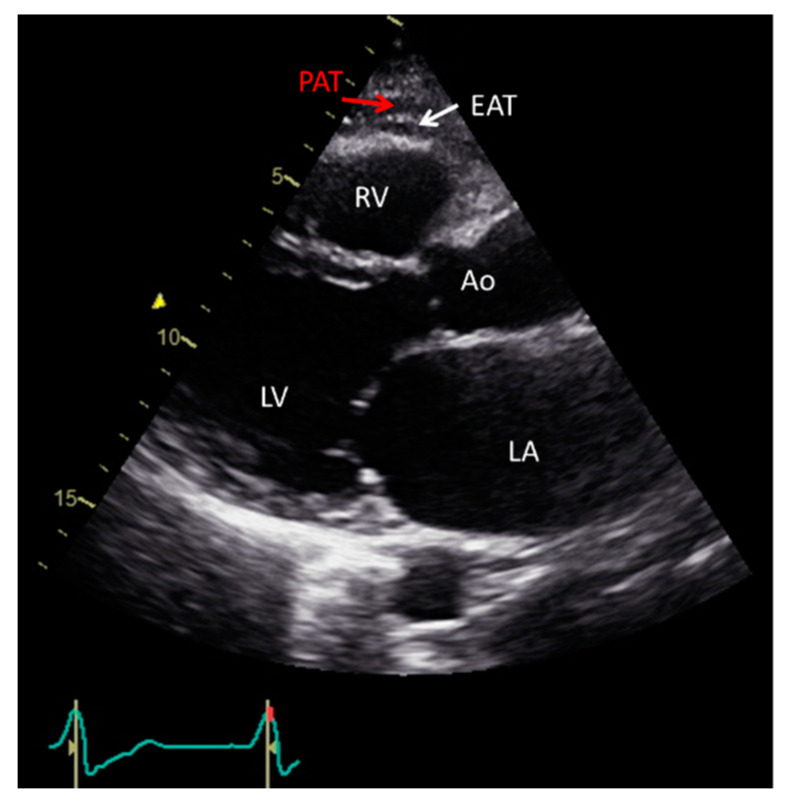
Figure 1
Figure 1
Transthoracic echocardiographic view showing EAT and PAT as echo-lucent areas in front of the RV free wall. EAT is pointed by a white arrow and PAT by a red arrow. Ao: aorta; EAT: epicardial adipose tissue; LA: left atrium; LV: left ventricle; PAT: pericardial tissue; RV: right ventricle.
Figure 2
Figure 2
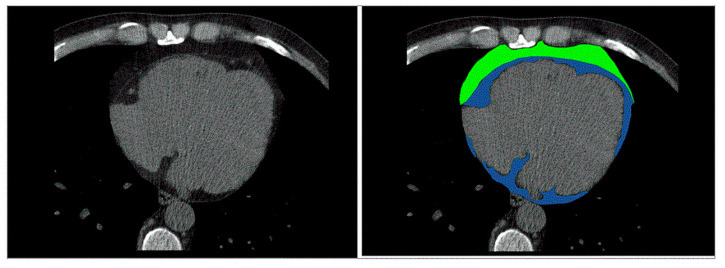
Cardiac Computed Tomography: EAT (depicted in blue) is located between the myocardium and visceral pericardium, PAT (depicted in green) is located adherent and external to the parietal pericardium. EAT: epicardial adipose tissue; PAT: pericardial tissue. de Wit-Verheggen VHW, et al. Cardiovasc Diabetol. 2020;19:129, under Creative Commons license 4.0.
Figure 3
Figure 3
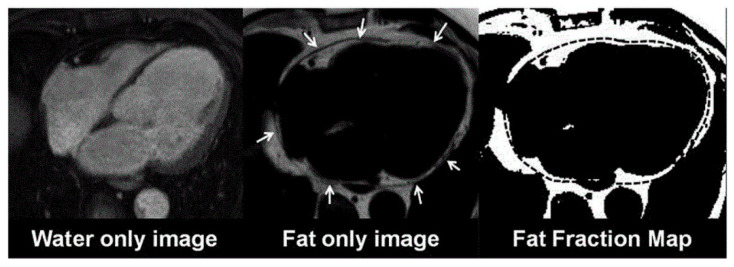
CMR Dixon images. A: Fat only image. B: Fat only Image with the epicardial outlines (arrows). C: Segmented fat voxels with the transferred region of interest. CM: cardiac magnetic resonance. Kropidlowski C, et al. Int J Cardiol Heart Vasc. 2020;27:100477, under Creative Commons license 4.0.

References

    1. Rodríguez A., Becerril S., Hernández-Pardos A.W., Frühbeck G. Adipose tissue depot differences in adipokines and effects on skeletal and cardiac muscle. Curr. Opin. Pharmacol. 2020;52:1–8. doi: 10.1016/j.coph.2020.04.003. - DOI - PubMed
    1. Piché M.E., Tchernof A., Després J.P. Obesity phenotypes, diabetes, and cardiovascular diseases. Circ. Res. 2020;126:1477–1500. doi: 10.1161/CIRCRESAHA.120.316101. - DOI - PubMed
    1. Abraham T.M., Pedley A., Massaro J.M., Hoffmann U., Fox C.S. Association between visceral and subcutaneous adipose depots and incident cardiovascular disease risk factors. Circulation. 2015;132:1639–1647. doi: 10.1161/CIRCULATIONAHA.114.015000. - DOI - PMC - PubMed
    1. Fantuzzi G., Mazzone T. Adipose tissue and atherosclerosis: Exploring the connection. Arterioscler. Thromb. Vasc. Biol. 2007;27:996–1003. doi: 10.1161/ATVBAHA.106.131755. - DOI - PubMed
    1. Ouwens D.M., Sell H., Greulich S., Eckel J. The role of epicardial and perivascular adipose tissue in the pathophysiology of cardiovascular disease. J. Cell. Mol. Med. 2010;14:2223–2234. doi: 10.1111/j.1582-4934.2010.01141.x. - DOI - PMC - PubMed

LinkOut - more resources