Review
. 2021 Feb 14;13(2):299.
doi: 10.3390/v13020299.

Entry of Phenuiviruses into Mammalian Host Cells

Affiliations
Review

Entry of Phenuiviruses into Mammalian Host Cells

Jana Koch et al. Viruses. .

Abstract

Phenuiviridae is a large family of arthropod-borne viruses with over 100 species worldwide. Several cause severe diseases in both humans and livestock. Global warming and the apparent geographical expansion of arthropod vectors are good reasons to seriously consider these viruses potential agents of emerging diseases. With an increasing frequency and number of epidemics, some phenuiviruses represent a global threat to public and veterinary health. This review focuses on the early stage of phenuivirus infection in mammalian host cells. We address current knowledge on each step of the cell entry process, from virus binding to penetration into the cytosol. Virus receptors, endocytosis, and fusion mechanisms are discussed in light of the most recent progress on the entry of banda-, phlebo-, and uukuviruses, which together constitute the three prominent genera in the Phenuiviridae family.

Keywords: Heartland; RNA virus; Rift; SFTSV; Toscana; Uukuniemi; arbovirus; arthropod; bandavirus; cell entry; emerging virus; endocytosis; fusion; phlebovirus; receptor; uukuvirus.


Conflict of interest statement

The authors declare no conflict of interest. The funders had no role in the design of the study; in the collection, analyses, or interpretation of data; in the writing of the manuscript; or in the decision to publish the results.

Figures

Figure 1
Figure 1
Phenuiviral particles and the glycoproteins GN and GC. (a) Schematic representation of a phenuiviral particle. The three viral genomic RNA segments are named according to their size: S (small), M (medium), and L (large). (b) Proteolytic processing of the phenuivirus M polypeptide precursor. The M precursor and the glycoproteins GN and GC can vary greatly among phenuiviral species. In addition to GN and GC, some phenuiviruses encode an additional nonstructural protein, NSm. Arrow heads indicate the cleavage sites by host cell proteases within the precursor. The position of the fusion peptide is given based on the crystal structure of the Rift Valley fever virus (RVFV) glycoprotein GC [39]. (c) Arrangement of GN and GC glycoproteins on the surface of phenuiviral particles. Electron cryo-tomography analysis of RVFV [36,37] and Uukuniemi virus (UUKV) [38] viral particles shows an icosahedral lattice with an atypical T = 12 triangulation.
Figure 2
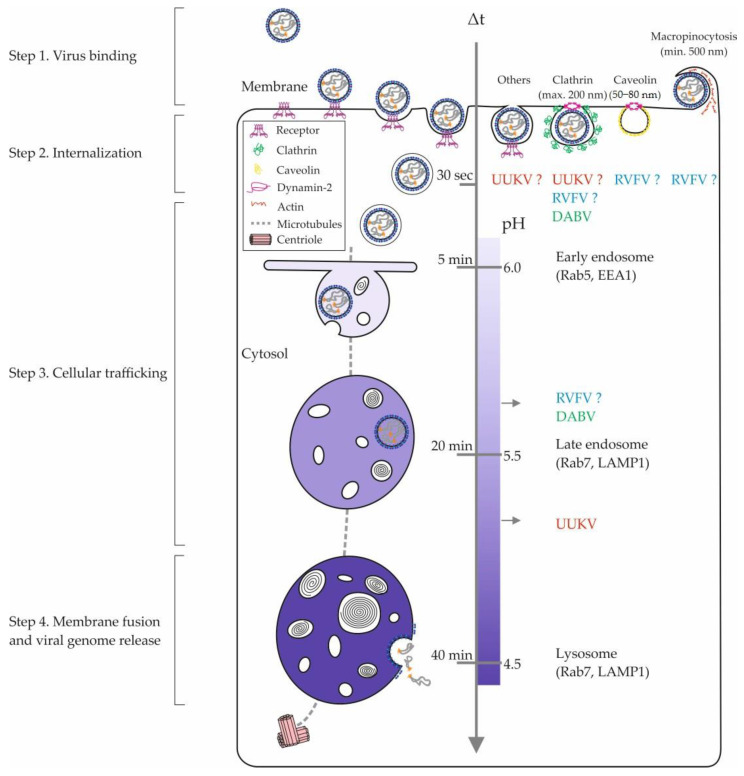
Figure 2
Phenuivirus endocytosis and intracellular trafficking. The internalization of phenuiviruses into mammalian cells involves diverse pinocytic pathways and hundreds of cellular factors. The figure shows an overview of the different cellular locations of phenuivirus penetration. The entry pathways of RVFV, UUKV, and DABV appear in blue, red, and green, respectively. Sizes refer to nonvirus cargo that are typically sorted into the clathrin-mediated endocytosis, caveolin-mediated pathway, and macropinocytosis [75]. In the middle, the scales indicate the time taken by a nonvirus cargo to go from the plasma membrane to an endosomal compartment and the corresponding endosomal pH values [75]. DABV, Dabie virus; EEA1, early endosome antigen 1; LAMP1, lysosome-associated membrane protein 1; Rab5 and Rab7, Ras-related protein 5 and 7; RVFV, Rift Valley fever virus; UUKV, Uukuniemi virus.

References

    1. ICTV 10th Report of the International Committee for Taxonomy of Viruses. [(accessed on 15 January 2021)];2017 Available online: https://ictv.global/report/
    1. Marklewitz M., Palacios G., Ebihara H., Kuhn J.H., Junglen S. Order Bunyavirales. ICTV; Berlin, Germany: 2019. Create Four New Genera, Create Seventy-Nine New Species, Rename/Move Seven Species, Rename/Move Three Genera and Abolish One Genus in the Family Phenuiviridae. - DOI
    1. Léger P., Lozach P.-Y. Bunyaviruses: From transmission by arthropods to virus entry into the mammalian host first-target cells. Future Virol. 2015;10:859–881. doi: 10.2217/fvl.15.52. - DOI
    1. Elliott R.M., Brennan B. Emerging phleboviruses. Curr. Opin. Virol. 2014;5:50–57. doi: 10.1016/j.coviro.2014.01.011. - DOI - PMC - PubMed
    1. Yu X.-J., Liang M.-F., Zhang S.-Y., Liu Y., Li J.-D., Sun Y.-L., Zhang L., Zhang Q.-F., Popov V.L., Li C., et al. Fever with Thrombocytopenia Associated with a Novel Bunyavirus in China. N. Engl. J. Med. 2011;364:1523–1532. doi: 10.1056/NEJMoa1010095. - DOI - PMC - PubMed

Publication types

LinkOut - more resources