. 2021 Feb 12;13(2):284.
doi: 10.3390/v13020284.

Titers of Neutralizing Antibodies against SARS-CoV-2 Are Independent of Symptoms of Non-Severe COVID-19 in Young Adults

Affiliations

Titers of Neutralizing Antibodies against SARS-CoV-2 Are Independent of Symptoms of Non-Severe COVID-19 in Young Adults

Hulda R Jonsdottir et al. Viruses. .

Abstract

Neutralizing antibodies are an important part of the humoral immune response to SARS-CoV-2. It is currently unclear to what extent such antibodies are produced after non-severe disease or asymptomatic infection. We studied a cluster of SARS-CoV-2 infections among a homogeneous population of 332 predominantly male Swiss soldiers and determined the neutralizing antibody response with a serum neutralization assay using a recombinant SARS-CoV-2-GFP. All patients with non-severe COVID-19 showed a swift humoral response within two weeks after the onset of symptoms, which remained stable for the duration of the study. One month after the outbreak, titers in COVID-19 convalescents did not differ from the titers of asymptomatically infected individuals. Furthermore, symptoms of COVID-19 did not correlate with neutralizing antibody titers. Therefore, we conclude that asymptomatic infection can induce the same humoral immunity as non-severe COVID-19 in young adults.

Keywords: COVID-19; ELISA; SARS-CoV-2; SNT; virus neutralization test; young adults.


Conflict of interest statement

The authors declare no conflict of interest.

Figures
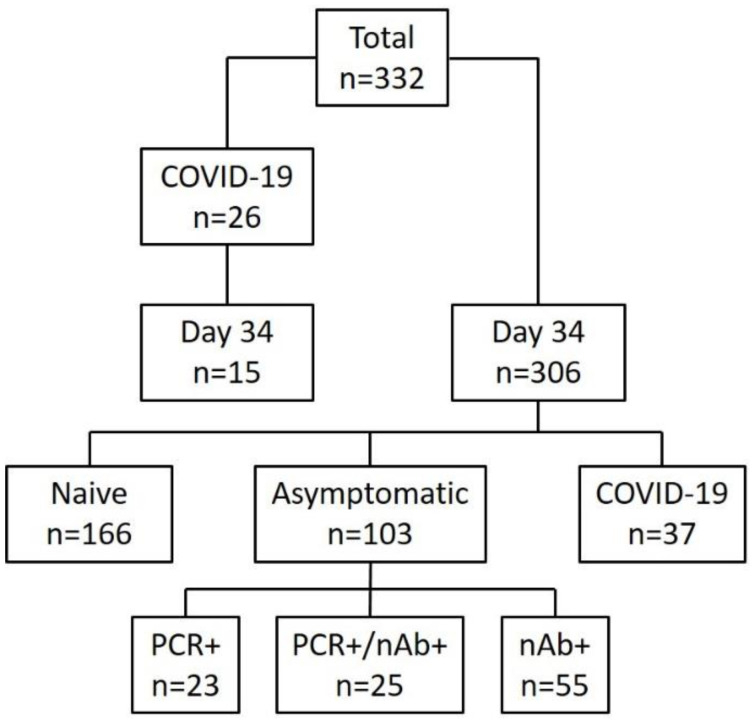
Figure 1
Figure 1
Schematic overview of the study. A total of 332 individuals participated: 306 in the cross-sectional part (one single sampling on 14 April 2020) and 26 patients suffering from non-severe COVID-19 in the longitudinal part with daily sampling. Out of 306 participants, 37 (12%) had previously been diagnosed with COVID-19, 103 (32%) had evidence of asymptomatic infection and 166 had no evidence of infection by SARS-CoV-2. Of the 103 asymptomatically infected, 23 were solely positive by PCR but had no neutralizing antibodies (nAbs), 55 (53%) had solely nAbs but were PCR negative and 25 (24%) had both, a positive PCR and nAb.
Figure 2
Figure 2
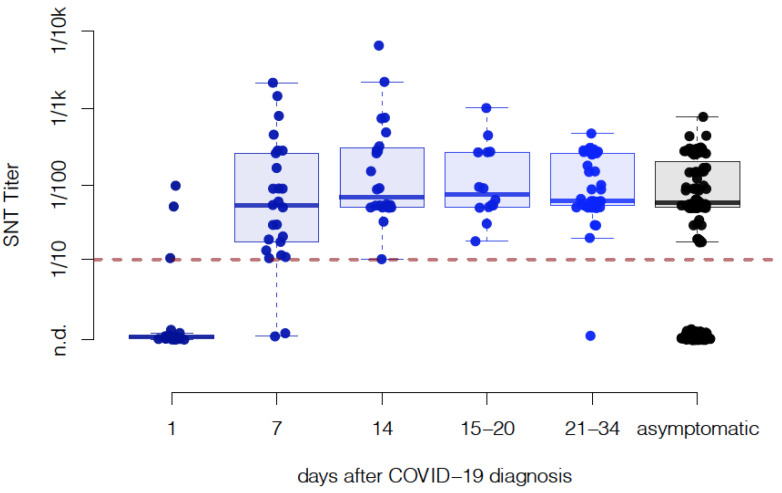
Serum neutralizing antibody titers of mildly symptomatic and asymptomatic individuals. Neutralizing titers of patients with non-severe COVID-19 and asymptomatically infected individuals were measured in quadruplicate and shown as the geometric mean titer (GMT). No statistically significant difference in titers was found between asymptomatic participants with a detectable titer and symptomatic patients at or after day 14 by the Wilcoxon rank sum test with continuity correction (p = 0.77). Healthy volunteers who either tested positive for viral RNA in nasal swabs or had detectable nAbs were defined as asymptomatic. Each dot represents one individual. n.d. = not detectable.
Figure 3
Figure 3
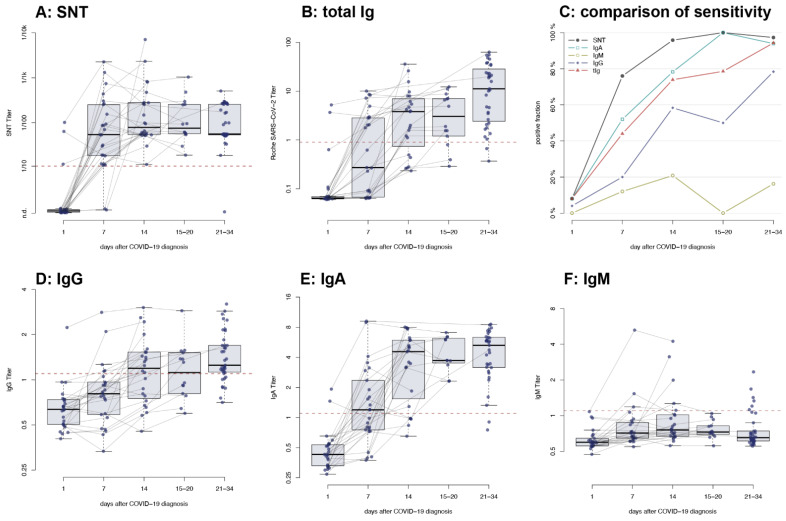
Time course of antibody titers of patients with non-severe COVID-19 measured on d1, d7, d14 and d30 post diagnosis: (A) neutralizing antibodies measured by serum neutralization test (SNT); (B) total SARS-CoV-2-specific antibodies measured by electrochemiluminescence immunoassay (ECLIA), (D) immunoglobulin (Ig) G, (E) IgA, and (F) IgM; (C) sensitivity of each test at the separate time points post-diagnosis. Dashed line: limit of detection as indicated by the manufacturer (B,DF) or as determined by the experimental setting (A). n.d. = not detected.
Figure 4
Figure 4
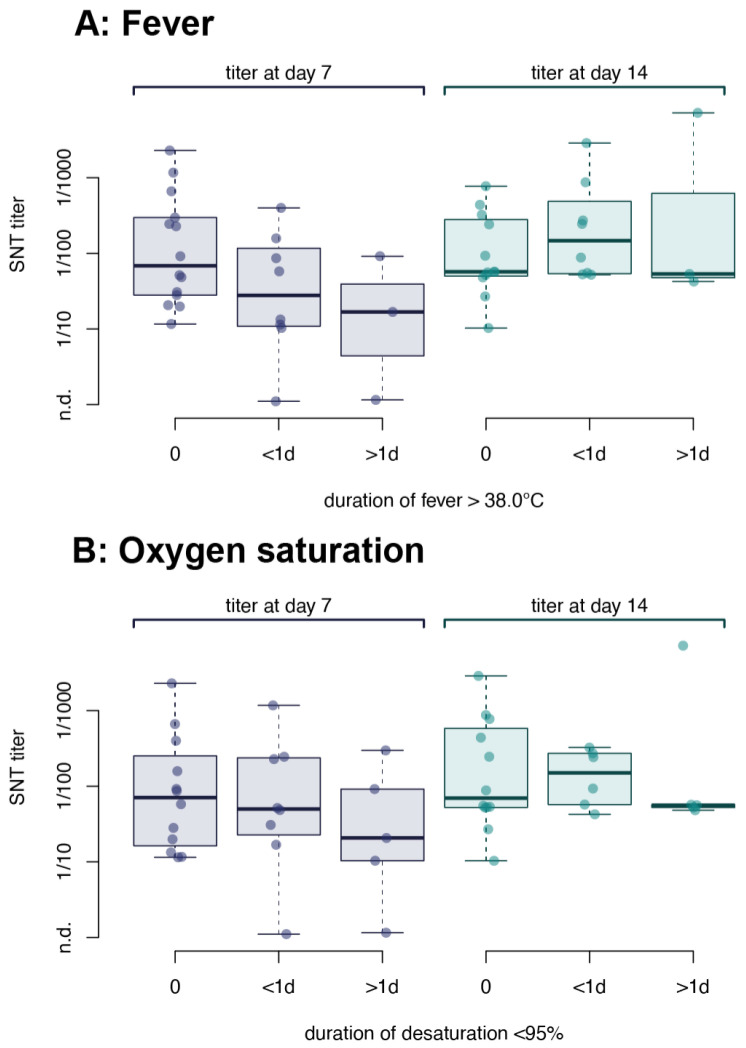
Correlation of the severity of COVID-19 with the antibody response in young adults. Neutralizing antibody titers were correlated with (A) tympanic temperature and (B) oxygen saturation of symptomatic patients. Patients were grouped according to fever: no fever (never > 38.0 °C), fever < 24 h or fever ≥ 24 h or according to oxygen saturation: no desaturation (never < 95% spO2), <24 h desaturation or ≥24 h desaturation. Data were stratified according to the day of sampling relative to the day of diagnosis. No significant differences were observed between the groups by analysis of variance (p = 0.68 for fever and p = 0.66 for desaturation). n.d. = not detected.
Figure 5
Figure 5
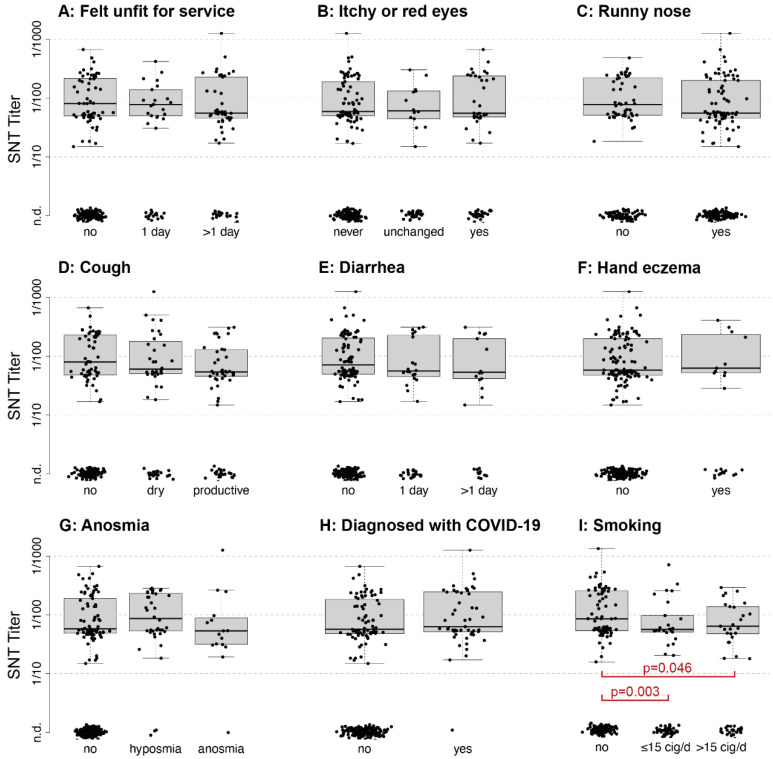
Correlation of symptoms and predisposing factors with the antibody response in young adults. Cross-sectional serum samples from 316 individuals were taken on the same day and neutralizing antibody titers were measured and plotted against self-declared symptoms experienced in the 30 days prior to sampling. Symptoms included general unfit feeling (A), itchy or red eyes (B), runny nose (C), cough (D), diarrhea (E), hand eczema (F), hyposmia or anosmia (G). Additionally, no differences in titers could be seen between the symptomatically and asymptomatically infected (H). (I) shows titers of individuals grouped by their smoking status: Individuals that smoked and produced nAbs showed significantly decreased titers as compared to non-smokers. Statistical significance was determined with the Wilcoxon rank sum test. p-values < 0.05 were considered statistically significant. n.d. = not detected.

References

    1. Nikolich-Zugich J., Knox K.S., Rios C.T., Natt B., Bhattacharya D., Fain M.J. SARS-CoV-2 and COVID-19 in older adults: What we may expect regarding pathogenesis, immune responses, and outcomes. Geroscience. 2020;42:505–514. doi: 10.1007/s11357-020-00186-0. - DOI - PMC - PubMed
    1. Reilev M., Kristensen K.B., Pottegård A., Lund L.C., Hallas J., Ernst M.T., Christiansen C.F., Sørensen H.T., Johansen N.B., Brun N.C., et al. Characteristics and predictors of hospitalization and death in the first 11 122 cases with a positive RT-PCR test for SARS-CoV-2 in Denmark: A nationwide cohort. Int. J. Epidemiol. 2020;49:1468–1481. doi: 10.1093/ije/dyaa140. - DOI - PMC - PubMed
    1. Jamieson-Lane A., Cytrynbaum E. Effects of age-targeted sequestration for COVID-19. J. Biol. Dyn. 2020;14:621–632. doi: 10.1080/17513758.2020.1795285. - DOI - PubMed
    1. Bielecki M., Züst R., Siegrist D., Meyerhofer D., Crameri G.A.G., Stanga Z.G., Stettbacher A., Buehrer T.W., Deuel J.W. Social Distancing Alters the Clinical Course of COVID-19 in Young Adults: A Comparative Cohort Study. Clin. Infect. Dis. 2020 doi: 10.1093/cid/ciaa889. - DOI - PMC - PubMed
    1. Ali M., Shah S.T.H., Imran M., Khan A. The role of asymptomatic class, quarantine and isolation in the transmission of COVID-19. J. Biol. Dyn. 2020;14:389–408. doi: 10.1080/17513758.2020.1773000. - DOI - PubMed

Publication types

LinkOut - more resources