Review
. 2021 Feb 12;11(2):273.
doi: 10.3390/biom11020273.

Novel Regulators of the IGF System in Cancer

Affiliations
Review

Novel Regulators of the IGF System in Cancer

Caterina Mancarella et al. Biomolecules. .

Abstract

The insulin-like growth factor (IGF) system is a dynamic network of proteins, which includes cognate ligands, membrane receptors, ligand binding proteins and functional downstream effectors. It plays a critical role in regulating several important physiological processes including cell growth, metabolism and differentiation. Importantly, alterations in expression levels or activation of components of the IGF network are implicated in many pathological conditions including diabetes, obesity and cancer initiation and progression. In this review we will initially cover some general aspects of IGF action and regulation in cancer and then focus in particular on the role of transcriptional regulators and novel interacting proteins, which functionally contribute in fine tuning IGF1R signaling in several cancer models. A deeper understanding of the biological relevance of this network of IGF1R modulators might provide novel therapeutic opportunities to block this system in neoplasia.

Keywords: ADAR; DDR1; E-cadherin; IGF system; IGF2BPs; cancer; circular RNAs; decorin; functional regulation; transcriptional regulators.


Conflict of interest statement

The authors declare no conflict of interest.

Figures
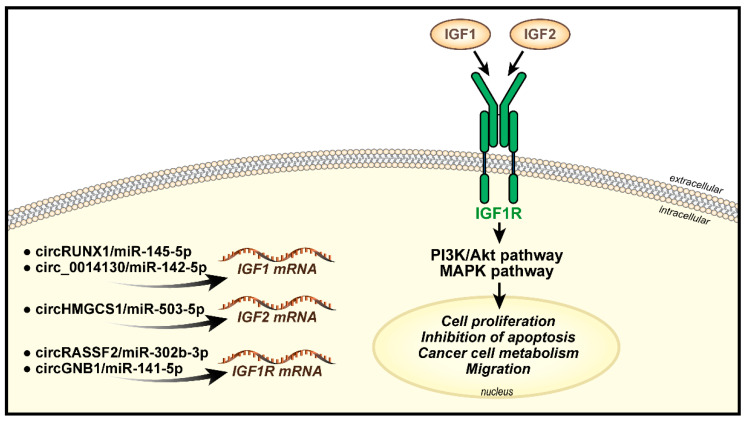
Figure 1
Figure 1
Schematic representation of circular RNAs governing IGF system in cancer. Circular RNAs sponge miRNAs binding to IGF1, IGF2 and IGF1R mRNAs, thus promoting transcripts translation. IGFs/IGF1R interaction promotes receptor phosphorylation and downstream activation of the PI3K/Akt or MAPK pathways, which transmit signals to the nucleus and activate biological responses critical for neoplastic transformation.
Figure 2
Figure 2
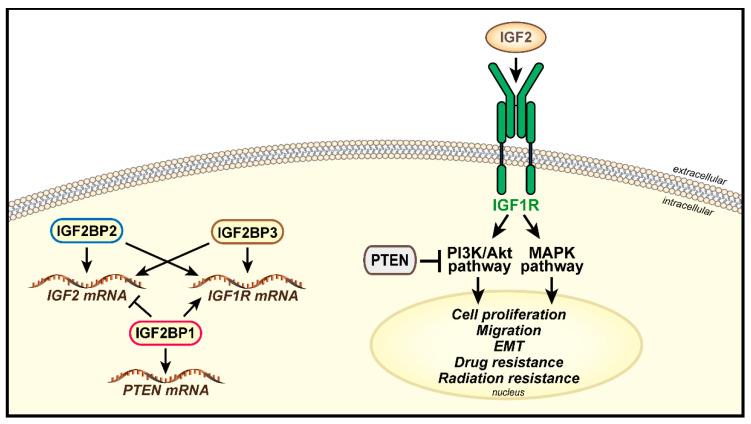
Cartoon depicting RNA-binding proteins IGF2BP1, IGF2BP2 and IGF2BP3 activity on the IGF system in cancer. IGF2BPs differentially regulate IGF2, IGF1R or PTEN transcripts. IGF2BP1 inhibits IGF2 mRNA but sustains IGF1R and PTEN mRNAs translation. IGF2BP2 and IGF2BP3 favor IGF2 and IGF1R mRNAs translation. The functional interaction between IGF2/IGF1R/PTEN proteins is shown. IGF2 binding to the IGF1R activates downstream pathways such as the PI3K/Akt, which is negatively regulated by PTEN, and MAPK.
Figure 3
Figure 3
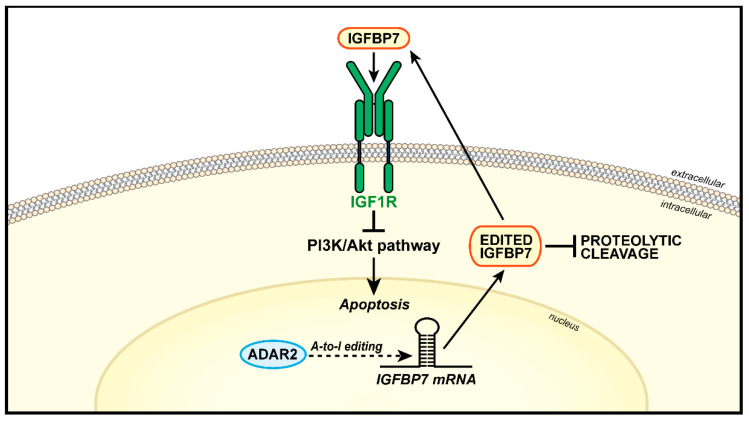
Representation of ADAR2-mediated RNA editing and its action in regulating the IGF system in cancer. A-to-I RNA editing of IGFBP7 mRNA guided by ADAR2 leads to increased production of a full-length edited IGFBP7 protein, which is resistant to proteolysis. Secreted IGFBP7 binds IGF1R, thus inhibiting the PI3K/Akt pathway and inducing apoptosis.
Figure 4
Figure 4
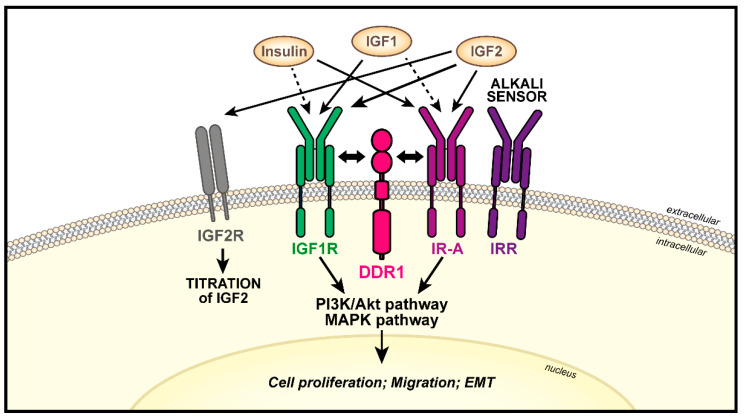
Schematic representation of the functional crosstalk between DDR1 and the IGF system in cancer. High or low ligand/receptor affinities are represented by continuous or dot arrows, respectively. DDR1 directly interacts with the IGF1R and IR-A thereby modulating the activation of IGF1R/IR-A downstream signaling pathways leading to transformation. As depicted, the IGF system includes two additional receptors, the IGF2R and IRR. However, whether these receptors may functionally interact with DDR1 has not been reported.
Figure 5
Figure 5
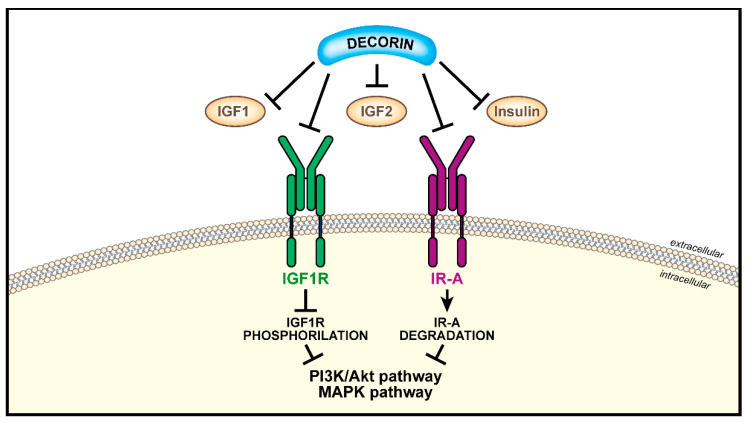
Schematic representation of antagonistic functional effects driven by decorin on the IGF system. In tumor stroma, decorin binds the ligands IGF1, IGF2 and insulin as well as the receptors IGF1R and IR-A. Decorin inhibits ligand-mediated IGF1R phosphorylation while it enhances IGF-2-mediated IR-A protein degradation. Negative decorin action on downstream pathways is reported.
Figure 6
Figure 6
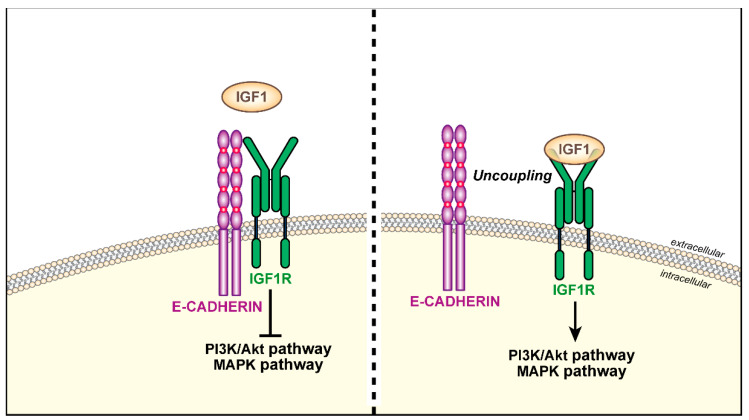
Cartoon showing E-cadherin functional interaction with the IGF1R in cancer. On the left side, E-cadherin interacts with the IGF1R at the cell membrane leading to downregulation of IGF-dependent signaling pathways. On the right side, the E-cadherin/IGF1R interaction is disrupted by IGF1 stimulation with consequent activation of downstream signaling pathways.

References

    1. Osher E., Macaulay V.M. Therapeutic targeting of the igf axis. Cells. 2019;8:895. doi: 10.3390/cells8080895. - DOI - PMC - PubMed
    1. Deyev I.E., Mitrofanova A.V., Zhevlenev E.S., Radionov N., Berchatova A.A., Popova N.V., Serova O.V., Petrenko A.G. Structural determinants of the insulin receptor-related receptor activation by alkali. J. Biol. Chem. 2013;288:33884–33893. doi: 10.1074/jbc.M113.483172. - DOI - PMC - PubMed
    1. Takahashi S.I. Igf research 2016–2018. Growth Horm. Igf Res. 2019;48–49:65–69. doi: 10.1016/j.ghir.2019.10.004. - DOI - PubMed
    1. De-Freitas-Junior J.C., Carvalho S., Dias A.M., Oliveira P., Cabral J., Seruca R., Oliveira C., Morgado-Diaz J.A., Reis C.A., Pinho S.S. Insulin/igf-i signaling pathways enhances tumor cell invasion through bisecting glcnac n-glycans modulation. An interplay with e-cadherin. PLoS ONE. 2013;8:e81579. doi: 10.1371/journal.pone.0081579. - DOI - PMC - PubMed
    1. Belfiore A., Malaguarnera R., Vella V., Lawrence M.C., Sciacca L., Frasca F., Morrione A., Vigneri R. Insulin receptor isoforms in physiology and disease: An updated view. Endocr. Rev. 2017;38:379–431. doi: 10.1210/er.2017-00073. - DOI - PMC - PubMed

Publication types

LinkOut - more resources