


Male Sexual Preference for Female Swimming Activity in the Guppy (Poecilia reticulata)
- PMID: 33673367
- PMCID: PMC7918064
- DOI: 10.3390/biology10020147
Male Sexual Preference for Female Swimming Activity in the Guppy (Poecilia reticulata)
Abstract
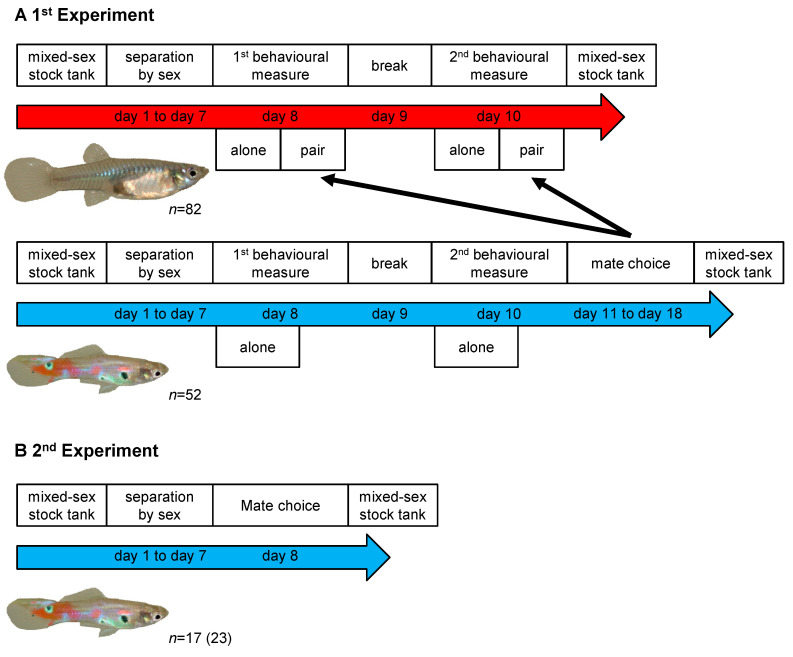
Mate choice that is based on behavioural traits is a common feature in the animal kingdom. Using the Trinidadian guppy, a species with mutual mate choice, we investigated whether males use female swimming activity-a behavioural trait known to differ consistently among individuals in many species-as a trait relevant for their mate choice. In the first experiment, we assessed male and female activity in an open field test alone (two repeated measures) and afterwards in heterosexual pairs (two repeated measures). In these pairs, we simultaneously assessed males' mating efforts by counting the number of sexual behaviours (courtship displays and copulations). Male and female guppies showed consistent individual differences in their swimming activity when tested both alone and in a pair, and these differences were maintained across both test situations. When controlling for male swimming behaviour and both male and female body size, males performed more courtship displays towards females with higher swimming activity. In a second experiment, we tested for a directional male preference for swimming activity by presenting males video animations of low- and high-active females in a dichotomous choice test. In congruence with experiment 1, we found males to spend significantly more time in association with the high-active female stimulus. Both experiments thus point towards a directional male preference for higher activity levels in females. We discuss the adaptive significance of this preference as activity patterns might indicate individual female quality, health or reproductive state while, mechanistically, females that are more active might be more detectable to males as well.
Keywords: Poecilia reticulata; animal personality; male mate choice; mating preferences; swimming activity.
Conflict of interest statement
The authors declare no conflict of interest. The funders had no role in the design of the study; in the collection, analyses, or interpretation of data; in the writing of the manuscript, or in the decision to publish the results.
Figures


References
-
- Andersson M. Sexual Selection. Princeton University Press; Princeton, NJ, USA: 1994.
-
- Berglund A. Many mates make male pipefish choosy. Behaviour. 1995;132:213–218. doi: 10.1163/156853995X00702. - DOI
-
- Bierbach D., Makowicz A.M., Schlupp I., Geupel H., Streit B., Plath M. Casanovas are liars: Behavioral syndromes, sperm competition risk, and the evolution of deceptive male mating behavior in live-bearing fishes [version 3; peer review: 3 approved] F1000Research. 2013;2:75. doi: 10.12688/f1000research.2-75.v2. - DOI - PMC - PubMed
Grants and funding
LinkOut - more resources
Full Text Sources
Other Literature Sources
