


"Stay-at-Home" Lifestyle Effect on Weight Gain during the COVID-19 Outbreak Confinement in China
- PMID: 33673375
- PMCID: PMC7918476
- DOI: 10.3390/ijerph18041813
"Stay-at-Home" Lifestyle Effect on Weight Gain during the COVID-19 Outbreak Confinement in China
Abstract
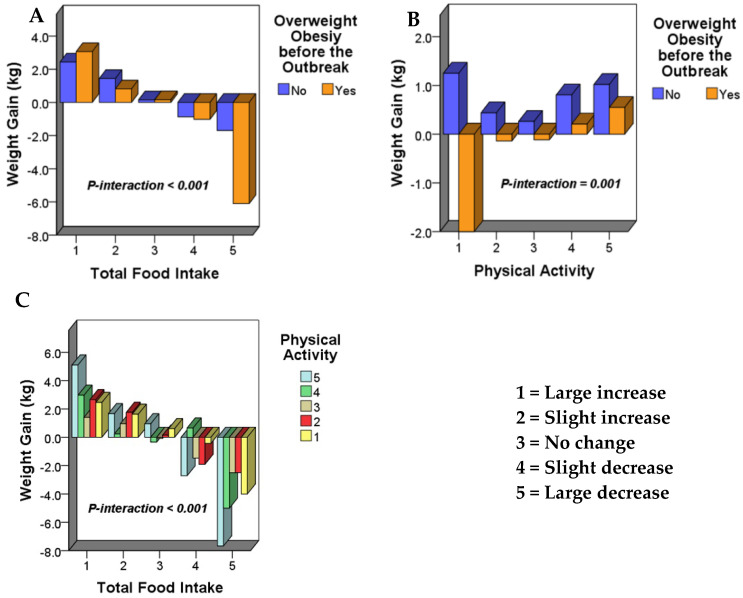
In February 2020, a novel coronavirus (SARS-COV2) broke out in Wuhan city of China. The Chinese government decisively imposed nationwide confinement. This study comprised a structured, online questionnaire, based on 40 items inquiring about socio-demographic information and anthropometric data (reporting weight and height), as well as changes in food intake, physical activity, and sleep during the COVID-19 outbreak. Questionnaires were distributed to residents of Jiangsu and other provinces from 29 March to 5 April. A total of 889 respondents were included, aged between 16 and 70 years (61% females). There was a significant increase in total food intake by 9.8% and a slight increase by 29.2% of respondents, and a significant decrease in physical activity by 31.5% and a slight decrease by 23.4% of respondents, especially in snacks and drinks, and outdoor activities. The rate of weight gain in the total population was 30.6% and the average weight gain was 0.5 ± 2.8 kg. The main factors contributing to weight gain were increased food intake and reduced physical activity. Additionally, normal-weight people were more likely to gain weight than people with overweight/obesity during the COVID-19 confinement. This study provided a good warning and educational reference value on lifestyle changes during the COVID-19 confinement.
Keywords: COVID-19; food intake; physical activity; weight gain; “stay-at-home” lifestyle.
Conflict of interest statement
The authors declare no conflict of interest.
Figures
References
-
- World Health Organization Director-General’s Remarks at the Media Briefing on 2019-nCoV on 11 February 2020. [(accessed on 11 April 2020)];2020 Available online: https://www.who.int/dg/speeches/detail/who-director-general-s-remarks-at....
-
- Guo Y.-R., Cao Q.-D., Hong Z.-S., Tan Y.-Y., Chen S.-D., Jin H.-J., Tan K.-S., Wang D.-Y., Yan Y. The origin, transmission and clinical therapies on coronavirus disease 2019 (COVID-19) outbreak—An update on the status. Mil. Med. Res. 2020;7:1–10. doi: 10.1186/s40779-020-00240-0. - DOI - PMC - PubMed
-
- Xinhua Net The Wuhan Health and Fitness Commission Reported That Many Cases of Pneumonia Were Found to Be Viral Pneumonia and no Obvious Human-to-Human Transmission Was Found. [(accessed on 9 April 2020)]; Available online: http://www.hb.xinhuanet.com/2019-12/31/c_1125409171.htm.
-
- World Health Organization Director-General’s Statement on IHR Emergency Committee on Novel Coronavirus (2019-nCoV) [(accessed on 9 April 2020)]; Available online: https://www.who.int/zh/dg/speeches/detail/who-director-general-s-stateme...
-
- World Health Organization Director-General’s Opening Remarks at the Media Briefing on COVID-19—11 March 2020. [(accessed on 28 June 2020)]; Available online: https://www.who.int/dg/speeches/detail/who-director-general-s-opening-re....
MeSH terms
Substances
LinkOut - more resources
Full Text Sources
Other Literature Sources
Medical
Miscellaneous
