


Exogenously Used 24-Epibrassinolide Promotes Drought Tolerance in Maize Hybrids by Improving Plant and Water Productivity in an Arid Environment
- PMID: 33673389
- PMCID: PMC7918100
- DOI: 10.3390/plants10020354
Exogenously Used 24-Epibrassinolide Promotes Drought Tolerance in Maize Hybrids by Improving Plant and Water Productivity in an Arid Environment
Abstract
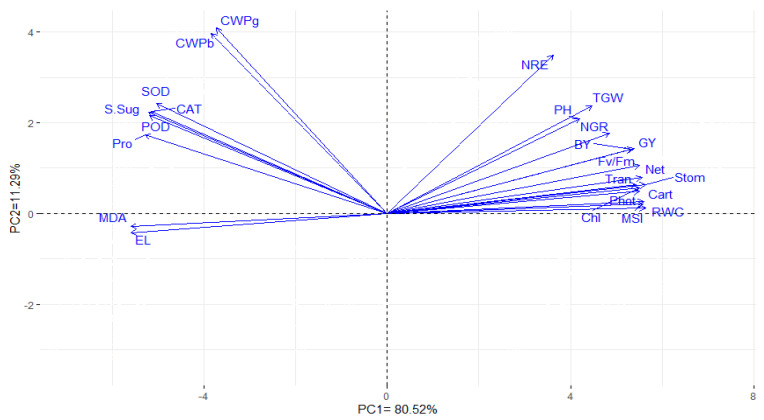
The influence of 24-epibrassinolide (EBR24), applied to leaves at a concentration of 5 μM, on plant physio-biochemistry and its reflection on crop water productivity (CWP) and other agronomic traits of six maize hybrids was field-evaluated under semi-arid conditions. Two levels of irrigation water deficiency (IWD) (moderate and severe droughts; 6000 and 3000 m3 water ha-1, respectively) were applied versus a control (well-watering; 9000 m3 water ha-1). IWD reduced the relative water content, membrane stability index, photosynthetic efficiency, stomatal conductance, and rates of transpiration and net photosynthesis. Conversely, antioxidant enzyme activities and osmolyte contents were significantly increased as a result of the increased malondialdehyde content and electrolyte leakage compared to the control. These negative influences of IWD led to a reduction in CWP and grain yield-related traits. However, EBR24 detoxified the IWD stress effects and enhanced all the above-mentioned parameters. The evaluated hybrids varied in drought tolerance; Giza-168 was the best under moderate drought, while Fine-276 was the best under severe drought. Under IWD, certain physiological traits exhibited a highly positive association with yield and yield-contributing traits or CWP. Thus, exogenously using EBR24 for these hybrids could be an effective approach to improve plant and water productivity under reduced available water in semi-arid environments.
Keywords: brassinosteroids; irrigation water deficit; physiological parameters; water output of yields; yield-contributing traits.
Conflict of interest statement
The authors declare no conflict of interest.
Figures

References
-
- Abd El-Mageed T.A., Semida W.M., Rady M.M. Moringa leaf extract as biostimulant improves water use efficiency, physio-biochemical attributes of squash plants under deficit irrigation. Agric. Water Manag. 2017;193:46–54. doi: 10.1016/j.agwat.2017.08.004. - DOI
-
- El-Mageed A.T.A., Semida W.M., Taha R.S., Rady M.M. Effect of summer-fall deficit irrigation on morpho-physiological, anatomical responses, fruit yield and water use efficiency of cucumber under salt affected soil. Sci. Hortic. 2018;237:148–155. doi: 10.1016/j.scienta.2018.04.014. - DOI
-
- Merwad A.M.A., Desoky E.M., Rady M.M. Response of water deficit-stressed Vigna unguiculata performances to silicon, proline or methionine foliar application. Sci. Hortic. 2018;228:132–144. doi: 10.1016/j.scienta.2017.10.008. - DOI
-
- Khademian R., Yaghoubian I. Growth of chick pea (Cicer arietinum) in response to salicylic acid under drought stress. J. Bio. Env. Sci. 2018;12:255–263.
Grants and funding
LinkOut - more resources
Full Text Sources
Other Literature Sources
Research Materials
