


A Machine Learning Approach as a Surrogate for a Finite Element Analysis: Status of Research and Application to One Dimensional Systems
- PMID: 33673605
- PMCID: PMC7957535
- DOI: 10.3390/s21051654
A Machine Learning Approach as a Surrogate for a Finite Element Analysis: Status of Research and Application to One Dimensional Systems
Abstract
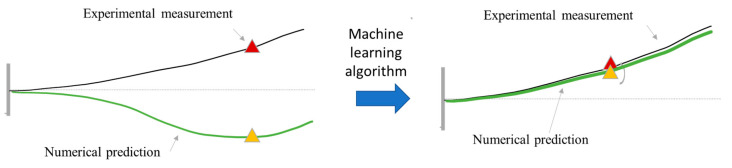
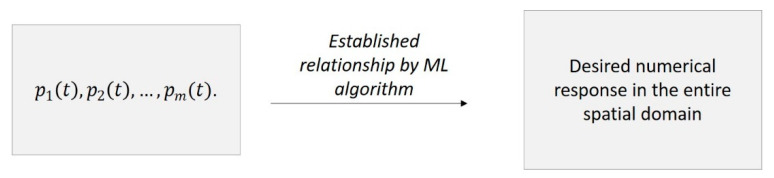
Current maintenance intervals of mechanical systems are scheduled a priori based on the life of the system, resulting in expensive maintenance scheduling, and often undermining the safety of passengers. Going forward, the actual usage of a vehicle will be used to predict stresses in its structure, and therefore, to define a specific maintenance scheduling. Machine learning (ML) algorithms can be used to map a reduced set of data coming from real-time measurements of a structure into a detailed/high-fidelity finite element analysis (FEA) model of the same system. As a result, the FEA-based ML approach will directly estimate the stress distribution over the entire system during operations, thus improving the ability to define ad-hoc, safe, and efficient maintenance procedures. The paper initially presents a review of the current state-of-the-art of ML methods applied to finite elements. A surrogate finite element approach based on ML algorithms is also proposed to estimate the time-varying response of a one-dimensional beam. Several ML regression models, such as decision trees and artificial neural networks, have been developed, and their performance is compared for direct estimation of the stress distribution over a beam structure. The surrogate finite element models based on ML algorithms are able to estimate the response of the beam accurately, with artificial neural networks providing more accurate results.
Keywords: artificial neural networks; beam analysis; finite element; gradient boosting regression trees; machine learning; random forest trees; structural monitoring.
Conflict of interest statement
The authors declare no conflict of interest.
Figures
References
-
- Smarsly K., Lehner K., Hartmann D. Structural Health Monitoring based on Artificial Intelligence Techniques. Comput. Civil Eng. 2007:111–118. doi: 10.1061/40937(261)14. - DOI
-
- Chierichetti M., Grappasonni C., Coppotelli G., McColl C. A modal approach for dynamic response monitoring from experimental data. Mech. Syst. Signal Process. 2014;48:199–217. doi: 10.1016/j.ymssp.2014.04.003. - DOI
-
- Chierichetti M., McColl C., Ruzzene M. Prediction of UH-60A blade loads: Insight on load confluence algorithm. AIAA J. 2014;52:2007–2018. doi: 10.2514/1.J052661. - DOI
-
- Chierichetti M. Load and response identification for a nonlinear flexible structure subject to harmonic loads. J. Comput. Nonlinear Dyn. 2014;9:011009. doi: 10.1115/1.4025505. - DOI
Publication types
MeSH terms
LinkOut - more resources
Full Text Sources
Other Literature Sources
Research Materials
