


COVID-19 and waste production in households: A trend analysis
- PMID: 33676209
- PMCID: PMC7895713
- DOI: 10.1016/j.scitotenv.2021.145997
COVID-19 and waste production in households: A trend analysis
Abstract
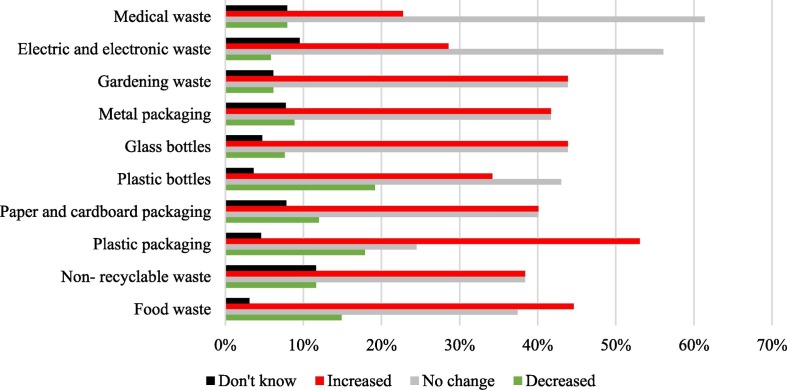
Apart from the health aspects and the high death toll, the COVID-19 pandemic has, since its official recognition in March 2020 caused may social and economic problems. It has also led to many environmental ones. For instance, the lockdowns have led to higher levels of consumption of packaged products, and of take-away food. This paper reports on an international study on the increased consumption and subsequent changes in the amounts of waste produced since the COVID-19 pandemic. The results show that 45-48% of the respondents observed an increased consumption of packed food, fresh food, and food delivery. One of the main reasons for the increased waste generation during the lockdown was the fact that people have spent more time at home. In addition, increases of 43% and 53% in food waste and plastic packaging. Drawing from comparisons on the amount of domestic waste produced before and during the pandemic, the findings suggest that some specific types of municipal waste have visibly increased, putting additional pressure on waste management systems. This characterises one of non-intended effects of the COVID-19 pandemic. The results from this study provide useful insights to city administrations and municipal utilities on consumption patterns during emergency situations. This, in turn, may support more systemic and strategic measures to be taken, so as to curtail the increase of household waste during pandemic situations.
Keywords: COVID-19; Households waste; International wide; Waste generation; Waste management.
Copyright © 2021 Elsevier B.V. All rights reserved.
Conflict of interest statement
Declaration of competing interest The authors declare that they have no known competing financial interests or personal relationships that could have appeared to influence the work reported in this paper.
Figures




References
-
- African-Union Impact of the coronavirus (COVID-19) on the African economy. 2020. https://www.tralac.org/documents/resources/covid-19/3218-impact-of-the-c... Available at:
-
- Alon T.M., Doepke M., Olmstead-Rumsey J., Tertilt M. In: The impact of COVID-19 on gender equality. N. B. o. E. Research, editor. Vol. 26947. 2020. (NBER Working Paper Series).
-
- Baker S.R., Farrokhnia R.A., Meyer S., Pagel M., Yannelis C. In: How does household spending respond to an epidemic? Consumption during the 2020 COVID-19 pandemic. N. B. o. E. Research, editor. Vol. 26949. 2020. (NBER Working Paper Series).
MeSH terms
LinkOut - more resources
Full Text Sources
Other Literature Sources
Medical
