


Sex-specific differences in left ventricular mass and myocardial energetic efficiency in non-diabetic, pre-diabetic and newly diagnosed type 2 diabetic subjects
- PMID: 33676510
- PMCID: PMC7937311
- DOI: 10.1186/s12933-021-01248-z
Sex-specific differences in left ventricular mass and myocardial energetic efficiency in non-diabetic, pre-diabetic and newly diagnosed type 2 diabetic subjects
Abstract
Background: Women with type 2 diabetes (T2DM) have a higher excess risk for cardiovascular disease (CVD) than their male counterparts. However, whether the risk for CVD is higher in prediabetic women than men is still debated. We aimed to determine whether sex-related differences exist in left ventricular mass index (LVMI), and myocardial mechano-energetic efficiency (MEEi) in with normal glucose tolerant (NGT), pre-diabetic and newly diagnosed type 2 diabetic subjects.
Methods: Sex-related differences in LVMI and myocardial MEEi, assessed by validated echocardiography-derived measures, were examined among 1562 adults with NGT, prediabetes, and newly diagnosed T2DM, defined according to fasting glucose, 2-h post-load glucose, or HbA1c.
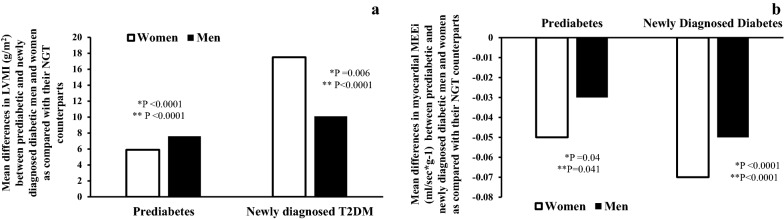
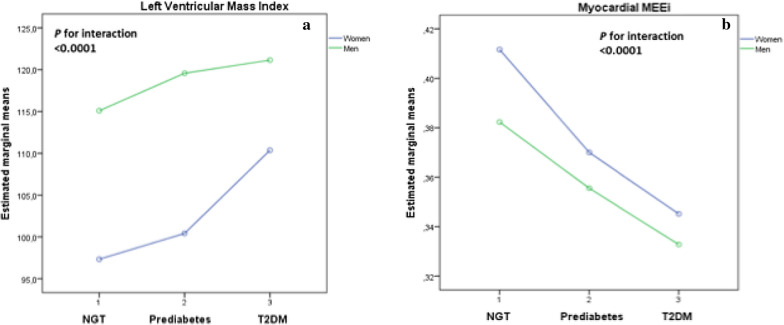
Results: Worsening of glucose tolerance in both men and women was associated with an increase in age-adjusted LVMI and myocardial MEEi. Women with newly diagnosed T2DM exhibited greater relative differences in LVMI and myocardial MEEi than diabetic men when compared with their NGT counterparts. Prediabetic women exhibited greater relative differences in myocardial MEEi, but not in LVMI, than prediabetic men when compared with their NGT counterparts. The statistical test for interaction between sex and glucose tolerance on both LVMI (P < 0.0001), and myocardial MEEi (P < 0.0001) was significant suggesting a sex-specific association.
Conclusions: Left ventricle is subject to maladaptive changes with worsening of glucose tolerance, especially in women with newly diagnosed T2DM. The sex-specific increase in LVM and decrease in MEEi, both being predictors of CVD, may have a role in explaining the stronger impact of T2DM on the excess risk of CVD in women than in men.
Keywords: Cardiovascular disease; Left ventricular mass; Myocardial mechano-energetic efficiency; Prediabetes; Sex-differences; Type 2 diabetes.
Conflict of interest statement
The authors declare that they have no competing interests.
Figures
References
-
- Peters SA, Huxley RR, Woodward M. Diabetes as risk factor for incident coronary heart disease in women compared with men: a systematic review and meta-analysis of 64 cohorts including 858,507 individuals and 28,203 coronary events. Diabetologia. 2014;57(8):1542–1551. doi: 10.1007/s00125-014-3260-6. - DOI - PubMed
-
- Shah AD, Langenberg C, Rapsomaniki E, Denaxas S, Pujades-Rodriguez M, Gale CP, Deanfield J, Smeeth L, Timmis A, Hemingway H. Type 2 diabetes and incidence of cardiovascular diseases: a cohort study in 19 million people. Lancet Diabetes Endocrinol. 2015;3(2):105–113. doi: 10.1016/S2213-8587(14)70219-0. - DOI - PMC - PubMed
-
- Fiona Bragg F, Holmes MV, Iona A, Guo Y, Du H, Chen Y, Bian Z, Yang L, Herrington W, Bennett D, Turnbull I, Liu Y, Feng S, Chen J, Clarke R, Collins R, Peto R, Li L, Chen Z. Association between diabetes and cause-specific mortality in rural and urban areas of China. JAMA. 2017;317:280–289. doi: 10.1001/jama.2016.19720. - DOI - PMC - PubMed
-
- Dong X, Cai R, Sun J, Huang R, Wang P, Sun H, Tian S, Wang S. Diabetes as a risk factor for acute coronary syndrome in women compared with men: a meta-analysis, including 10 856 279 individuals and 106 703 acute coronary syndrome events. Diabetes Metab Res Rev. 2017;33:5. doi: 10.1002/dmrr.2887. - DOI - PubMed
Publication types
MeSH terms
Substances
LinkOut - more resources
Full Text Sources
Other Literature Sources
Medical
