Observational Study
. 2021 Jun:63:106-112.
doi: 10.1016/j.jcrc.2021.02.005. Epub 2021 Feb 25.

Transpulmonary pressure measurements and lung mechanics in patients with early ARDS and SARS-CoV-2

Affiliations
Observational Study

Transpulmonary pressure measurements and lung mechanics in patients with early ARDS and SARS-CoV-2

Elias Baedorf Kassis et al. J Crit Care. 2021 Jun.

Abstract

Purpose: Acute Respiratory Distress Syndrome (ARDS) secondary to severe acute respiratory syndrome coronavirus-2 (SARS-CoV-2) has demonstrated variable oxygenation and respiratory-system mechanics without investigation of transpulmonary and chest-wall mechanics. This study describes lung, chest wall and respiratory-system mechanics in patients with SARS-CoV-2 and ARDS.

Methods: Data was collected from forty patients with confirmed SARS-CoV-2 and ARDS at Beth Israel Deaconess Medical Center in Boston, Massachusetts. Esophageal balloons were placed to estimate pleural and transpulmonary pressures. Clinical characteristics, respiratory-system, transpulmonary, and chest-wall mechanics were measured over the first week.

Results: Patients had moderate-severe ARDS (PaO2/FiO2 123[98-149]) and were critically ill (APACHE IV 108 [94-128] and SOFA 12 [11-13]). PaO2/FiO2 improved over the first week (150 mmHg [122.9-182] to 185 mmHg [138-228] (p = 0.035)). Respiratory system (30-35 ml/cm H2O), lung (40-50 ml/cm H2O) and chest wall (120-150 ml/cm H2O) compliance remained similar over the first week. Elevated basal pleural pressures correlated with BMI. Patients required prolonged mechanical ventilation (14.5 days [9.5-19.0]), with a mortality of 32.5%.

Conclusions: Patients displayed normal chest-wall mechanics, with increased basal pleural pressure. Respiratory system and lung mechanics were similar to known existing ARDS cohorts. The wide range of respiratory system mechanics illustrates the inherent heterogeneity that is consistent with typical ARDS.

Keywords: ARDS; Acute respiratory distress syndrome; COVID-19; Chest wall mechanics; Coronavirus; Mechanical ventilation; Mechanics; SARS-CoV-2; Transpulmonary pressure.


Conflict of interest statement

Declaration of Competing Interest Dr. Baedorf Kassis and Dr. Talmor have received speaking fees for educational conferences from Hamilton Medical Inc. There are no conflicts related to the submitted research manuscript. As above, this work was conducted under the support of the NIHKL2 TR002542 award.

Figures
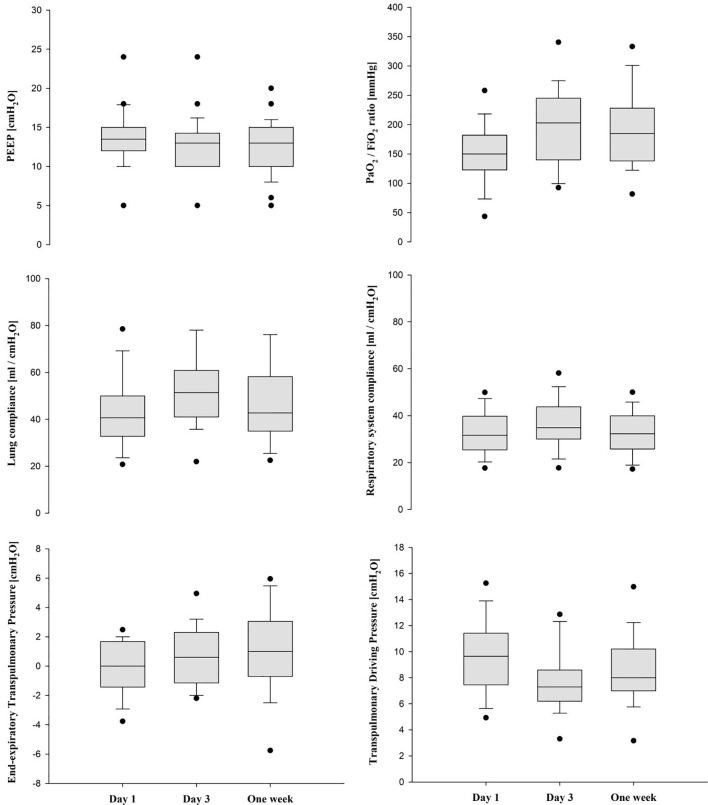
Fig. 1
Fig. 1
Median (IQR) physiological and mechanical parameters over first week of measurement.
Fig. 2
Fig. 2
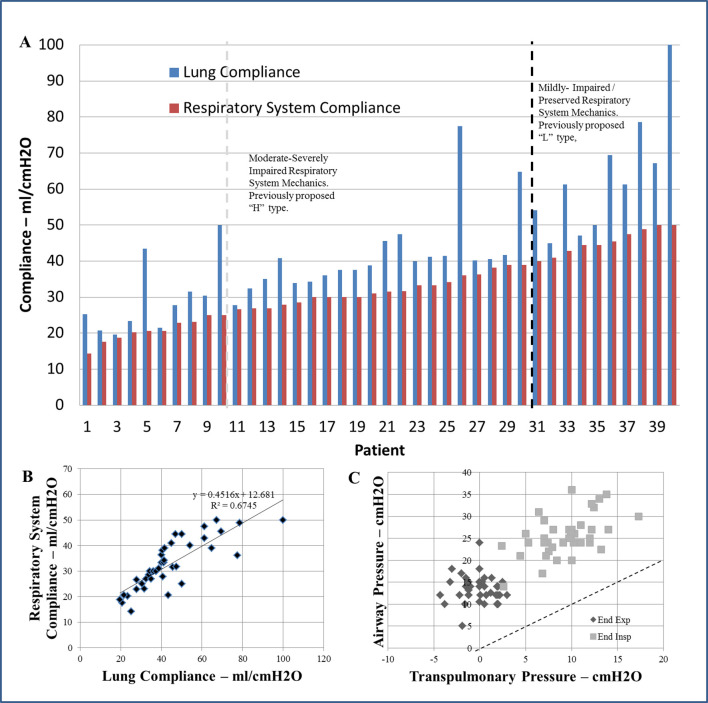
Patients with SARS-CoV-2 and Acute Respiratory Distress Syndrome (ARDS). Lung mechanics were measured using esophageal manometry to remove the component of the chest wall from the respiratory system values. (A) Respiratory system (red bars) and lung compliance (blue bars) measurements in each of the 40 patients. There was wide variability in the distribution of lung and respiratory system mechanics overall without clear differentiation of phenotypes by degree of compliance. The distribution of mechanics appears similar to other known cohorts of non-SARS-CoV-2 related ARDS. With mechanics appearing more as a continuum as opposed to unique phenotypes, cutoffs appear arbitrary in nature. The black dotted line differentiates the proposed “L” from “H” types, and the light grey dotted line differentiates the equally arbitrary cutoff from severe (compliance <25 ml/cmH2O) to moderately impaired mechanics (compliance 25-40 ml/cmH2O) (B) Comparison between respiratory system and lung compliance illustrating the expected excellent correlation. The solid line represents the slops of this correlation. (C) Comparison of end inspiratory (light grey) and end expiratory (dark grey) airway and transpulmonary pressures. This illustrates that despite the good correlation, there is wide variability for the corresponding transpulmonary pressure illustrating the variability inherent to the chest wall mechanics. The dotted line illustrates the line of identity. There was an unpredictable and inconsistent and underestimation of transpulmonary pressure by the corresponding airway pressure as seen by the variable offset from the line of identity. (For interpretation of the references to colour in this figure legend, the reader is referred to the web version of this article.)
Fig. 3
Fig. 3
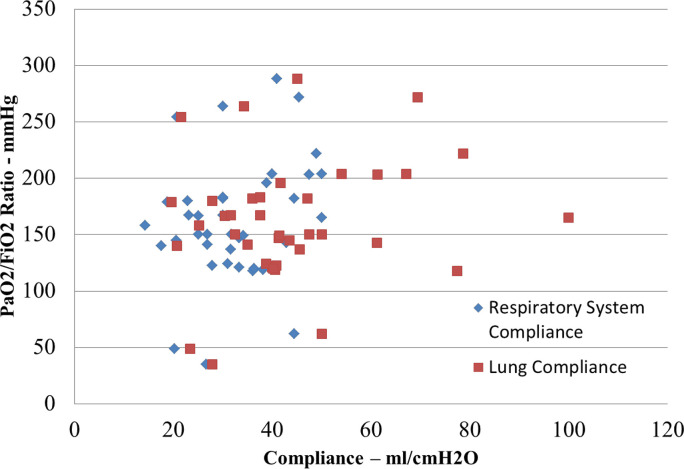
Comparison of the PaO2/FiO2 ratio with respiratory system and lung compliance on day 1 of measurements. There is no correlation between PaO2/FiO2 ratio and either measurement of compliance illustrating the inherent and expected variability in this cohort.

References

    1. Guan W., Ni Z., Hu Y., Liang W., Ou C., He J., et al. Clinical characteristics of coronavirus disease 2019 in China. N Engl J Med. 2020 doi: 10.1056/nejmoa2002032. - DOI - PMC - PubMed
    1. Brower R.G., Matthay M.A., Morris A., Schoenfeld D., Thompson B.T., Wheeler A. Ventilation with lower tidal volumes as compared with traditional tidal volumes for acute lung injury and the acute respiratory distress syndrome. N Engl J Med. 2000 doi: 10.1056/NEJM200005043421801. - DOI - PubMed
    1. Gattinoni L., Coppola S., Cressoni M., Busana M., Rossi S., Chiumello D. Covid-19 does not Lead to a “typical” acute respiratory distress syndrome. Am J Respir Crit Care Med. 2020 doi: 10.1164/rccm.202003-0817LE. - DOI - PMC - PubMed
    1. Pan C., Chen L., Lu C., Zhang W., Xia J.-A., Sklar M.C., et al. Lung Recruitability in SARS-CoV-2 associated acute respiratory distress syndrome: a single-center, observational study. Am J Respir Crit Care Med. 2020 doi: 10.1164/rccm.202003-0527le. - DOI - PMC - PubMed
    1. Gattinoni L., Chiumello D., Caironi P., Busana M., Romitti F., Brazzi L., et al. COVID-19 pneumonia: different respiratory treatments for different phenotypes? Intensive Care Med. 2020 doi: 10.1007/s00134-020-06033-2. - DOI - PMC - PubMed

Publication types

MeSH terms