


Effects of photoperiod on performance, ovarian morphology, reproductive hormone level, and hormone receptor mRNA expression in laying ducks
- PMID: 33677400
- PMCID: PMC8046941
- DOI: 10.1016/j.psj.2021.01.002
Effects of photoperiod on performance, ovarian morphology, reproductive hormone level, and hormone receptor mRNA expression in laying ducks
Abstract
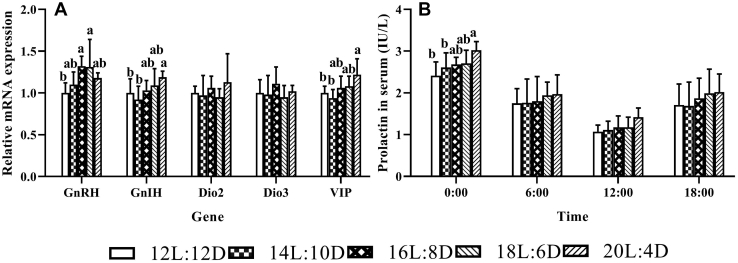
We investigated the effect of photoperiod on performance, ovarian morphology, reproductive hormones levels, and their receptors mRNA expressions in laying ducks. After adaption, 300 252-day-old Jinding laying ducks were randomly allocated to 5 groups, receiving 12L:12D, 14L:10D, 16L:8D, 18L:6D, or 20L:4D, respectively. Each treatment had 6 replicates of 10 birds each. The feeding trial lasted 8 wk. Egg production, egg mass, and ADFI increased linearly and quadratically with increasing photoperiods (P < 0.05), and the higher values of them occurred in photoperiods ≥ 16 h, compared with 12L:12D (P > 0.05). Initial and bare stroma weight increased quadratically, while total large white follicle (LWF) number and weight increased linearly and quadratically, with increasing photoperiods (P < 0.05). The higher values of them occurred in 16L:8D and 18L:6D treatments as well as the higher total LWF weight also occurred in 20L:4D, compared with 12L:12D (P > 0.05). Besides, 16.93 and 16.93 h were the optimal photoperiods for bare stroma (follicles ≥ 2 mm in diameter removed) weight and total LWF weight, respectively, calculated from reliable regression equations (R2 ≥ 0.5071). Compared with 12L:12D, the higher levels of estradiol, progesterone, follicle-stimulating hormone (FSH) as well as the higher expressions of estrogen, luteinizing hormone (LH) and progesterone receptors were observed in ≥16 h photoperiods (P < 0.05), while the higher LH level and FSH receptor expression only occurred in 16L:8D and 18L:6D (P < 0.05). In the hypothalamus, higher mRNA expression of gonadotropin-releasing hormone occurred in 16L:8D and 18L:6D groups (P < 0.05). Meanwhile, gonadotropin-inhibitory hormone and prolactin increased in 20-hour photoperiod (P < 0.05), and the latter may be due to theup-regulation of vasoactive intestinal peptide expression (P < 0.05). To sum up, an appropriate photoperiod could improve the performance and reproductive organ and ovarian follicles development through reproductive hormones and their receptors, and 16.56 to 10.93 h is an adequate photoperiod for laying ducks.
Keywords: follicle; laying duck; ovarian morphology; photoperiod; reproductive hormone.
Copyright © 2021 The Authors. Published by Elsevier Inc. All rights reserved.
Figures
References
-
- Banerjee S., Chaturvedi C.M. Testicular atrophy and reproductive quiescence in photorefractory and scotosensitive quail: Involvement of hypothalamic deep brain photoreceptors and GnRH-GnIH system. J. Photoch. Photobio. B. 2017;175:254–268. - PubMed
-
- Bhatt R., Youngren O., Kang S., Halawani M.E. Dopamine infusion into the third ventricle increases gene expression of hypothalamic vasoactive intestinal peptide and pituitary prolactin and luteinizing hormone b subunit in the Turkey. Gen. Comp. Endor. 2003;130:41–47. - PubMed
-
- Bulbul T., Akosman M.S., Yilmaz O., Ulutas E., Bulbul A. Supplementary dietary nitric oxide donor (sodium nitroprusside) or inhibitor (NG-nitro-L-arginine methyl ester) depressed growth performance and ovarian primordial and primary follicles in Japanese quail (Coturnix coturnix japonica) in a dose-dependent manner. Br. Poult. Sci. 2015;56:113–120. - PubMed
-
- Chen H., Huang R.L., Zhang H.X., Di K.Q., Pan D., Hou Y.G. Effects of photoperiod on ovarian morphology and carcass traits at sexual maturity in pullets. Poult. Sci. 2007;86:917–920. - PubMed
-
- Cui Y.M., Wang J., Lu W., Zhang H.J., Wu S.G., Qi G.H. Effect of dietary supplementation with Moringa Oleifera leaf on performance, meat quality, and oxidative stability of meat in broilers. Poult. Sci. 2018;97:2836–2844. - PubMed
MeSH terms
Substances
LinkOut - more resources
Full Text Sources
Other Literature Sources
