


Patient-reported factors influencing the choice of their kidney replacement treatment modality
- PMID: 33677544
- PMCID: PMC8875472
- DOI: 10.1093/ndt/gfab059
Patient-reported factors influencing the choice of their kidney replacement treatment modality
Abstract
Background: Access to various kidney replacement therapy (KRT) modalities for patients with end-stage kidney disease differs substantially within Europe.
Methods: European adults on KRT filled out an online or paper-based survey about factors influencing and experiences with modality choice (e.g. information provision, decision-making and reasons for choice) between November 2017 and January 2019. We compared countries with low, middle and high gross domestic product (GDP).
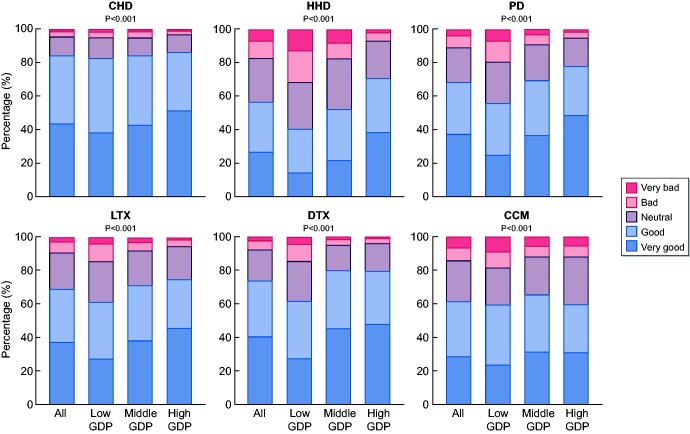
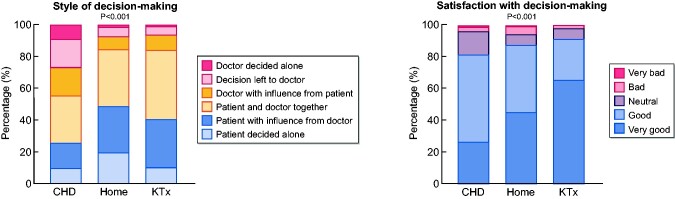
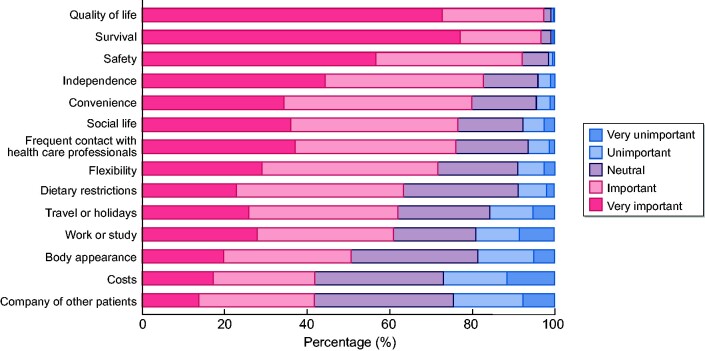
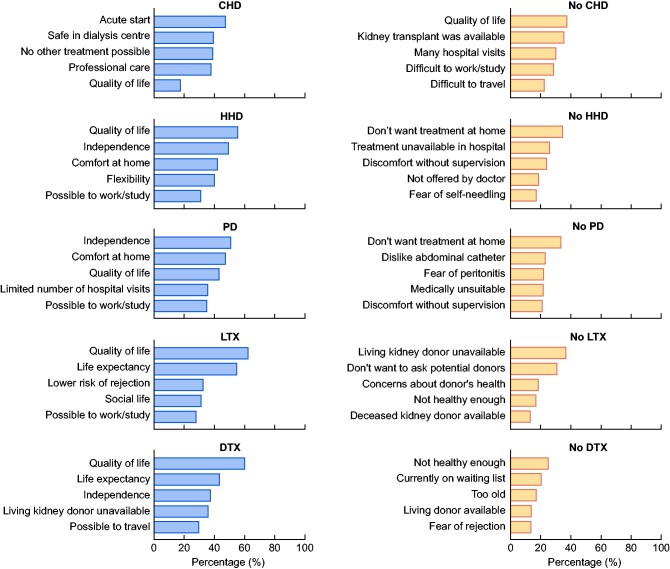
Results: In total, 7820 patients [mean age 59 years, 56% male, 63% on centre haemodialysis (CHD)] from 38 countries participated. Twenty-five percent had received no information on the different modalities, and only 23% received information >12 months before KRT initiation. Patients were not informed about home haemodialysis (HHD) (42%) and comprehensive conservative management (33%). Besides nephrologists, nurses more frequently provided information in high-GDP countries, whereas physicians other than nephrologists did so in low-GDP countries. Patients from low-GDP countries reported later information provision, less information about other modalities than CHD and lower satisfaction with information. The majority of modality decisions were made involving both patient and nephrologist. Patients reported subjective (e.g. quality of life and fears) and objective reasons (e.g. costs and availability of treatments) for modality choice. Patients had good experiences with all modalities, but experiences were better for HHD and kidney transplantation and in middle- and high-GDP countries.
Conclusion: Our results suggest European differences in patient-reported factors influencing KRT modality choice, possibly caused by disparities in availability of KRT modalities, different healthcare systems and varying patient preferences. Availability of home dialysis and kidney transplantation should be optimized.
Keywords: ESRD; chronic haemodialysis; dialysis; kidney transplantation; peritoneal dialysis.
© The Author(s) 2021. Published by Oxford University Press on behalf of the ERA.
Figures
Comment in
-
Disparities in decision-making practices for dialysis modality in advanced chronic kidney disease: closing the gap across Europe.Nephrol Dial Transplant. 2022 Feb 25;37(3):400-402. doi: 10.1093/ndt/gfab214. Nephrol Dial Transplant. 2022. PMID: 34245287 No abstract available.
References
-
- ERA-EDTA Registry. ERA-EDTA Registry Annual Report 2017. Amsterdam, the Netherlands: Amsterdam UMC, location AMC, Department of Medical Informatics, 2019
-
- Bello AK, Levin A, Lunney M. et al. Global Kidney Health Atlas: a report by the International Society of Nephrology on the Global Burden of End-stage Kidney Disease and Capacity for Kidney Replacement Therapy and Conservative Care across World Countries and Regions. Brussels, Belgium: International Society of Nephrology, 2019
-
- Wolfe RA, Ashby VB, Milford EL. et al. Comparison of mortality in all patients on dialysis, patients on dialysis awaiting transplantation, and recipients of a first cadaveric transplant. N Engl J Med 1999; 341: 1725–1730 - PubMed
-
- Tonelli M, Wiebe N, Knoll G. et al. Systematic review: kidney transplantation compared with dialysis in clinically relevant outcomes. Am J Transplant 2011; 11: 2093–2109 - PubMed
Publication types
MeSH terms
LinkOut - more resources
Full Text Sources
Other Literature Sources
Medical
Research Materials
