


Evidence of Reduced Efferent Renal Sympathetic Innervation After Chemical Renal Denervation in Humans
- PMID: 33677553
- PMCID: PMC8351509
- DOI: 10.1093/ajh/hpab022
Evidence of Reduced Efferent Renal Sympathetic Innervation After Chemical Renal Denervation in Humans
Abstract
Background: Renal denervation (RDN) is effective at lowering blood pressure. However, it is unknown if ablative procedures elicit sympathetic denervation of the kidneys in humans. The aim of this investigation was to assess sympathetic innervation of the renal cortex following perivascular chemical RDN, which may be particularly effective at ablating perivascular efferent and afferent nerves.
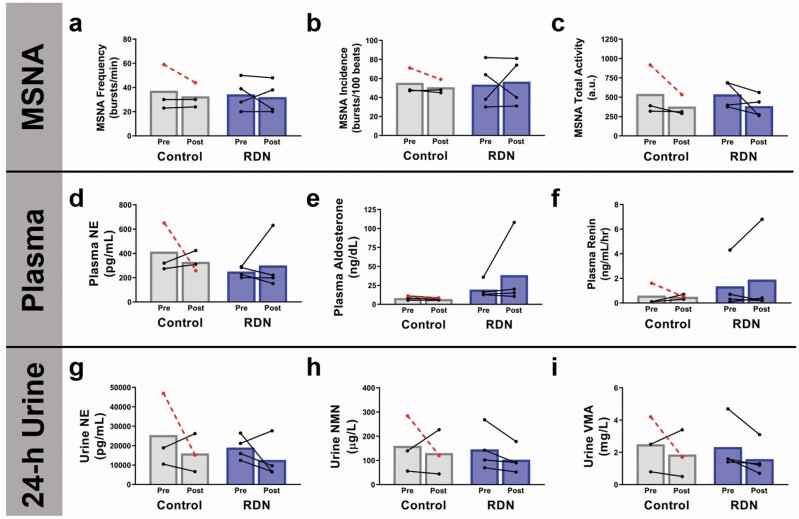
Methods: Seven hypertensive patients (4F:3M; 50-65 years) completed PET-CT sympathetic neuroimaging of the renal cortex using 11C-methylreboxetine (11C-MRB, norepinephrine transporter ligand) and 6-[18F]-fluorodopamine (18F-FDA; substrate for the cell membrane norepinephrine transporter) before and 8 weeks after chemical RDN (Peregrine System Infusion Catheter, Ablative Solutions; n = 4; 2F:2M) or control renal angiography (n = 3; 2F:1M). Patients completed physiological phenotyping including 24-hour ambulatory blood pressure, hemodynamics, muscle sympathetic nerve activity, and 24-hour urine collection.
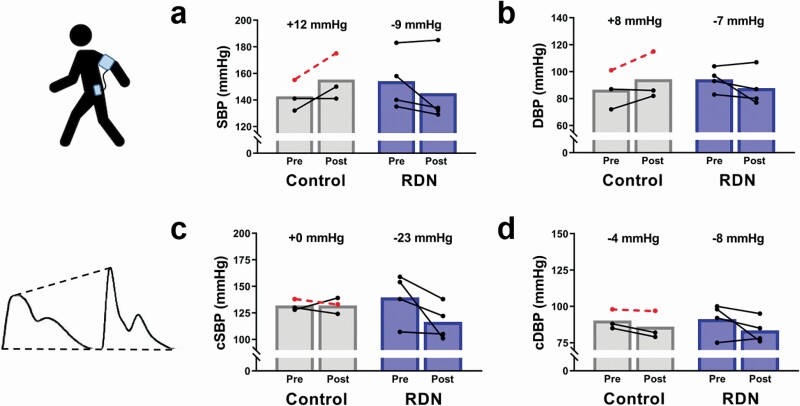
Results: RDN decreased 11C-MRB-derived radioactivity by ~30% (Δ 11C-MRB/chamber: -0.95 a.u. confidence interval (CI): -1.36 to -0.54, P = 0.0002), indicative of efferent RDN. In contrast, 18F-FDA-derived radioactivity increased (Δ 18F-FDA/chamber: 2.72 a.u. CI: 0.73-4.71, P = 0.009), consistent with reduced vesicular turnover. Controls showed no change in either marker. Ambulatory systolic pressure decreased in 3 of 4 patients (-9 mm Hg CI: -27 to 9, P = 0.058), and central systolic pressure decreased in all patients (-23 mm Hg CI: -51 to 5, P = 0.095).
Conclusions: These results are the first to show efferent sympathetic denervation of the renal cortex following RDN in humans. Further studies of mechanisms underlying variable blood pressure lowering in the setting of documented RDN may provide insights into inconsistencies in clinical trial outcomes.
Clinical trials registration: Trial Number NCT03465917.
Keywords: blood pressure; hypertension; renal denervation; sympathetic nervous system.
© American Journal of Hypertension, Ltd 2021. All rights reserved. For Permissions, please email: journals.permissions@oup.com.
Figures


References
-
- Schlaich MP, Kiuchi MG, Esler MD. Renal denervation—ready for prime time!? The steep SPYRAL stairs to RADIANCE in hypertension treatment. Hypertension 2018; 72:287–290. - PubMed
-
- Esler MD, Krum H, Sobotka PA, Schlaich MP, Schmieder RE, Böhm M; Symplicity HTN-2 Investigators . Renal sympathetic denervation in patients with treatment-resistant hypertension (The Symplicity HTN-2 Trial): a randomised controlled trial. Lancet 2010; 376:1903–1909. - PubMed
-
- Krum H, Schlaich M, Whitbourn R, Sobotka PA, Sadowski J, Bartus K, Kapelak B, Walton A, Sievert H, Thambar S, Abraham WT, Esler M. Catheter-based renal sympathetic denervation for resistant hypertension: a multicentre safety and proof-of-principle cohort study. Lancet 2009; 373:1275–1281. - PubMed
-
- Krum H, Schlaich MP, Sobotka PA, Böhm M, Mahfoud F, Rocha-Singh K, Katholi R, Esler MD. Percutaneous renal denervation in patients with treatment-resistant hypertension: final 3-year report of the Symplicity HTN-1 study. Lancet 2014; 383:622–629. - PubMed
-
- Bhatt DL, Kandzari DE, O’Neill WW, D’Agostino R, Flack JM, Katzen BT, Leon MB, Liu M, Mauri L, Negoita M, Cohen SA, Oparil S, Rocha-Singh K, Townsend RR, Bakris GL; SYMPLICITY HTN-3 Investigators . A controlled trial of renal denervation for resistant hypertension. N Engl J Med 2014; 370:1393–1401. - PubMed
Publication types
MeSH terms
Associated data
Grants and funding
LinkOut - more resources
Full Text Sources
Other Literature Sources
Medical
