


Entry, egress and vertical transmission of SARS-CoV-2
- PMID: 33677567
- PMCID: PMC8108610
- DOI: 10.1093/jmcb/mjab013
Entry, egress and vertical transmission of SARS-CoV-2
Abstract
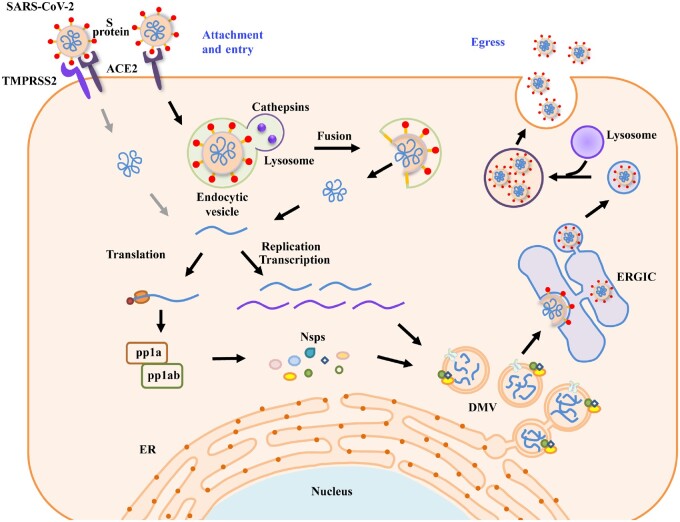
The high infectivity and pathogenicity of severe acute respiratory syndrome coronavirus 2 (SARS-CoV-2) have caused the COVID-19 outbreak, one of the most devastating pandemics in more than a century. This pandemic has already left a trail of destruction, including enormous loss of life, a global economic slump, and widespread psychological damage. Despite assiduous world-wide endeavors, an effective cure for COVID-19 is still lacking. Surprisingly, infected neonates and children have relatively mild clinical manifestations and a much lower fatality rate than elderly adults. Recent studies have unambiguously demonstrated the vertical transmission of SARS-CoV-2 from infected pregnant women to fetuses, which creates yet another challenge for disease prevention. In this review, we will summarize the molecular mechanism for entry of SARS-CoV-2 into host cells, the basis for the failure of the lungs and other organs in severe acute cases, and the evidence for congenital transmission.
Keywords: ACE2; COVID-19; SARS-CoV-2; TMPRSS2; placental transmission.
© The Author(s) (2021). Published by Oxford University Press on behalf of Journal of Molecular Cell Biology, CEMCS, CAS.
Figures
References
-
- Boehm M., Nabel E.G. (2002). Angiotensin-converting enzyme 2—a new cardiac regulator. New Engl. J. Med. 347, 1795–1797. - PubMed
Publication types
MeSH terms
Grants and funding
- Work in Hong Zhang's laboratory
- 31421002/National Natural Science Foundation of China
- 2017YFA0503401/Chinese Ministry of Science and Technology
- Z181100001318003/Beijing Municipal Science and Technology Committee
- XDB19000000/Strategic Priority Research Program of the Chinese Academy of Sciences (CAS)
LinkOut - more resources
Full Text Sources
Other Literature Sources
Medical
Miscellaneous
