


Remimazolam anesthesia for cardiac surgery with cardiopulmonary bypass: a case report
- PMID: 33677710
- PMCID: PMC7937000
- DOI: 10.1186/s40981-021-00424-0
Remimazolam anesthesia for cardiac surgery with cardiopulmonary bypass: a case report
Abstract
Background: Remimazolam has less cardiovascular depressant effects than propofol in non-cardiac surgical patients. However, the efficacy and safety of remimazolam in cardiac surgery with cardiopulmonary bypass (CPB) have not been reported. We present a case of successful anesthetic management using remimazolam in cardiac surgery with CPB.
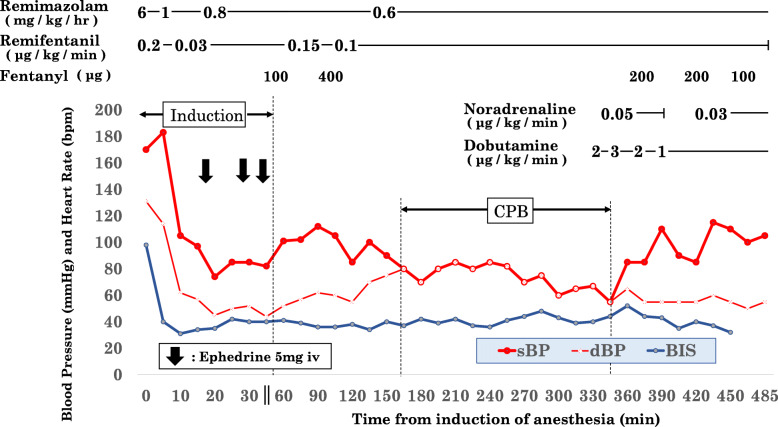
Case presentation: A 76-year-old female was scheduled for mitral valve repair, tricuspid annuloplasty, maze procedure, and left atrial appendage closure. We used remimazolam in induction (6.0 mg/kg/h) and maintenance (0.6-1.0 mg/kg/h) of general anesthesia, and the bispectral index value was maintained in the range of 36 to 48 including the period of CPB. Hemodynamics, mixed venous oxygen saturation, and bilateral regional cerebral oxygen saturation were maintained within acceptable ranges. There was no intraoperative awareness/recall or serious complications associated with remimazolam throughout the perioperative period.
Conclusions: Remimazolam can be used the same as other existing anesthetics in cardiac surgery with CPB.
Keywords: Cardiac surgery; Cardiopulmonary bypass; Remimazolam.
Conflict of interest statement
The authors declare that they have no competing interests.
Figures
References
-
- Schüttler J, Eisenried A, Lerch M, Fechner J, Jeleazcov C, Ihmsen H. Pharmacokinetics and pharmacodynamics of remimazolam (CNS 7056) after continuous infusion in healthy male volunteers: part I. Pharma Clin Pharma Anesthesiol. 2020;132(4):636–651. - PubMed
-
- Doi M, Hirata N, Suzuki T, Morisaki H, Morimatsu H, Sakamoto A. Safety and efficacy of remimazolam in induction and maintenance of general anesthesia in high-risk surgical patients (ASA Class III): results of a multicenter, randomized, double-blind, parallel-group comparative trial. J Anesth. 2020;34(4):491–501. doi: 10.1007/s00540-020-02776-w. - DOI - PubMed
LinkOut - more resources
Full Text Sources
Other Literature Sources