. 2021 Mar 25;64(6):3479-3492.
doi: 10.1021/acs.jmedchem.1c00185. Epub 2021 Mar 6.

Synthesis, Optimization, and Biological Evaluation of Corrinated Conjugates of the GLP-1R Agonist Exendin-4

Affiliations

Synthesis, Optimization, and Biological Evaluation of Corrinated Conjugates of the GLP-1R Agonist Exendin-4

Ian C Tinsley et al. J Med Chem. .

Abstract

Corrination is the conjugation of a corrin ring containing molecule, such as vitamin B12 (B12) or B12 biosynthetic precursor dicyanocobinamide (Cbi), to small molecules, peptides, or proteins with the goal of modifying pharmacology. Recently, a corrinated GLP-1R agonist (GLP-1RA) exendin-4 (Ex4) has been shown in vivo to have reduced penetration into the central nervous system relative to Ex4 alone, producing a glucoregulatory GLP-1RA devoid of anorexia and emesis. The study herein was designed to optimize the lead conjugate for GLP-1R agonism and binding. Two specific conjugation sites were introduced in Ex4, while also utilizing various linkers, so that it was possible to identify Cbi conjugates of Ex4 that exhibit improved binding and agonist activity at the GLP-1R. An optimized conjugate (22), comparable with Ex4, was successfully screened and subsequently assayed for insulin secretion in rat islets and in vivo in shrews for glucoregulatory and emetic behavior, relative to Ex4.


Conflict of interest statement

The authors declare the following competing financial interest(s): RPD is the named inventor of a patent associated with this work, which is assigned to Syracuse University. R.P.D., I.C.T., T.B., B.C.D.J. and M.R.H. are owners of Cantius Therapeutics LLC (Lansdale, Pennsylvania, United States), which played no role in this work. MRH receives re-search support from Eli Lilly & Co. and Boehringer Ingelheim for projects unrelated to the current manuscript.

Figures
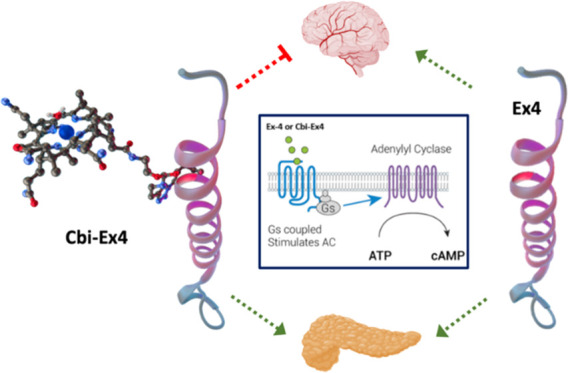
Figure 1
Figure 1
Corrination of Ex4 (Cbi-Ex4) does not prevent GLP-1R agonism in the pancreas but does mitigate agonism in the CNS as tracked by emesis and anorexia. Ex4 alone agonizes GLP-1R populations in both the pancreas and CNS.
Figure 2
Figure 2
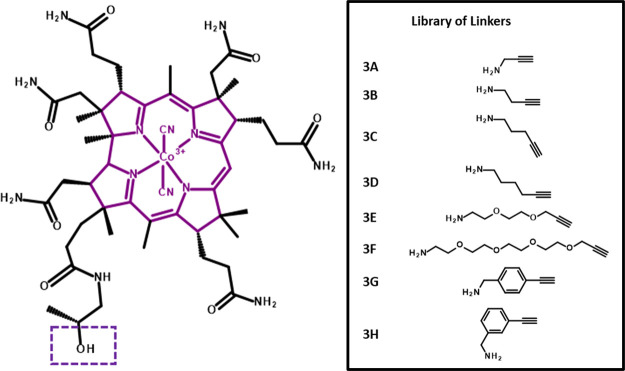
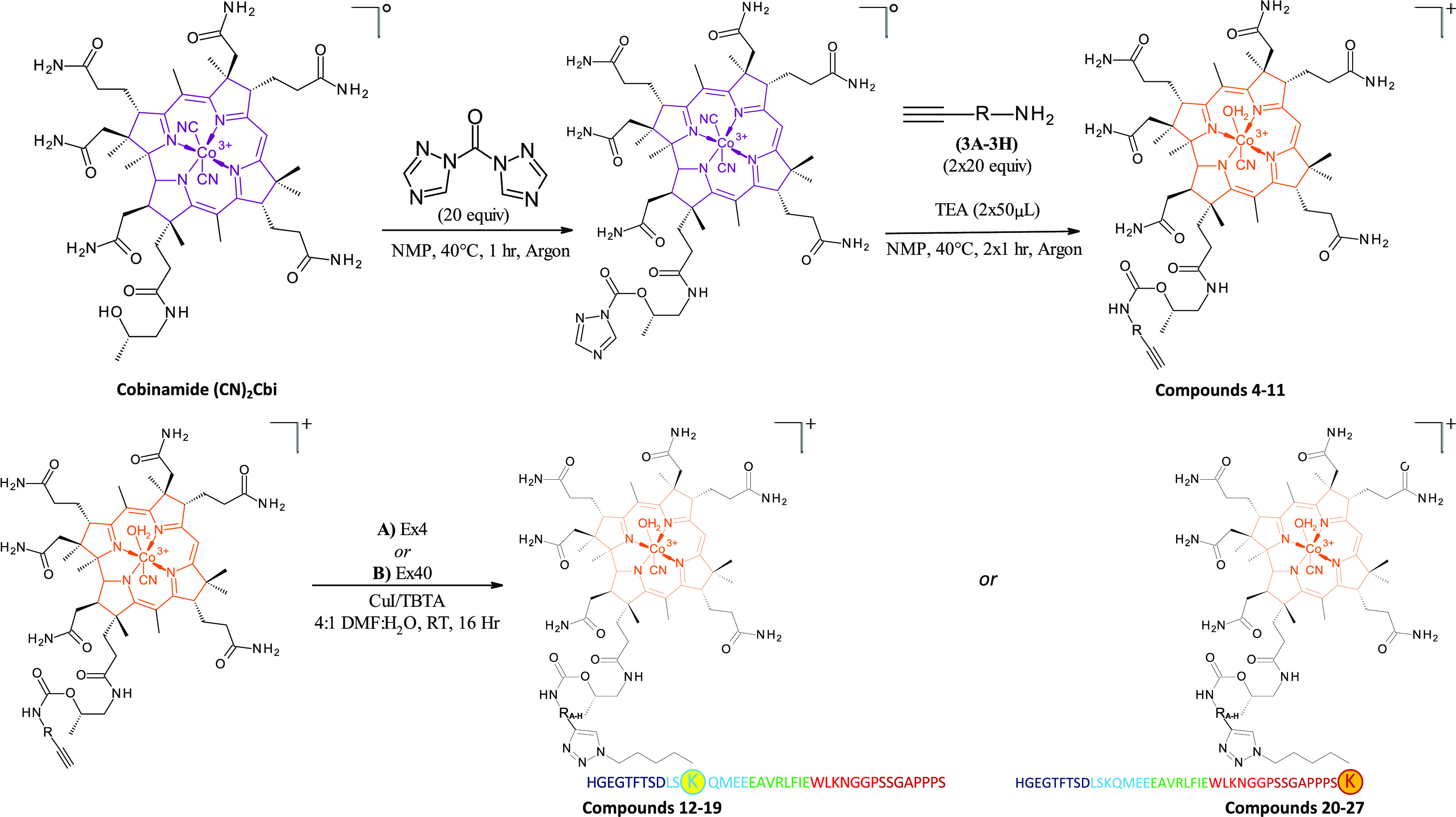
(Left) Structure of the dicyanocobinamide (CN2Cbi) starting material, a purple solid prepared via microwave chemistry from B12, with the hydroxyl group boxed used as a site of conjugation to linker series. (Right) Library of linkers used in the conjugation of Cbi to Ex4 peptides. The library of linkers chosen in this study included short hydrophobic alkane chains, amphiphilic PEG, and rigid substituted ethynyl phenyl methanamines, which were coupled to the Cbi hydroxyl group via CDT-mediated amide formation, resulting in Cbi compounds (411) with an available alkyne group for subsequent reaction with azido-modified Ex4 peptides via copper-mediated alkyne-azide click chemistry (Scheme 1).
Scheme 1
Scheme 1. Synthesis of Cbi Linkers (411) and Cbi-Peptide Conjugates (1227). Linkers 3A3H are shown in Figure 2
Figure 3
Figure 3
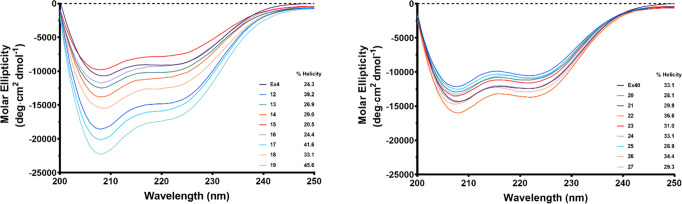
Effect of Cbi conjugation on the secondary structure of Ex4 or Ex40. CD spectra were collected with a sample concentration of 40 μM at pH 7 between 200 and 250 nm. % helicity was measured at 222 nm.
Figure 4
Figure 4
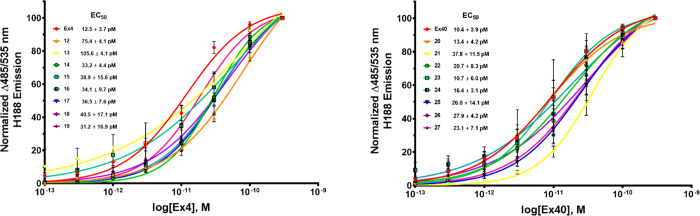
Conjugation of Cbi to Ex4 or Ex40 peptides maintains agonism at the GLP-1R. Nonlinear regression analysis was performed with GraphPad Prism 8. All compounds were assayed at least as triplicate independent runs. Data are shown as mean ± SEM.
Figure 5
Figure 5
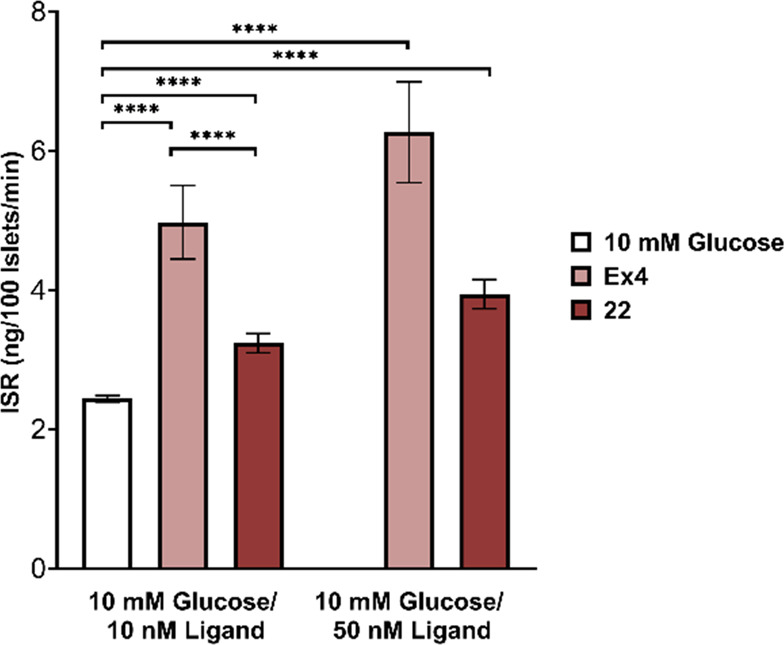
22 increases glucose-stimulated insulin secretion in rat islets relative to glucose controls. Insulin secretion rate from static cultures of Sprague–Dawley rat islets incubated in media containing glucose (10 mM) and Ex4 (10 or 50 nM) or 22 (10 or 50 nM). Data was calculated from three independent experiments and analyzed with repeated-measurements two-way ANOVA followed by Tukey’s posthoc test. Results are expressed as mean ± SEM, **** p < 0.0001.
Figure 6
Figure 6
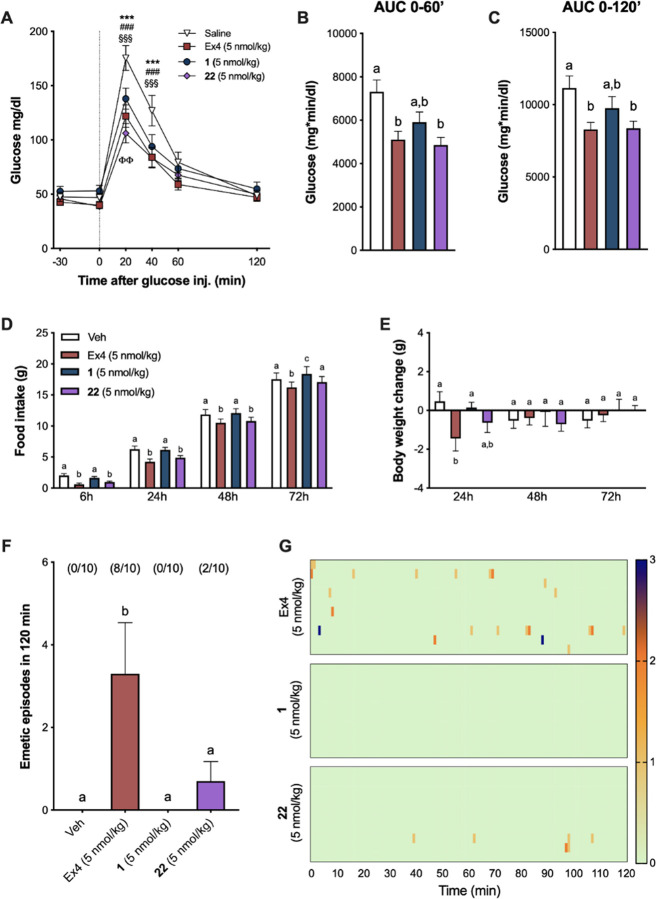
Cbi-Ex4 enhances glucose clearance without inducing emesis or body weight loss. (A) In an IPGTT, Ex4, 1, and 22 (50 nmol/kg, IP) showed similar potency in suppressing BG levels after glucose administration (2 g/kg, IP) compared to saline; vehicle vs 1: *** P < 0.001; vehicle vs 22: ### P < 0.001; vehicle vs Ex4: §§§ P < 0.001; 1 vs 22: ΦΦ P < 0.01 (n = 12 shrews). (B) Area under the curve (AUC) analysis from 0 (i.e., post-glucose bolus) to 60 min following 1, 22, and Ex4. (C) AUC analysis from 0 to 120 min; 22 and Ex4 similarly reduced AUCs compared to vehicle (P < 0.05). (D) Ex4 and 22 (5 nmol/kg, IP) induced anorexia at 6, 24, and 48 h (and at 72 h for Ex4 only), whereas 1 had no effect on food intake (n = 10). (E) Ex4-induced anorexia was accompanied by significant body weight loss at 24 h. No significant changes in body weight occurred after 1 and 22 administration compared to controls. (F) The number of single emetic episodes following Ex4, 1, 22, or saline systemic administration was recorded for 120 min. The number of animals exhibiting emesis, expressed as a fraction of the total number of animals tested, is indicated above each treatment group. Ex4 induced robust emetic responses that were not observed after 1 or saline injections. 22 induced emesis in two of the animals tested; however, the number of emetic episodes was significantly lower than that of Ex4 and did not differ from animals treated with vehicle or 1 (n = 10). (G) Heatmaps showing latency, number, and intensity of emesis following Ex4, 1, and 22 dosing for each individual animal across time. All data expressed as mean ± SEM (n = 10). Data in panels (A), (D), and (E) were analyzed with repeated-measurements two-way ANOVA followed by Tukey’s posthoc test. Data in panels (B), (C), and (F) were analyzed with repeated-measurements one-way ANOVA followed by Tukey’s posthoc test. Means with different letters are significantly different (P < 0.05).

References

    1. Chen L.; Magliano D. J.; Zimmet P. Z. The worldwide epidemiology of type 2 diabetes mellitus--present and future perspectives. Nat. Rev. Endocrinol. 2012, 8, 228–236. 10.1038/nrendo.2011.183. - DOI - PubMed
    1. Flegal K. M.; Carroll M. D.; Ogden C. L.; Curtin L. R. Prevalence and trends in obesity among US adults, 1999-2008. JAMA 2010, 303, 235–241. 10.1001/jama.2009.2014. - DOI - PubMed
    1. Sherwin R.; Jastreboff A. M. Year in diabetes 2012: The diabetes tsunami. J. Clin. Endocrinol. Metab. 2012, 97, 4293–4301. 10.1210/jc.2012-3487. - DOI - PMC - PubMed
    1. Franks P. W.; McCarthy M. I. Exposing the exposures responsible for type 2 diabetes and obesity. Science 2016, 354, 69–73. 10.1126/science.aaf5094. - DOI - PubMed
    1. Upadhyay J.; Polyzos S. A.; Perakakis N.; Thakkar B.; Paschou S. A.; Katsiki N.; Underwood P.; Park K. H.; Seufert J.; Kang E. S.; Sternthal E.; Karagiannis A.; Mantzoros C. S. Pharmacotherapy of type 2 diabetes: An update. Metabolism. 2018, 78, 13–42. 10.1016/j.metabol.2017.08.010. - DOI - PubMed

Publication types

MeSH terms