


P2X7 Receptor Agonist 2'(3')-O-(4-Benzoylbenzoyl)ATP Differently Modulates Cell Viability and Corticostriatal Synaptic Transmission in Experimental Models of Huntington's Disease
- PMID: 33679392
- PMCID: PMC7933594
- DOI: 10.3389/fphar.2020.633861
P2X7 Receptor Agonist 2'(3')-O-(4-Benzoylbenzoyl)ATP Differently Modulates Cell Viability and Corticostriatal Synaptic Transmission in Experimental Models of Huntington's Disease
Abstract
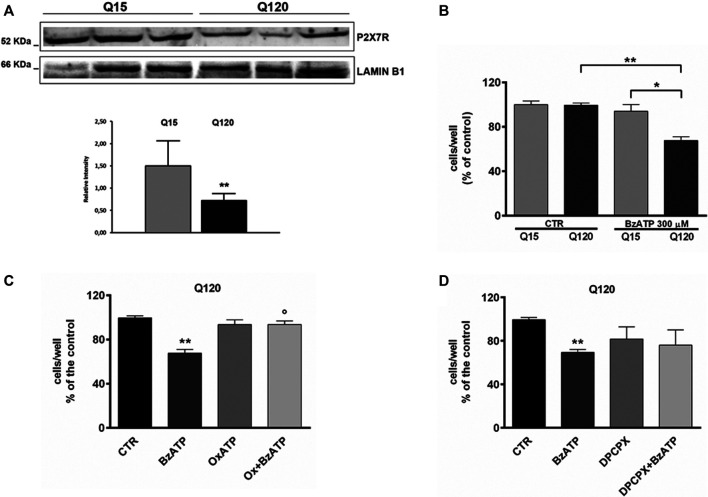
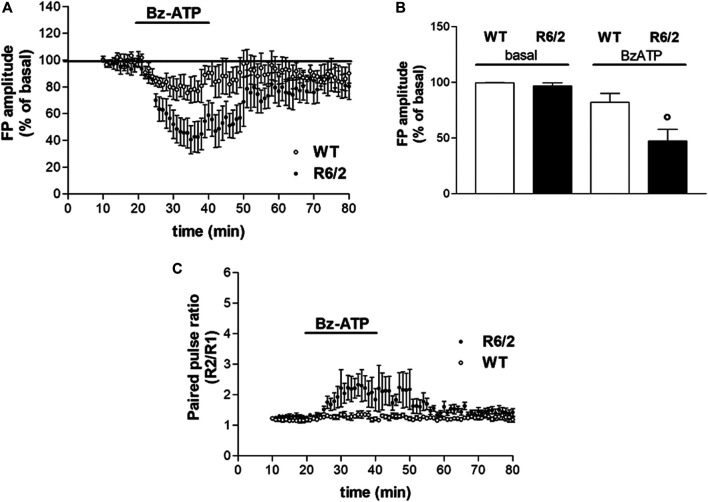
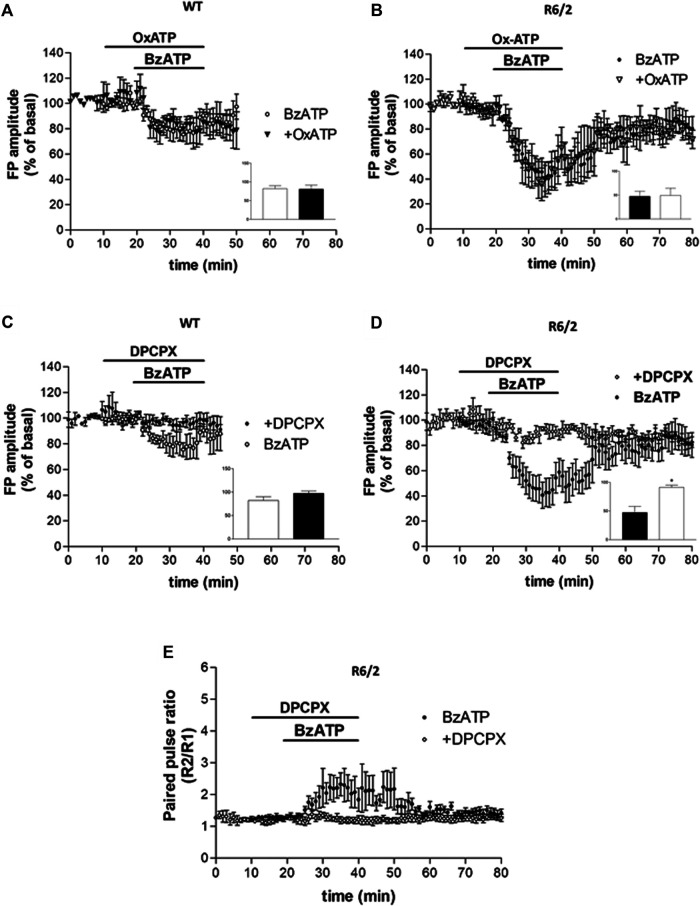
Huntington's disease (HD) is a life-threatening neurodegenerative disorder. Altered levels and functions of the purinergic ionotropic P2X7 receptors (P2X7Rs) have been found in animal and cellular models of HD, suggesting their possible role in the pathogenesis of the disease; accordingly, the therapeutic potential of P2X7R antagonists in HD has been proposed. Here we further investigated the effects of P2X7R ligands in in vitro and ex vivo HD experimental models. In ST14A/Q120 rat striatal cells, we found a reduction of P2X7R expression; however, the P2X7R agonist 2'(3')-O-(4-benzoylbenzoyl)adenosine-5'-triphosphate (BzATP) induced cellular death, and this effect was fully reversed by the antagonist periodate-oxidized adenosine 5'-triphosphate (OxATP). Moreover, in corticostriatal slices from symptomatic R6/2 mice, BzATP reduced the synaptic transmission to a larger extent than in wild-type (WT) mice. Such an effect was accompanied by a concomitant increase of the paired-pulse ratio, suggesting a presynaptic inhibitory action. This was confirmed to be the case, since while the effects of BzATP were unaffected by the P2X7R antagonist OxATP, they were blocked by the adenosine A1 receptor (A1R) antagonist 8-cyclopentyl-1,3-dipropylxanthine (DPCPX), suggesting possible BzATP hydrolysis to 2'(3')-O-(4-benzoylbenzoyl)adenosine (Bz-adenosine) and consequent activation of A1Rs as a mechanism. Taken together, these data point out that 1) P2X7R expression and activity are confirmed to be altered in the presence of HD mutation; 2) in some experimental settings, such an abnormal functioning can be ascribed to presynaptic A1Rs activation.
Keywords: BzATP; DPCPX; Huntington’s disease; OxATP; P2X7 receptor; adenosine; adenosine A1 receptor; corticostriatal slices.
Copyright © 2021 Martire, Pepponi, Liguori, Volonté and Popoli.
Conflict of interest statement
The authors declare that the research was conducted in the absence of any commercial or financial relationships that could be construed as a potential conflict of interest.
Figures
References
-
- Abbracchio M. P., Burnstock G., Boeynaems J. M., Barnard E. A., Boyer J. L., Kennedy C., et al. (2006). International Union of Pharmacology LVIII: update on the P2Y G protein-coupled nucleotide receptors: from molecular mechanisms and pathophysiology to therapy. Pharmacol. Rev. 58 (3), 281–341. 10.1124/pr.58.3.3 - DOI - PMC - PubMed
LinkOut - more resources
Full Text Sources
Other Literature Sources
Molecular Biology Databases
