


Well-Designed Food Governance as Psychological Mechanism of Consumer Perceptions in the Context of Tourism Poverty Alleviation
- PMID: 33679495
- PMCID: PMC7928344
- DOI: 10.3389/fpsyg.2020.590816
Well-Designed Food Governance as Psychological Mechanism of Consumer Perceptions in the Context of Tourism Poverty Alleviation
Abstract
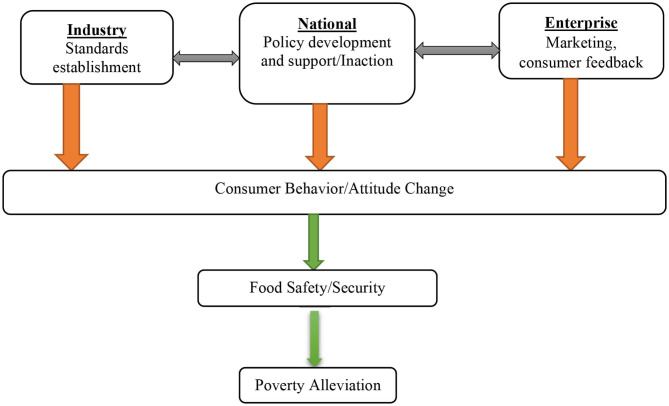
Poverty is a challenge leading to food insecurity in people's minds. This article discusses food governance as a psychological mechanism to facilitate the sense of wellness in people's minds in the context of tourism poverty alleviation. Mainly, we argue that, when a government is implementing tourism poverty alleviation, not only are economic efforts, but also positive psychological feelings are required. We, thus, argue that sound food governance may increase the sense of wellness in the minds of people as food consumers by increasing food safety and security. This perspective paper contributes by explicating the influences of macrolevel governance design of safer and more secure food systems on people's psychological wellness, especially against the background of tourism poverty alleviation in developing countries.
Keywords: developing countries; food governance; micro- foundation; psychological remedy; tourism poverty alleviation.
Copyright © 2021 Huang and Lin.
Conflict of interest statement
The authors declare that the research was conducted in the absence of any commercial or financial relationships that could be construed as a potential conflict of interest.
Figures
References
-
- Beveridge L., Whitfield S., Fraval S., van Wijk M., van Etten J., Mercado L., et al. (2019). Experiences and drivers of food insecurity in guatemala's dry corridor: insights from the integration of ethnographic and household survey data. Front. Sustain. Food Syst. 3:65. 10.3389/fsufs.2019.00065 - DOI
-
- Butler J. R. A., Rochester W., Skewes T. D., Wise R. M., Bohensky E. L., Katzfey J., et al. (2020). How feasible is the scaling-out of livelihood and food system adaptation in Asia-Pacific Islands? Front. Sustain. Food Syst. 4:43. 10.3389/fsufs.2020.00043 - DOI
-
- Butler-Stroud C. (2016). What drives Japanese whaling policy? Front. Mar. Sci. 3:102. 10.3389/fmars.2016.00102 - DOI
Publication types
LinkOut - more resources
Full Text Sources
Other Literature Sources
