


Who's Leading This Dance?: Theorizing Automatic and Strategic Synchrony in Human-Exoskeleton Interactions
- PMID: 33679541
- PMCID: PMC7925620
- DOI: 10.3389/fpsyg.2021.624108
Who's Leading This Dance?: Theorizing Automatic and Strategic Synchrony in Human-Exoskeleton Interactions
Abstract
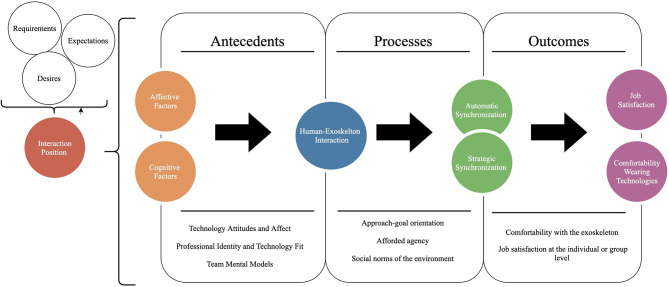
Wearable robots are an emerging form of technology that allow organizations to combine the strength, precision, and performance of machines with the flexibility, intelligence, and problem-solving abilities of human wearers. Active exoskeletons are a type of wearable robot that gives wearers the ability to effortlessly lift up to 200 lbs., as well as perform other types of physically demanding tasks that would be too strenuous for most humans. Synchronization between exoskeleton suits and wearers is one of the most challenging requirements to operate these technologies effectively. In this conceptual paper, we extend interpersonal adaption theory (IAT) to the exoskeleton context and explicate (a) the antecedents that are most likely to shape synchrony in human-exoskeleton interactions, (b) automatic and strategic synchrony as adaptive behaviors in human-exoskeleton interactions, and (c) outcome variables that are especially important in these processes. Lastly, we offer a discussion of key methodological challenges for measuring synchrony in human-exoskeleton interactions and offer a future research agenda for this important area.
Keywords: emerging technologies; exoskeletons; human-machine interaction; human-robot interaction; methodological challenges; synchrony.
Copyright © 2021 Kirkwood, Otmar and Hansia.
Conflict of interest statement
The authors declare that the research was conducted in the absence of any commercial or financial relationships that could be construed as a potential conflict of interest.
Figures
References
-
- Andersen P. A. (1998). The cognitive valence theory of intimate communication, in Progress in Communication Sciences: Vol. 14. Mutual Influence in Interpersonal Communication Theory and Research in Cognition, Affect, and Behavior, eds Palmer M., Barnett G. A. (Stamford, CT: Ablex; ), 39–72.
-
- Andersen P. A., Guerrero L. K. (1998). Principles of communication and emotion in social interaction, in Handbook of Communication and Emotion, eds Andersen P., Guerrero L. (San Diego, CA: Academic Press; ), 49–96.
-
- Arundale R. B. (1996). Indexing pattern over time: criteria for studying communication as a dynamic process, in Dynamic Patterns in Communication Processes, eds Watt J., van Lear C. A. (Thousand Oaks, CA: Sage; ), 95–118.
-
- Asher M., Kauffmann A., Aderka I. M. (2020). Out of Sync: nonverbal synchrony in social anxiety disorder. Clin. Psychol. Sci. 8, 280–294. 10.1177/2167702619894566 - DOI
-
- Banks J., de Graaf M. (2020). Toward an agent-agnostic transmission model: synthesizing anthropocentric and technocentric paradigms in communication. Hum. Mach. Commun. 1, 19–36. 10.30658/hmc.1.2 - DOI
LinkOut - more resources
Full Text Sources
Other Literature Sources
Miscellaneous
