Review
. 2021 Feb 19:11:631713.
doi: 10.3389/fimmu.2020.631713. eCollection 2020.

Harnessing the cDC1-NK Cross-Talk in the Tumor Microenvironment to Battle Cancer

Affiliations
Review

Harnessing the cDC1-NK Cross-Talk in the Tumor Microenvironment to Battle Cancer

Johanna Bödder et al. Front Immunol. .

Abstract

Immunotherapeutic approaches have revolutionized the treatment of several diseases such as cancer. The main goal of immunotherapy for cancer is to modulate the anti-tumor immune responses by favoring the recognition and destruction of tumor cells. Recently, a better understanding of the suppressive effect of the tumor microenvironment (TME) on immune cells, indicates that restoring the suppressive effect of the TME is crucial for an efficient immunotherapy. Natural killer (NK) cells and dendritic cells (DCs) are cell types that are currently administered to cancer patients. NK cells are used because of their ability to kill tumor cells directly via cytotoxic granzymes. DCs are employed to enhance anti-tumor T cell responses based on their ability to present antigens and induce tumor-antigen specific CD8+ T cell responses. In preclinical models, a particular DC subset, conventional type 1 DCs (cDC1s) is shown to be specialized in cross-presenting extracellular antigens to CD8+ T cells. This feature makes them a promising DC subset for cancer treatment. Within the TME, cDC1s show a bidirectional cross-talk with NK cells, resulting in a higher cDC1 recruitment, differentiation, and maturation as well as activation and stimulation of NK cells. Consequently, the presence of cDC1s and NK cells within the TME might be of utmost importance for the success of immunotherapy. In this review, we discuss the function of cDC1s and NK cells, their bidirectional cross-talk and potential strategies that could improve cancer immunotherapy.

Keywords: conventional type 1 DCs; cross-talk; immunotherapy; natural killer cells; tumor microenvironment.


Conflict of interest statement

The authors declare that the research was conducted in the absence of any commercial or financial relationships that could be construed as a potential conflict of interest.

Figures
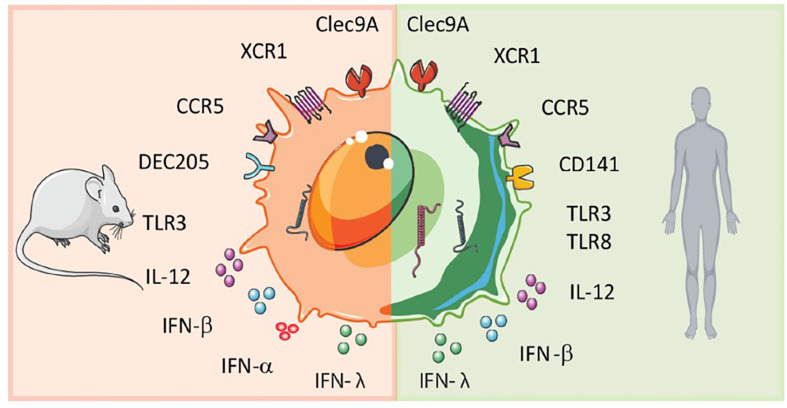
Figure 1
Figure 1
Scheme of murine and human cDC1 features. Human and mouse cDC1s display similarities but also differences in surface receptor expression and cytokine secretion.
Figure 2
Figure 2
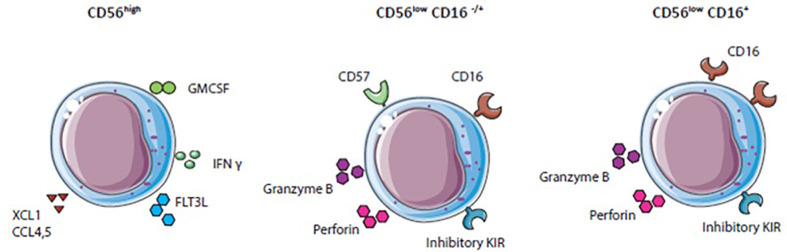
Natural killer (NK) cell subset differentation: NK cell subsets express variouus activating and inhibitory receptors and secrete different cytokines.
Figure 3
Figure 3
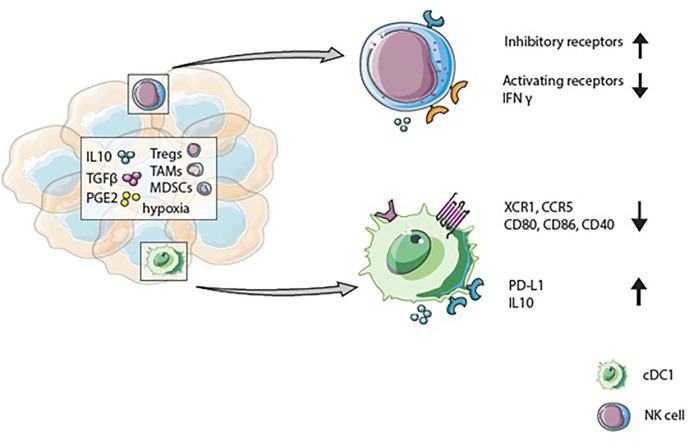
The tumor microenvironment influences cDC1 and natural killer (NK) cell phenotype and function. Immunosupressive factors like IL-10, TGF-β, and PGE2 can be secreted by tumor- and immune cells such as regulatory T cells (Tregs), tumor-associated macrophages (TAMs), or myeloid-derived-suppressor cells (MDSCs) present in the tumor microenvironment (TME). These factors, and hypoxia, can upregulate inhibitory receptors and decrease activating receptors on NK cells. Together with diminished IFN-γ secretion, the changed receptor expression results in reduced cytotoxicity of NK cells. Due to immunosuppressive factors in the TME cDC1s express low levels of XCR1 and CCR5 and display an immature phenotype with reduced CD80, CD86, and CD40 expression. Whereas checkpoint receptors and anti-inflammatory cytokine expression are upregulated.
Figure 4
Figure 4
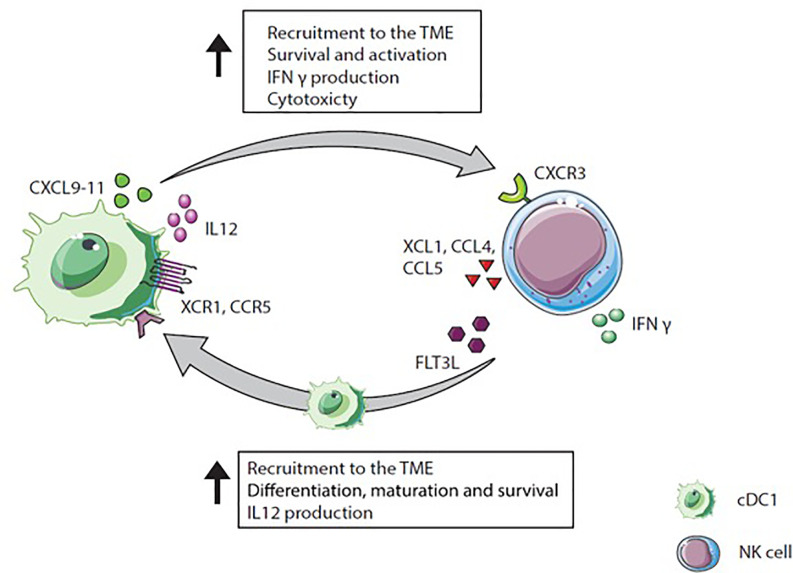
Natural killer (NK) cell and cDC1 cross-talk. NK cells secrete XCL1, CCL4, and CCL5 which attract XCR1 and CCR5 expressing cDC1s. Moreover, NK cells produce FLT3L, a differentiation factor for precursor DCs to cDC1s recruit NK cells via CXCL9-11 secretion into the TME. In a positive feedback loop, IL-12 produced by cDC1s activates IFN-γ extraction by NK cells, which again increases IL-12 secretion by cDC1s.
Figure 5
Figure 5
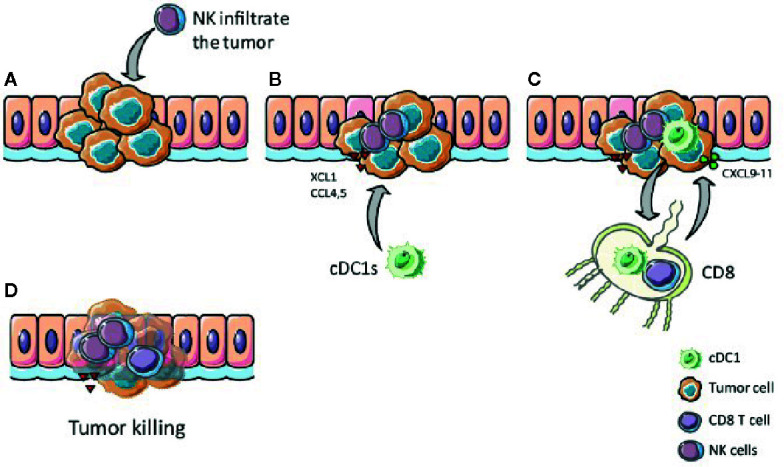
The XCR1 – XCL1 axis plays a role in tumor clearance. (A) NK and T cells, which infiltrate the tumor, produce XCL1 upon stimulation. (B) XCL1 attracts XCR1 expressing cDC1s to the tumor (C) cDC1s internalize, process, and cross-present tumor antigens to CD8+ T cells in the lymph nodes, thereby activate CD8+ T cells, which migrate to the tumor attracted by CXCL9-11 secreted by local cDC1s. (D) Activated CD8+ T cells kill tumor cells antigen-specifically
Figure 6
Figure 6
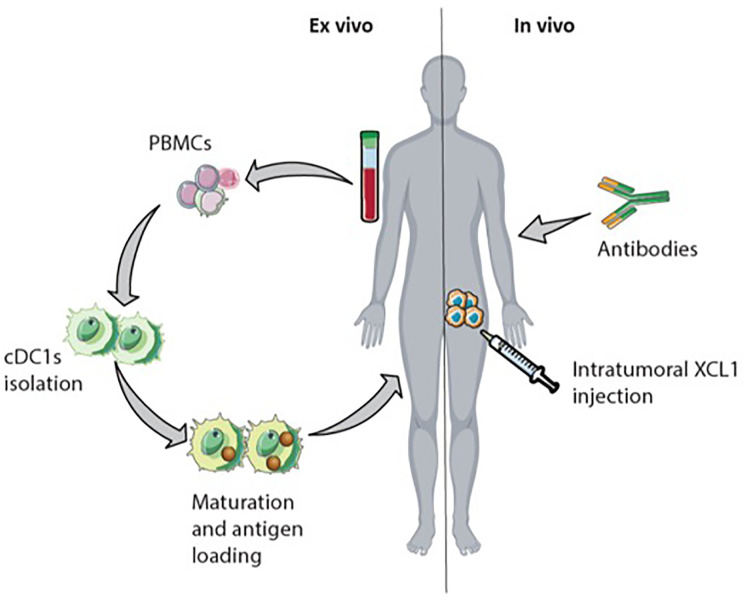
Possible immunotherapeutic approach targeting natural killer (NK) cells and cDC1s. Interfering with the XCR1-XCL1 axis in the tumor could increase antigen-specific CD8+ T cell infiltration. The intranodal reinfusion of cDC1s from patients after isolation them from PBMCs, maturation, and antigen-loading could be an ex vivo approach. In vivo, intratumoral XCL1 injection could recruit cDC1s into the tumor. Injected or attracted cross-presenting cDC1s in the tumor enhance CD8+ T cells activation. Monoclonal antibodies initiate antibody-dependent cellular cytotoxicity (ADCC) by NK cells leading to increased cross-presentation of tumor-cell derived antigens by cDC1s.

References

    1. Paul S, Lal G. The Molecular Mechanism of Natural Killer Cells Function and Its Importance in Cancer Immunotherapy. Front Immunol (2017) 8:1124–4. 10.3389/fimmu.2017.01124 - DOI - PMC - PubMed
    1. Long EO, Kim HS, Liu D, Peterson ME, Rajagopalan S. Controlling Natural Killer Cell Responses: Integration of Signals for Activation and Inhibition. Annu Rev Immunol (2013) 31(1):227–58. 10.1146/annurev-immunol-020711-075005 - DOI - PMC - PubMed
    1. Pende D, Falco M, Vitale M, Cantoni C, Vitale C, Munari E, et al. Killer Ig-Like Receptors (KIRs): Their Role in NK Cell Modulation and Developments Leading to Their Clinical Exploitation. Front Immunol (2019) 10(1179). 10.3389/fimmu.2019.01179 - DOI - PMC - PubMed
    1. Banchereau J, Steinman RM. Dendritic cells and the control of immunity. Nature (1998) 392:245. 10.1038/32588 - DOI - PubMed
    1. Collin M, McGovern N, Haniffa M. Human dendritic cell subsets. Immunology (2013) 140(1):22–30. 10.1111/imm.12117 - DOI - PMC - PubMed

Publication types

MeSH terms