. 2021 Feb 17:12:634553.
doi: 10.3389/fgene.2021.634553. eCollection 2021.

Integrative Analysis of Omics Data Reveals Regulatory Network of CDK10 in Vitiligo Risk

Affiliations

Integrative Analysis of Omics Data Reveals Regulatory Network of CDK10 in Vitiligo Risk

Minglong Cai et al. Front Genet. .

Abstract

Vitiligo is a multifactorial polygenic disorder, characterized by acquired depigmented skin and overlying hair resulting from the destruction of melanocytes. Genome-wide association studies (GWASs) of vitiligo have identified approximately 100 genetic variants. However, the identification of functional genes and their regulatory elements remains a challenge. To prioritize putative functional genes and DNAm sites, we performed a Summary data-based Mendelian Randomization (SMR) and heterogeneity in dependent instruments (HEIDI) test to integrate omics summary statistics from GWAS, expression quantitative trait locus (eQTL), and methylation quantitative trait loci (meQTL) analysis of large sample size. By integrating omics data, we identified two newly putative functional genes (SPATA2L and CDK10) associated with vitiligo and further validated CDK10 by qRT-PCR in independent samples. We also identified 17 vitiligo-associated DNA methylation (DNAm) sites in Chr16, of which cg05175606 was significantly associated with the expression of CDK10 and vitiligo. Colocalization analyses detected transcript of CDK10 in the blood and skin colocalizing with cg05175606 at single nucleotide polymorphism (SNP) rs77651727. Our findings revealed that a shared genetic variant rs77651727 alters the cg05175606 as well as up-regulates gene expression of CDK10 and further decreases the risk of vitiligo.

Keywords: expression quantitative trait locus; genome wide association study; mendelian randomization; methylation quantitative trait loci; vitiligo.


Conflict of interest statement

The authors declare that the research was conducted in the absence of any commercial or financial relationships that could be construed as a potential conflict of interest.

Figures

FIGURE 1
FIGURE 1
The pipeline of our integrative analysis of vitiligo. Integrative analysis of mQTL, eQTL, and vitiligo GWAS data to prioritize DNAm sites, putative functional genes, shared causal variants, and reveal a possible regulatory mechanism that the effect of genetic variants on vitiligo susceptibility is mediated by altering gene expression through DNAm.
FIGURE 2
FIGURE 2
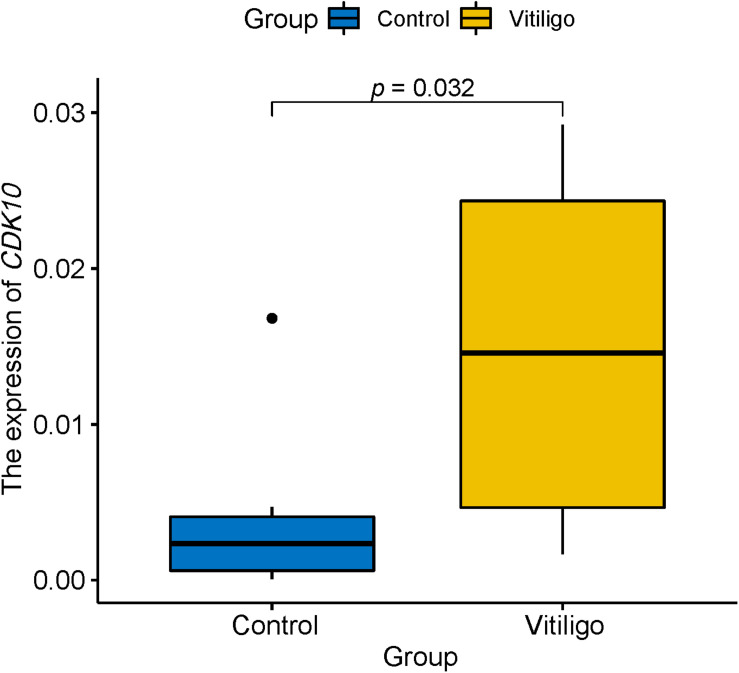
qRT-PCR showed the expression of CDK10 is significantly increased in the blood of vitiligo relative to control.
FIGURE 3
FIGURE 3
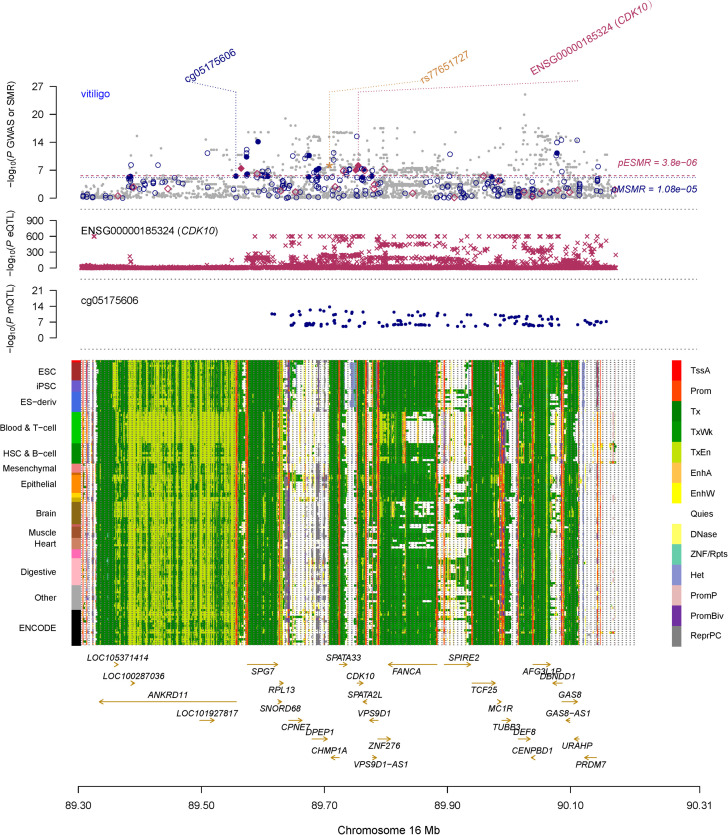
Prioritizing CDK10 and cg05175606 for vitiligo. The top plot shows –log10(P-value) of SNPs from GWAS for vitiligo. The red diamonds and blue circles represent –log10(P-values) from SMR tests for associations of vitiligo with gene expression and DNAm probes, respectively. The solid circles and diamonds are the probes not rejected by the HEIDI test, the yellow star indicates the top-associated variant rs77651727 in the eQTL analysis of the CDK10 and the meQTL analysis of the cg05175606. The second plot shows –log10(P-values) from the eQTLGen dataset for associations of SNPs with gene expression probe ENSG00000185324 (tagging CDK10). The third plot shows –log10(P-values) from meQTL study for associations of the SNPs with DNAm probes (cg05175606). The bottom plot shows 14 chromatin state annotations (indicated by colors) of 127 samples from REMC for different primary cells and tissue types (rows). TSSA, active TSS; Prom, promoter, Tx, active transcription; TxWk, weak transcription; TxEn, transcribed and regulatory promoter/enhancer; EnhA, active enhancer; EnhW, weak enhancer; DNase, primary DNase; ZNF/Rpts, ZNF genes and repeats; Het, heterochromatin; PromP, poised promoter; PromBiv, bivalent promoter; ReprPC, repressed PolyComb; Quies, quiescent/low.
FIGURE 4
FIGURE 4
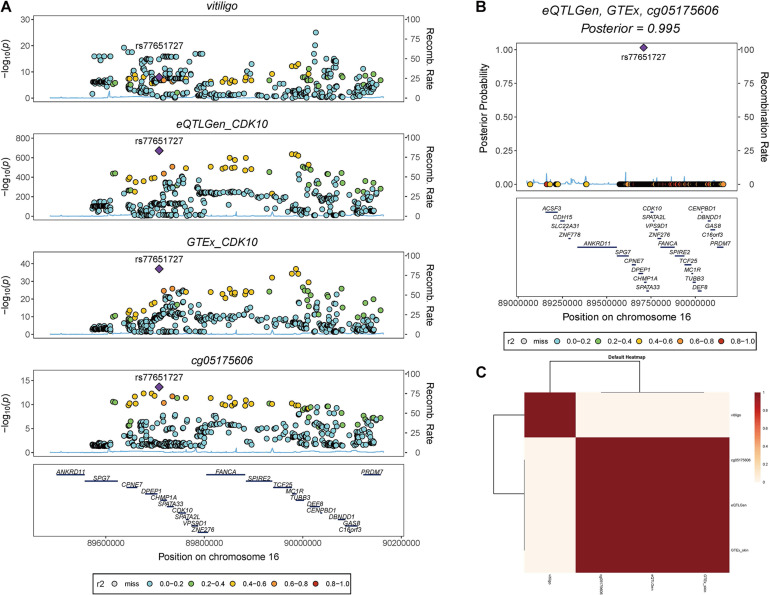
Colocalization analysis of vitiligo, transcript of CDk10, and cg05175606. (A) Stacked association plots of vitiligo with the transcript of CDK10 in eQTLGen and GTEx sun-exposed skin eQTL data, and cg05175606 in meQTL data. HyPrColoc detected rs77651727 is the top-associated variant in eQTL and meQTL data. The variant is also associated with vitiligo at a genome-wide significant level. (B) HyPrColoc identified rs77651727 as a candidate causal variant explaining the shared association signal between the transcript of CDK10 and cg05175606, i.e., rs77651727 explained 100% of the posterior probability of colocalization. (C) HyPrColoc sensitivity analysis shows the transcript of CDK10 in two eQTL analysis and cg05175606 form a very strong cluster of colocalized traits.

References

    1. Aguet F., Brown A. A., Castel S. E., Davis J. R., He Y., Jo B., et al. (2017). Genetic effects on gene expression across human tissues. Nature 550 204–213. 10.1038/nature24277 - DOI - PMC - PubMed
    1. Arcos-Burgos M., Parodi E., Salgar M., Bedoya E., Builes J., Jaramillo D., et al. (2002). Vitiligo: complex segregation and linkage disequilibrium analyses with respect to microsatellite loci spanning the HLA. Hum. Genet. 110 334–342. 10.1007/s00439-002-0687-5 - DOI - PubMed
    1. Bae J. M., Chung K. Y., Yun S. J., Kim H., Park B. C., Kim J. S., et al. (2019). Markedly reduced risk of internal malignancies in patients with vitiligo: a nationwide population-based cohort study. J. Clin. Oncol. 37 903–911. 10.1200/jco.18.01223 - DOI - PubMed
    1. Berisa T., Pickrell J. K. (2016). Approximately independent linkage disequilibrium blocks in human populations. Bioinformatics 32 283–285. 10.1093/bioinformatics/btv546 - DOI - PMC - PubMed
    1. Bogdanović O., Lister R. (2017). DNA methylation and the preservation of cell identity. Curr. Opin. Genet. Dev. 46 9–14. 10.1016/j.gde.2017.06.007 - DOI - PubMed

LinkOut - more resources