


Reducing stress and promoting well-being in healthcare workers using mindfulness-based cognitive therapy for life
- PMID: 33680001
- PMCID: PMC7903308
- DOI: 10.1016/j.ijchp.2021.100227
Reducing stress and promoting well-being in healthcare workers using mindfulness-based cognitive therapy for life
Abstract
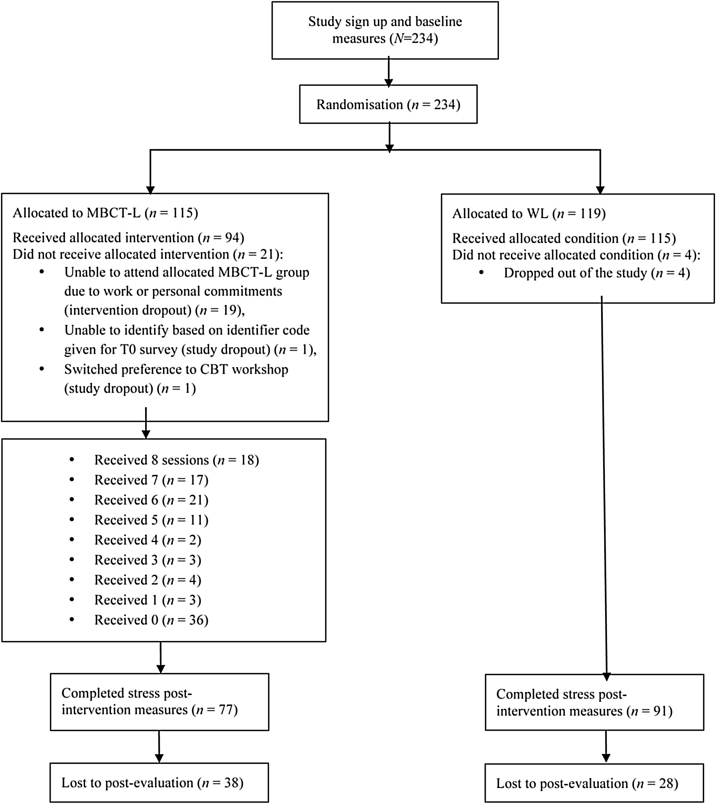
Healthcare workers play a critical role in the health of a nation, yet rates of healthcare worker stress are disproportionately high. We evaluated whether mindfulness-based cognitive therapy for life (MBCT-L), could reduce stress in healthcare workers and target a range of secondary outcomes. Method: This is the first parallel randomised controlled trial of MBCT-L. Participants were NHS workers, who were randomly assigned (1:1) to receive either MBCT-L or wait-list. The primary outcome was self-reported stress at post-intervention. Secondary variables were well-being, depression, anxiety, and work-related outcomes. Mixed regressions were used. Mindfulness and self/other-compassion were explored as potential mechanisms of effects on stress and wellbeing. Results: We assigned 234 participants to MBCT-L (n = 115) or to wait-list (n = 119). 168 (72%) participants completed the primary outcome and of those who started the MBCT-L 73.40% (n = 69) attended the majority of the sessions. MBCT-L ameliorated stress compared with controls (B = 2.60, 95% CI = 1.63‒3.56; d = -0.72; p < .0001). Effects were also found for well-being, depression and anxiety, but not for work-related outcomes. Mindfulness and self-compassion mediated effects on stress and wellbeing. Conclusions: MBCT-L could be an effective and acceptable part of a wider healthcare workers well-being and mental health strategy.
Los trabajadores sanitarios juegan un papel fundamental en la salud de una nación, pero sus tasas de estrés son desproporcionadamente altas. Se evaluó si la terapia cognitiva basada en mindfulness para la vida (MBCT-L) podría reducir el estrés y otras variables secundarias en trabajadores sanitarios. Método: Primer ensayo controlado aleatorizado de MBCT-L. Los participantes fueron asignados aleatoriamente (1:1) a un grupo MBCT-L o a una lista de espera. La variable principal fue estrés percibido (post-intervención), y las variables secundarias bienestar, depresión, ansiedad, y otras relativas al trabajo. Se utilizaron regresiones mixtas. Mindfulness y autocompasión fueron explorados como potenciales mediadores del estrés y bienestar. Resultados: 234 participantes fueron asignados a MBCT-L (n = 115) o grupo control (n = 119) y 168 (72%) participantes completaron la variable principal. Un 74% (n = 69) de quienes empezaron MBCT-L atendieron la mayoría de las sesiones. MBCT-L mejoró el estrés comparado con lista de espera (B = 2,60; 95% CI = 1,63‒3,56; d =-0,57; p < 0,0001). También se encontraron efectos en bienestar, depresión y ansiedad, pero no en variables del trabajo. Mindfulness y autocompasión mediaron efectos sobre estrés y bienestar. Conclusiones: MBCT-L podría ser una pieza eficaz y aceptable dentro de una estrategia más amplia de bienestar y salud mental para trabajadores sanitarios.
Keywords: Experiment; Healthcare workers; MBCT-L; Mindfulness; Stress.
© 2021 Asociación Española de Psicología Conductual. Published by Elsevier España, S.L.U.
References
-
- Crane R.S., Brewer J., Feldman C., Kabat-Zinn J., Santorelli S., Williams J.M.G., Kuyken W. What defines mindfulness-based programs? The warp and the weft. Psychological Medicine. 2017;47:990–999. - PubMed
LinkOut - more resources
Full Text Sources
Other Literature Sources
