


Review
doi: 10.1002/cld.986.
eCollection 2021 Feb.
Wilson's Disease and Iron Overload: Pathophysiology and Therapeutic Implications
Affiliations
- PMID: 33680437
- PMCID: PMC7916432
- DOI: 10.1002/cld.986
Item in Clipboard
Review
Wilson's Disease and Iron Overload: Pathophysiology and Therapeutic Implications
Clin Liver Dis (Hoboken).
.
No abstract available
Figures
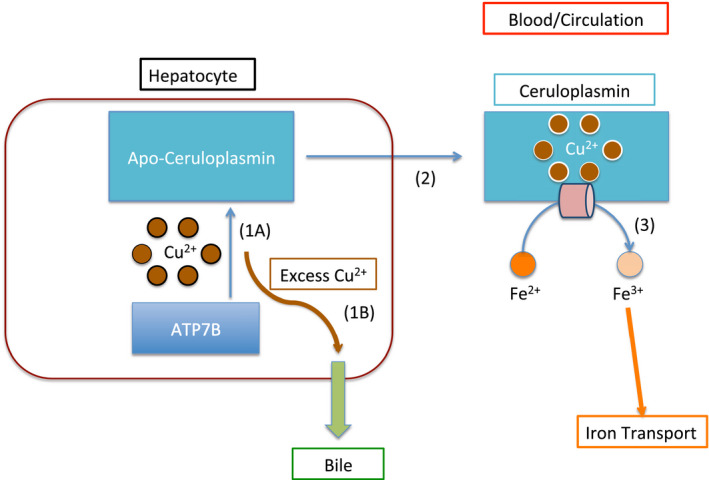
Normal copper and iron transportation. Schematic representation of normal copper transport in the liver. All blue arrows represent normal physiological pathways. (1A) ATP7B loads copper onto Apo‐ceruloplasmin. (2) This transforms it into the copper‐carrying protein Ceruloplasmin. (3) Ceruloplasmin is able to execute its ferroxidation. Ferroxidation is represented by the peach horizontal cylinder. Fe3+ is then able to be transported throughout the body (iron transportation is represented by the orange arrow). (1B) The curved brown arrow represents ATP7B transportation of the excess copper. ATP7B transports excess copper into the bile (thick green arrow) for excretion.
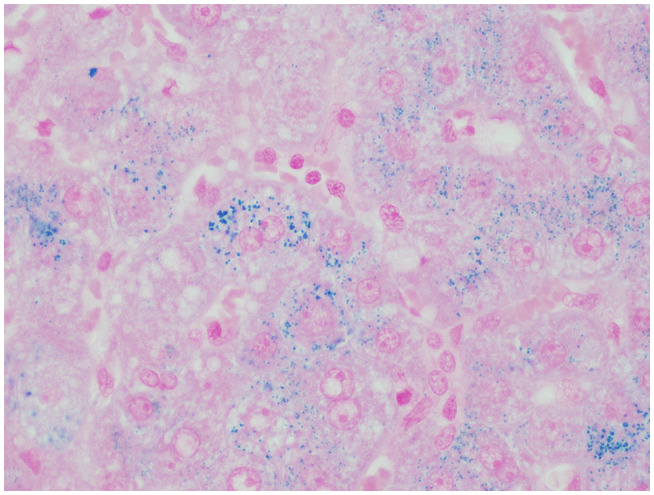
Hepatocellular siderosis in a patient with WD (Prussian blue staining, original magnification ×400).
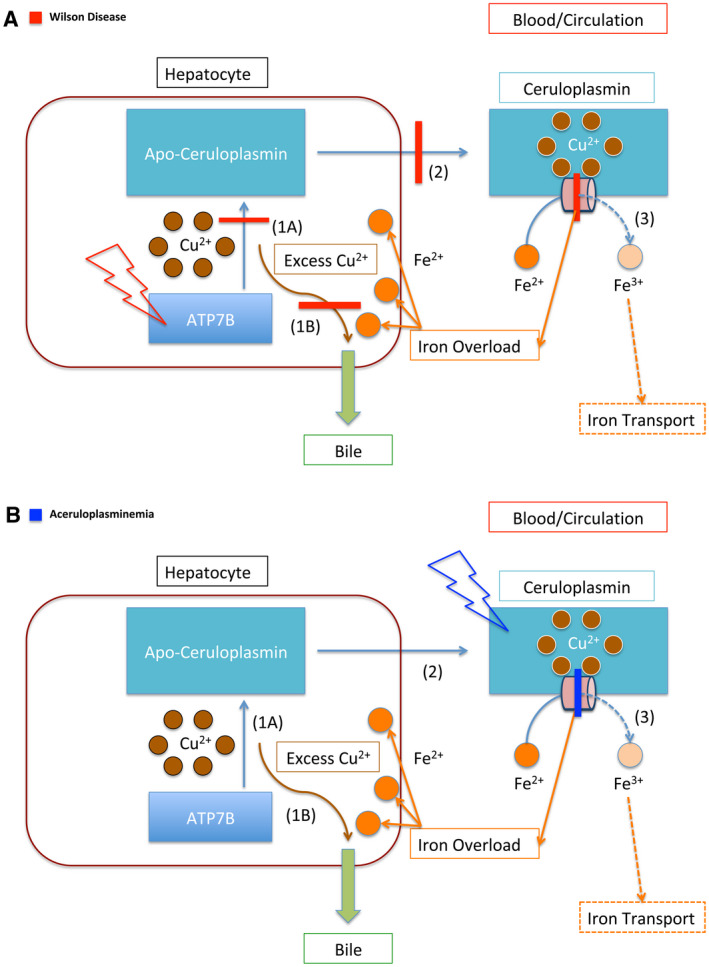
Copper and iron transportation in WD and ACP. (A) Schematic representation of the impaired copper and iron transportation in WD. The red lightning bolt represents mutation. This panel illustrates the mutation of the ATP7B protein, the primary defect in WD. The red bars represent the downstream effects of this protein mutation. In WD, ATP7B is unable to load copper onto Apo‐ceruloplasmin (1A), which prevents copper from being transported throughout the body (2). In addition, ATP7B is unable to facilitate the secretion of copper through the bile, which further causes copper accumulation within the hepatocyte (1B). Furthermore, because Ceruloplasmin lacks copper, it cannot ferroxidize iron (3). The impairment of ferroxidase activity is represented by the red bar across the peach cylinder. The dashed lines represent downstream effects of impaired ferroxidation, leading to iron accumulation in the liver. (B) Schematic representation of the impaired iron transportation in ACP. The blue lightning bolt represents the mutation of the protein Ceruloplasmin. The blue bar represents the impairment of Ceruloplasmin’s ferroxidase activity. As in (A), the dashed lines represent the impaired downstream effects of this, which is the inability of Ceruloplasmin to oxidize iron, which leads to impaired iron transport (3). In contrast with WD (A), the function of the ATP7B protein is not impaired, and it is able to transport copper (1A, 2). It retains the function of facilitating copper excretion through bile (1B). Thus, copper accumulation is not typically associated with ACP, whereas iron accumulation is.
References
-
- Shiono Y, Wakusawa S, Hayashi H, et al. Iron accumulation in the liver of male patients with Wilson's disease. Am J Gastroenterol 2001;96:3147‐3151. - PubMed
-
- Harada M, Miyagawa K, Honma Y, et al. Excess copper chelating therapy for Wilson disease induces anemia and liver dysfunction. Intern Med 2011;50:1461‐1464. - PubMed
-
- Hayashi H, Yano M, Fujita Y, et al. Compound overload of copper and iron in patients with Wilson's disease. Med Mol Morphol 2006;39:121‐126. - PubMed
-
- European Association for Study of Liver . EASL Clinical Practice Guidelines: Wilson's disease. J Hepatol 2012;56:671‐685. - PubMed
Publication types
LinkOut - more resources
Full Text Sources
Other Literature Sources
