


Neurological outcome and quality of life 3 months after COVID-19: A prospective observational cohort study
- PMID: 33682276
- PMCID: PMC8250725
- DOI: 10.1111/ene.14803
Neurological outcome and quality of life 3 months after COVID-19: A prospective observational cohort study
Abstract
Background and purpose: To assess neurological manifestations and health-related quality of life (QoL) 3 months after COVID-19.
Methods: In this prospective, multicenter, observational cohort study we systematically evaluated neurological signs and diseases by detailed neurological examination and a predefined test battery assessing smelling disorders (16-item Sniffin Sticks test), cognitive deficits (Montreal Cognitive Assessment), QoL (36-item Short Form), and mental health (Hospital Anxiety and Depression Scale, Posttraumatic Stress Disorder Checklist-5) 3 months after disease onset.
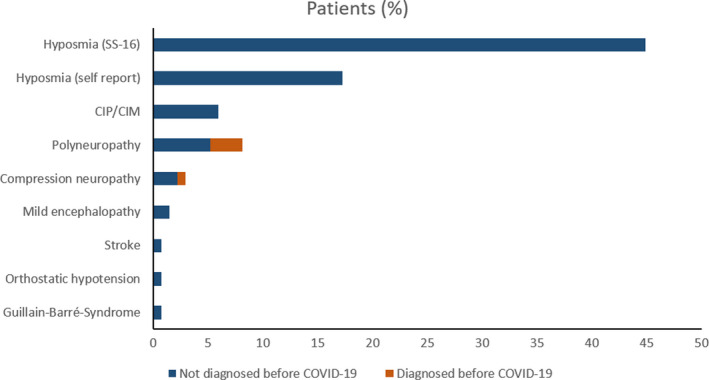
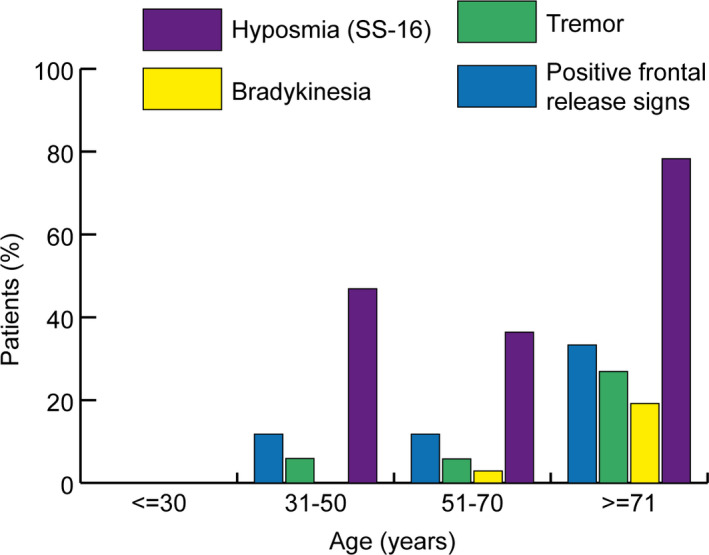
Results: Of 135 consecutive COVID-19 patients, 31 (23%) required intensive care unit (ICU) care (severe), 72 (53%) were admitted to the regular ward (moderate), and 32 (24%) underwent outpatient care (mild) during acute disease. At the 3-month follow-up, 20 patients (15%) presented with one or more neurological syndromes that were not evident before COVID-19. These included polyneuro/myopathy (n = 17, 13%) with one patient presenting with Guillain-Barré syndrome, mild encephalopathy (n = 2, 2%), parkinsonism (n = 1, 1%), orthostatic hypotension (n = 1, 1%), and ischemic stroke (n = 1, 1%). Objective testing revealed hyposmia/anosmia in 57/127 (45%) patients at the 3-month follow-up. Self-reported hyposmia/anosmia was lower (17%) at 3 months, however, improved when compared to the acute disease phase (44%; p < 0.001). At follow-up, cognitive deficits were apparent in 23%, and QoL was impaired in 31%. Assessment of mental health revealed symptoms of depression, anxiety, and posttraumatic stress disorders in 11%, 25%, and 11%, respectively.
Conclusions: Despite recovery from the acute infection, neurological symptoms were prevalent at the 3-month follow-up. Above all, smelling disorders were persistent in a large proportion of patients.
Keywords: COVID-19; SARS-CoV-2; neuro-COVID; neurologic manifestations; quality of life.
© 2021 The Authors. European Journal of Neurology published by John Wiley & Sons Ltd on behalf of European Academy of Neurology.
Conflict of interest statement
K.S. reports grants from the FWF Austrian Science Fund, Michael J. Fox Foundation, and the International Parkinson and Movement Disorder Society; and personal fees from Teva, UCB, Lundbeck, AOP Orphan Pharmaceuticals AG, Abbvie, Roche, and Grünenthal; all outside the submitted work. P.M. reports grants from TWF (Tyrolean Science Fund) and Medtronic, and personal fees from Boston Scientific, all outside the submitted work. The other authors have nothing to disclose. All other authors declare no competing interests.
Figures
References
Publication types
MeSH terms
LinkOut - more resources
Full Text Sources
Other Literature Sources
Medical
Miscellaneous
