Review
. 2021 May 1;320(5):F671-F682.
doi: 10.1152/ajprenal.00007.2021. Epub 2021 Mar 8.

The Indiana O'Brien Center for Advanced Renal Microscopic Analysis

Affiliations
Review

The Indiana O'Brien Center for Advanced Renal Microscopic Analysis

Kenneth W Dunn et al. Am J Physiol Renal Physiol. .

Abstract

The Indiana O'Brien Center for Advanced Microscopic Analysis is a National Institutes of Health (NIH) P30-funded research center dedicated to the development and dissemination of advanced methods of optical microscopy to support renal researchers throughout the world. The Indiana O'Brien Center was founded in 2002 as an NIH P-50 project with the original goal of helping researchers realize the potential of intravital multiphoton microscopy as a tool for understanding renal physiology and pathophysiology. The center has since expanded into the development and implementation of large-scale, high-content tissue cytometry. The advanced imaging capabilities of the center are made available to renal researchers worldwide via collaborations and a unique fellowship program. Center outreach is accomplished through an enrichment core that oversees a seminar series, an informational website, and a biennial workshop featuring hands-on training from members of the Indiana O'Brien Center and imaging experts from around the world.

Keywords: O'Brien Center; fluorescence microscopy; intravital microscopy; kidney.


Conflict of interest statement

No conflicts of interest, financial or otherwise, are declared by the authors.

Figures

None
Graphical abstract
Figure 1.
Figure 1.
Early multiphoton microscopy of the rodent kidney. A: projected image volume collected from the kidney of an inv/inv mouse model of polycystic kidney disease. B: three-color image collected from the kidney of a living rat following intravenous injection of Hoechst 33342 (blue nuclei), 500-kDa fluorescein dextran (green peritubular capillaries), and 10-kDa rhodamine dextran (red endosomes in proximal tubules and bright red concentration in distal lumens). [Image in B was adapted from Dunn et al. (3).] Scale bars = 40 µm in length.
Figure 2.
Figure 2.
Intravital microscopy studies of the Indiana O’Brien Center. A: proximal tubule endocytosis of filtered Alexa 568-albumin in the rat. Multiphoton fluorescence image of the kidney of a living rat after intravenous injection of Hoechst 33342 (blue nuclei) before (A) and 24 min after (B) intravenous injection of Alexa 568-albumin. Alexa 568-albumin can be seen in the glomerular and intertubular capillaries and in endosomes of proximal tubule cells. Scale bar = 30 µm. [Figure adapted from Russo et al. (6).] C and D: oxidative stress in S2 segments of the mouse proximal tubule 2 h after intravenous injection of bacterial endotoxin. Endotoxin (red) binds to S1 segments, but oxidative stress can be observed in downstream S2 segments (green, 2′,7′-dichlorofluorescin diacetate). Scale bar = 40 µm in length. [Figure adapted from Hato et al. (11).] E: colonization of the rat proximal tubule by Escherichia coli following tubular microperfusion. At time 0, green fluorescent protein-expressing bacteria were injected into the lumens of tubules outlined with blue dextran. A fraction of the injected bacteria bound to the tubules, subsequently increasing in number and inducing tubular and endothelial injury. Scale bar = 30 µm in length. [Figure adapted from Melican et al. (32).] G, glomerulus; H2DCFDA, 2′,7′-dichlorodihydrofluorescein diacetate; LPS, lipopolysaccharide; PT, proximal tubule.
Figure 3.
Figure 3.
Image-analysis software developed by the Indiana O’Brien Center. A − F: Image Motion Artifact Reduction Tool (IMART) digital correction of a time series of images of 500-kDa molecular weight red dextran and 3-kDa molecular weight green dextran collected from the kidney of a living rat following intravenous injection. A: single frame. B and C: results of rigid and nonrigid registration depicted as YT and XT images collected along the lines in A. D: the original and registered time series depicted as three-dimensional volumes. IMART registration enabled measurement of microvascular leakage, as shown in E and F, which show measurements of interstitial (open circles) and capillary fluorescence (closed symbols) over time. [Figure adapted from Dunn et al. (39).] G−I: Spatial Temporal Analysis of Fieldwise Flow (STAFF) image-analysis software for continuous measurement of microvascular flow in two-dimensional networks. G: time series of images collected from the liver of a living mouse depicted as a three-dimensional volume. H: velocity map derived from STAFF measurements obtained at one time point. I: time series of continuously measured velocities obtained from sinusoidal segments with high and low/intermittent flow. The field was 663 µm across. [Figure adapted from Clendenon et al. (43).] AU, arbitrary units; PT, proximal tubule; RBC, red blood cell.
Figure 4.
Figure 4.
Volumetric Tool for Exploration and Analysis (VTEA)-based tissue cytometry of the human kidney. A: maximum projection of combined fluorescence images of DAPI (gray), phalloidin (green), and antibodies to Tamm–Horsfall protein (THP; cyan), aquaporin-1 (AQP1; magenta), myeloperoxidase (MPO; red), CD68 (yellow), and CD3 (white). Arrows indicate two regions of immune cell infiltrates. B: corresponding ×4 magnification images of the regions indicated in the two boxes indicated in A. C: scatterplots of the fluorescence intensity of THP vs. AQP1 and MPO vs. CD68, respectively, with gates used to identify specific cell types. Scale bars = 1 mm in A and 250 µm in B. [Figure adapted from Ferkowicz et al. (52).]
Figure 5.
Figure 5.
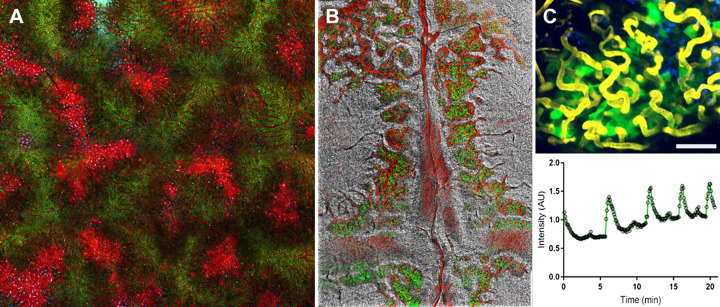
Dissemination of intravital microscopy at the Indiana University. A: intravital microscopy image of the liver of a living mouse following treatment with acetaminophen. The red fluorescence of Texas red-dextran was found in the sinusoidal capillaries and the cytosol of necrotic hepatocytes. The green fluorescence derives from rhodamine 123, which accumulates only in mitochondria of healthy cells. The image is a projection of a mosaic of 16 image volumes. Scale bar = 200 µm. B: mosaic image volume collected from the calvarium of a living green fluorescent protein (GFP)-Lys mouse (provided by Malgorzata Kamocka and Nadia Carlesso). The red fluorescence of Texas red-dextran was found in the capillaries. The green fluorescence derives from GFP expressed in myelomonocytic cells. Scale bar = 1 mm. C: intravital microscopy image collected from the pancreas of a mouse transduced with adeno-associated virus vector serotype 8 expressing the calcium biosensor GCaMP6s (green islet cells) following injection with Texas red-dextran (yellow vasculature) Scale bar = 50 µm. The graph at the bottom shows calcium responses of the islet over time after intraperitoneal injection of glucose. [Image in C adapted from Reissaus et al. (66).] AU, arbitrary units.
Figure 6.
Figure 6.
Schematic diagram of the services and resources of the Indiana O’Brien Center. Research services are mediated through the Fellowship Program, which provides funds to support microscopy of living animals through the Intravital Microscopy Core and large-scale microscopy and tissue cytometry through the three-dimensional (3-D) Tissue Imaging Core. The Biosensor Development and Expression Core validates and provides fluorescent protein biosensors and transgenic animals to support studies conducted by the Intravital Microscopy Core. The Digital Analysis and Development Core develops software solutions to support quantitative analysis of studies conducted by the Intravital and 3-D Tissue Imaging Cores, including the development and support of the DINAVID online image-analysis system. The developments of the Indiana O’Brien Center are disseminated through the O’Brien Enrichment program, which also organizes and presents a biennial workshop on cutting-edge techniques in microscopy.

References

    1. Phillips CL, Arend LJ, Filson AJ, Kojetin DJ, Clendenon JL, Fang S, Dunn KW. Three-dimensional imaging of embryonic mouse kidney by two-photon microscopy. Am J Pathol 158: 49–55, 2001. doi:10.1016/S0002-9440(10)63943-0. - DOI - PMC - PubMed
    1. Phillips CL, Miller KJ, Filson AJ, Nurnberger J, Clendenon JL, Cook GW, Dunn KW, Overbeek PA, Gattone VH 2nd, Bacallao RL. Renal cysts of inv/inv mice resemble early infantile nephronophthisis. J Am Soc Nephrol 15: 1744–1755, 2004. doi:10.1097/01.asn.0000131520.07008.b3. - DOI - PubMed
    1. Dunn KW, Sandoval RM, Kelly KJ, Dagher PC, Tanner GA, Atkinson SJ, Bacallao RL, Molitoris BA. Functional studies of the kidney of living animals using multicolor two-photon microscopy. Am J Physiol Cell Physiol 283: C905–C916, 2002. doi:10.1152/ajpcell.00159.2002. - DOI - PubMed
    1. Staruschenko A, Brooks HL. O'Brien kidney research centers. Am J Physiol Renal Physiol 319: F1042, 2020. doi:10.1152/ajprenal.00580.2020. - DOI - PubMed
    1. Endres BT, Sandoval RM, Rhodes GJ, Campos-Bilderback SB, Kamocka MM, McDermott-Roe C, Staruschenko A, Molitoris BA, Geurts AM, Palygin O. Intravital imaging of the kidney in a rat model of salt-sensitive hypertension. Am J Physiol Renal Physiol 313: F163–F173, 2017. doi:10.1152/ajprenal.00466.2016. - DOI - PMC - PubMed

Publication types