


The role of C-reactive protein as a prognostic marker in COVID-19
- PMID: 33683344
- PMCID: PMC7989395
- DOI: 10.1093/ije/dyab012
The role of C-reactive protein as a prognostic marker in COVID-19
Abstract
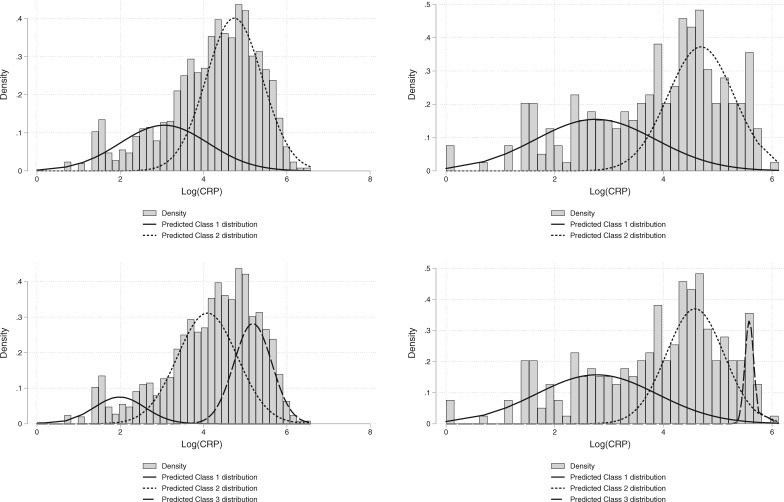
Background: C-reactive protein (CRP) is a non-specific acute phase reactant elevated in infection or inflammation. Higher levels indicate more severe infection and have been used as an indicator of COVID-19 disease severity. However, the evidence for CRP as a prognostic marker is yet to be determined. The aim of this study is to examine the CRP response in patients hospitalized with COVID-19 and to determine the utility of CRP on admission for predicting inpatient mortality.
Methods: Data were collected between 27 February and 10 June 2020, incorporating two cohorts: the COPE (COVID-19 in Older People) study of 1564 adult patients with a diagnosis of COVID-19 admitted to 11 hospital sites (test cohort) and a later validation cohort of 271 patients. Admission CRP was investigated, and finite mixture models were fit to assess the likely underlying distribution. Further, different prognostic thresholds of CRP were analysed in a time-to-mortality Cox regression to determine a cut-off. Bootstrapping was used to compare model performance [Harrell's C statistic and Akaike information criterion (AIC)].
Results: The test and validation cohort distribution of CRP was not affected by age, and mixture models indicated a bimodal distribution. A threshold cut-off of CRP ≥40 mg/L performed well to predict mortality (and performed similarly to treating CRP as a linear variable).
Conclusions: The distributional characteristics of CRP indicated an optimal cut-off of ≥40 mg/L was associated with mortality. This threshold may assist clinicians in using CRP as an early trigger for enhanced observation, treatment decisions and advanced care planning.
Keywords: COVID-19; CRP; bimodal; mixture model; mortality; prognostic marker; trimodal.
© The Author(s) 2021; all rights reserved. Published by Oxford University Press on behalf of the International Epidemiological Association.
Figures
References
-
- Haran JP, Beaudoin FL, Suner S, Lu S.. C-reactive protein as predictor of bacterial infection among patients with an influenza-like illness. Am J Emerg Med 2013;31:137–44. - PubMed
Publication types
MeSH terms
Substances
LinkOut - more resources
Full Text Sources
Other Literature Sources
Medical
Research Materials
Miscellaneous
