


Diagnostic Performance of the 4-Item Geriatric Depression Scale for Depression Screening in Older Patients with Cancer: The ELCAPA Cohort Study
- PMID: 33683759
- PMCID: PMC8176988
- DOI: 10.1002/onco.13746
Diagnostic Performance of the 4-Item Geriatric Depression Scale for Depression Screening in Older Patients with Cancer: The ELCAPA Cohort Study
Abstract
Background: In older patients with cancer, depression is difficult to assess because of its heterogeneous clinical expression. The 4-item version of the Geriatric Depression Scale (GDS-4) is quick and easy to administer but has not been validated in this population. The present study was designed to test the diagnostic performance of the GDS-4 in a French cohort of older patients with cancer before treatment.
Materials and methods: Our cross-sectional analysis of data from the Elderly Cancer Patient cohort covered all patients with cancer aged ≥70 years and referred for geriatric assessment at two centers in France between 2007 and 2018. The GDS-4's psychometric properties were evaluated against three different measures of depression: the geriatrician's clinical diagnosis (based on a semistructured interview), the 4th edition of the Diagnostic and Statistical Manual of Mental Disorders, and a cluster analysis. The scale's sensitivity, specificity, positive and negative likelihood ratios, and area under the receiver operating characteristic curve (AUROC) were calculated.
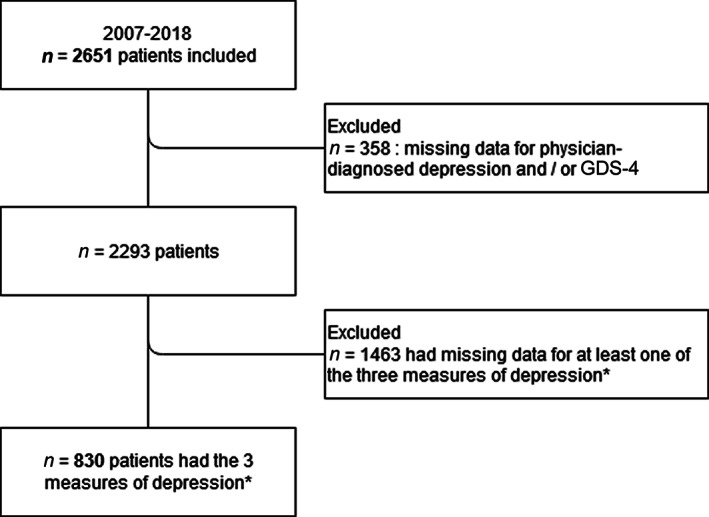
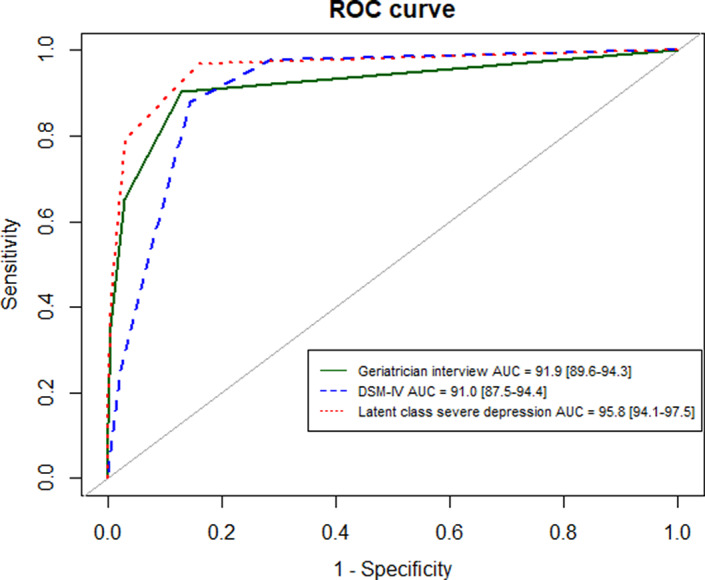
Results: In a sample of 2,293 patients (median age, 81 years; women, 46%), the GDS-4's sensitivity and specificity for detecting physician-diagnosed depression were, respectively, 90% and 89%. The positive and negative likelihood ratios were 8.2 and 0.11, and the AUROC was 92%. When considering the subset of patients with data on all measures of depression, the sensitivity and specificity values were, respectively, ≥90% and ≥72%, the positive and negative likelihood ratios were, respectively, ≥3.4 and ≤ 0.11, and the AUROC was ≥91%.
Conclusion: The GDS-4 appears to be a clinically relevant, easy-to-use tool for routine depression screening in older patients with cancer.
Implications for practice: Considering the overlap between symptoms of cancer and symptoms of depression, depression is particularly difficult to assess in older geriatric oncology and is associated with poor outcomes; there is a need for a routine psychological screening. Self-report instruments like the 4-item version of the Geriatric Depression Scale appears to be a clinically relevant, easy-to-use tool for routine depression screening in older patients with cancer. Asking four questions might enable physicians to screen older patients with cancer for depression and then guide them toward further clinical evaluation and appropriate care if required.
Keywords: Aged; Depression; Diagnosis; Neoplasms; Psychiatric status rating scales.
© 2021 AlphaMed Press.
Conflict of interest statement
Figures
References
-
- Cancer today . Global Cancer Observatory. Available at http://gco.iarc.fr/today/home. Accessed June 23, 2019.
-
- Arrieta O, P Angulo L, Núñez‐Valencia C et al. Association of depression and anxiety on quality of life, treatment adherence, and prognosis in patients with advanced non‐small cell lung cancer. Ann Surg Oncol 2012;20:1941–1948. - PubMed
-
- Balentine CJ, Hermosillo‐Rodriguez J, Robinson CN et al. Depression is associated with prolonged and complicated recovery following colorectal surgery. J Gastrointest Surg 2011;15:1712–1717. - PubMed
-
- Mols F, Husson O, Roukema JA et al. Depressive symptoms are a risk factor for all‐cause mortality: Results from a prospective population‐based study among 3,080 cancer survivors from the PROFILES registry. J Cancer Surviv 2013;7:484–492. - PubMed
Publication types
MeSH terms
LinkOut - more resources
Full Text Sources
Other Literature Sources
Medical
