


Associations of working from home with occupational physical activity and sedentary behavior under the COVID-19 pandemic
- PMID: 33683779
- PMCID: PMC7938758
- DOI: 10.1002/1348-9585.12212
Associations of working from home with occupational physical activity and sedentary behavior under the COVID-19 pandemic
Abstract
Objectives: To compare physical activity (PA) and sedentary behavior (SB) levels during work time between those who work from home (WFH) and at workplaces (no WFH), and by WFH subgroups.
Methods: This cross-sectional internet-based survey included 1239 workers (mean age [standard deviation], 44.7 [13.7] years; 59.2% men) living in the Tokyo Metropolitan Area. Time spent sitting (SB), standing (light-intensity PA; LPA), walking, and engaging in heavy labor (moderate-to-vigorous PA; MVPA) during work time was measured using the Work-related Physical Activity Questionnaire. Workers reported weekly WFH percentages (eg, 0% implies no WFH and 100% implies full WFH), and WFH percentages were categorized into no WFH (0% WFH) and WFH (1%-100% WFH) groups. The WFH group was further subcategorized into 1%-25%, 26%-50%, 51%-75%, and 76%-100% subgroups.
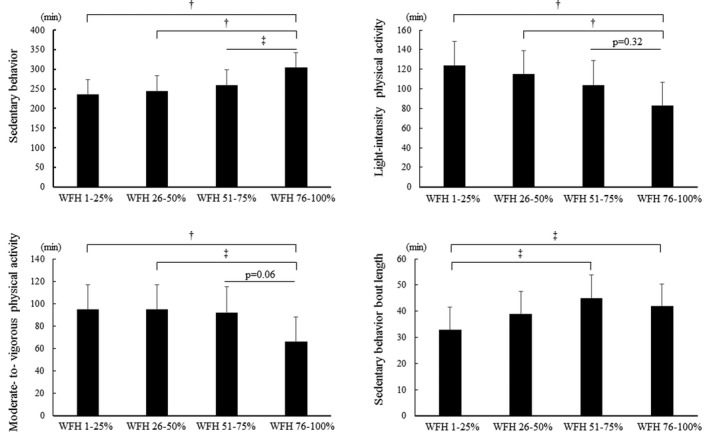
Results: Overall, 494 workers (39.9%) worked from home. During working hours, SB time was longer in the WFH group than in the no WFH group (mean minutes [% working-time SB]: 335.7 vs 224.7 min [74% vs 50%]). Significantly shorter LPA and MVPA times (%) were reported in the WFH group than in the no WFH group (LPA, 59.6 vs 122.9 min [14% vs 29%]; MVPA, 55.3 vs 91.9 min [13% vs 22%], all P < .001). Among the WFH subgroups, longer SB time and shorter LPA and MVPA times were observed in the highest WFH group (WFH 76%-100%) than in the WFH 1%-25% and 26%-50% subgroups.
Conclusions: Workers who telecommuted were less physically active and had longer sedentary during work time than those who worked at the workplaces.
Keywords: COVID-19; physical activity; sedentary behavior; telework.
© 2021 The Authors. Journal of Occupational Health published by John Wiley & Sons Australia, Ltd on behalf of The Japan Society for Occupational Health.
Conflict of interest statement
Figures
References
-
- World Health Organization . Coronavirus disease (COVID‐19) pandemic, situation reports. 2020. https://www.who.int/emergencies/diseases/novel‐coronavirus‐2019/situatio.... Accessed February 9, 2021.
-
- Japanese Ministry of Internal Affairs and Communications . Information and communications policy. 2020. https://www.soumu.go.jp/main_sosiki/joho_tsusin/eng/index.html. Accessed February 9, 2021
-
- Japanese Ministry of Internal Affairs and Communications . The 2020 White Paper on Information and Communications in Japan. 2020. https://www.soumu.go.jp/johotsusintokei/whitepaper/eng/WP2020/2020‐index.... Accessed February 9, 2021
Publication types
MeSH terms
Grants and funding
LinkOut - more resources
Full Text Sources
Other Literature Sources
Medical
Miscellaneous
