


Health, Psychosocial, and Social Issues Emanating From the COVID-19 Pandemic Based on Social Media Comments: Text Mining and Thematic Analysis Approach
- PMID: 33684052
- PMCID: PMC8025920
- DOI: 10.2196/22734
Health, Psychosocial, and Social Issues Emanating From the COVID-19 Pandemic Based on Social Media Comments: Text Mining and Thematic Analysis Approach
Abstract
Background: The COVID-19 pandemic has caused a global health crisis that affects many aspects of human lives. In the absence of vaccines and antivirals, several behavioral change and policy initiatives such as physical distancing have been implemented to control the spread of COVID-19. Social media data can reveal public perceptions toward how governments and health agencies worldwide are handling the pandemic, and the impact of the disease on people regardless of their geographic locations in line with various factors that hinder or facilitate the efforts to control the spread of the pandemic globally.
Objective: This paper aims to investigate the impact of the COVID-19 pandemic on people worldwide using social media data.
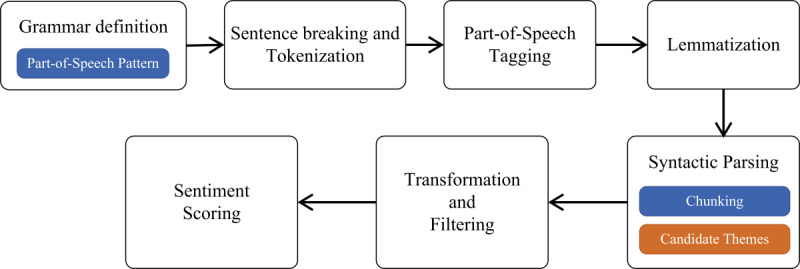
Methods: We applied natural language processing (NLP) and thematic analysis to understand public opinions, experiences, and issues with respect to the COVID-19 pandemic using social media data. First, we collected over 47 million COVID-19-related comments from Twitter, Facebook, YouTube, and three online discussion forums. Second, we performed data preprocessing, which involved applying NLP techniques to clean and prepare the data for automated key phrase extraction. Third, we applied the NLP approach to extract meaningful key phrases from over 1 million randomly selected comments and computed sentiment score for each key phrase and assigned sentiment polarity (ie, positive, negative, or neutral) based on the score using a lexicon-based technique. Fourth, we grouped related negative and positive key phrases into categories or broad themes.
Results: A total of 34 negative themes emerged, out of which 15 were health-related issues, psychosocial issues, and social issues related to the COVID-19 pandemic from the public perspective. Some of the health-related issues were increased mortality, health concerns, struggling health systems, and fitness issues; while some of the psychosocial issues were frustrations due to life disruptions, panic shopping, and expression of fear. Social issues were harassment, domestic violence, and wrong societal attitude. In addition, 20 positive themes emerged from our results. Some of the positive themes were public awareness, encouragement, gratitude, cleaner environment, online learning, charity, spiritual support, and innovative research.
Conclusions: We uncovered various negative and positive themes representing public perceptions toward the COVID-19 pandemic and recommended interventions that can help address the health, psychosocial, and social issues based on the positive themes and other research evidence. These interventions will help governments, health professionals and agencies, institutions, and individuals in their efforts to curb the spread of COVID-19 and minimize its impact, and in reacting to any future pandemics.
Keywords: COVID-19; coronavirus; health issues; infodemiology; infoveillance; interventions; natural language processing; psychosocial issues; social issues; social media; text mining; thematic analysis.
©Oladapo Oyebode, Chinenye Ndulue, Ashfaq Adib, Dinesh Mulchandani, Banuchitra Suruliraj, Fidelia Anulika Orji, Christine T Chambers, Sandra Meier, Rita Orji. Originally published in JMIR Medical Informatics (http://medinform.jmir.org), 06.04.2021.
Conflict of interest statement
Conflicts of Interest: None declared.
Figures

References
-
- Morse SS. Factors in the emergence of infectious diseases. In: Price-Smith AT, editor. Plagues and Politics: Infectious Disease and International Policy. London: Palgrave Macmillan; 2001. pp. 8–26.
-
- Kimberlin DW. Red Book: 2018-2021 Report of the Committee on Infectious Diseases. Elk Grove Village, IL: American Academy of Pediatrics; 2018. p. 152.
-
- Morens DM, Folkers GK, Fauci AS. The challenge of emerging and re-emerging infectious diseases. Nature. 2004 Jul 08;430(6996):242–9. doi: 10.1038/nature02759. http://europepmc.org/abstract/MED/15241422 - DOI - PMC - PubMed
-
- Jilani TN, Jamil RT, Siddiqui AH. StatPearls. Treasure Island, FL: StatPearls Publishing; 2018. H1N1 influenza.
-
- Dawood FS, Iuliano AD, Reed C, Meltzer MI, Shay DK, Cheng P, Bandaranayake D, Breiman RF, Brooks WA, Buchy P, Feikin DR, Fowler KB, Gordon A, Hien NT, Horby P, Huang QS, Katz MA, Krishnan A, Lal R, Montgomery JM, Mølbak K, Pebody R, Presanis AM, Razuri H, Steens A, Tinoco YO, Wallinga J, Yu H, Vong S, Bresee J, Widdowson M. Estimated global mortality associated with the first 12 months of 2009 pandemic influenza A H1N1 virus circulation: a modelling study. Lancet Infect Dis. 2012 Sep;12(9):687–95. doi: 10.1016/S1473-3099(12)70121-4. - DOI - PubMed
LinkOut - more resources
Full Text Sources
