


Global epidemiology and socio-economic development correlates of the reproductive ratio of COVID-19
- PMID: 33684196
- PMCID: PMC7989226
- DOI: 10.1093/inthealth/ihab006
Global epidemiology and socio-economic development correlates of the reproductive ratio of COVID-19
Abstract
Background: The most commonly cited argument for imposing or lifting various restrictions in the context of the coronavirus disease 2019 (COVID-19) pandemic is an assumed impact on the reproductive ratio of the pathogen. It has furthermore been suggested that less-developed countries are particularly affected by this pandemic. Empirical evidence for this is lacking.
Methods: Based on a dataset covering 170 countries, patterns of empirical 7-d reproductive ratios during the first months of the COVID-19 pandemic were analysed. Time trends and associations with socio-economic development indicators, such as gross domestic product per capita, physicians per population, extreme poverty prevalence and maternal mortality ratio, were analysed in mixed linear regression models using log-transformed reproductive ratios as the dependent variable.
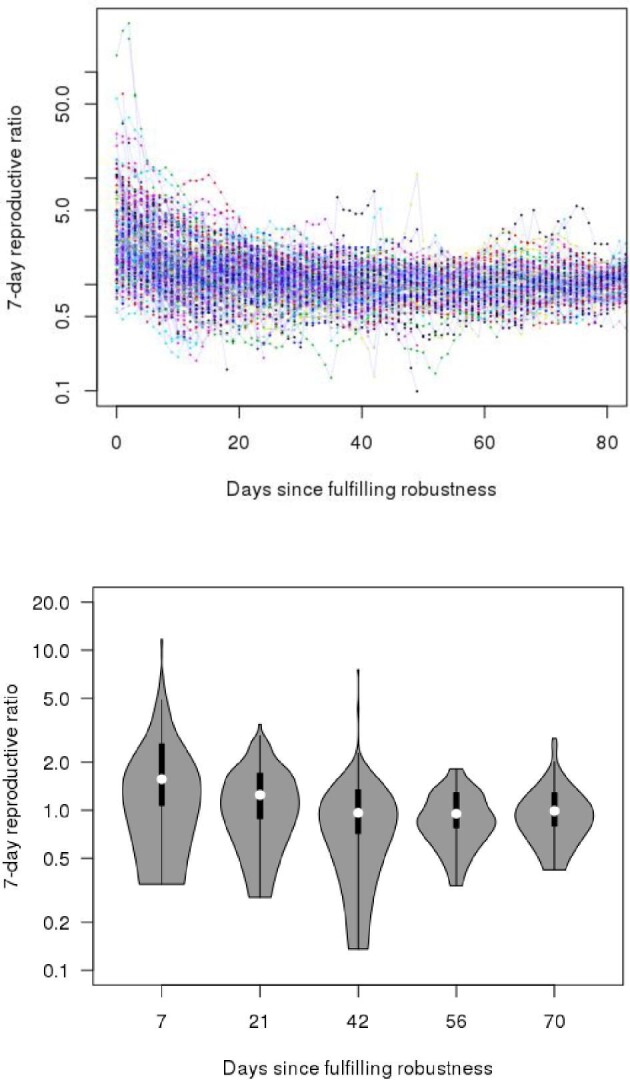
Results: Reproductive ratios during the early phase of a pandemic exhibited high fluctuations and overall strong declines. Stable estimates were observed only several weeks into the pandemic, with a median reproductive ratio of 0.96 (interquartile range 0.72-1.34) 6 weeks into the analysis period. Unfavourable socio-economic indicators showed consistent associations with higher reproductive ratios, which were elevated by a factor of 1.29 (95% confidence interval 1.15 to 1.46), for example, in the countries in the highest compared with the lowest tertile of extreme poverty prevalence.
Conclusions: The COVID-19 pandemic has allowed for the first time description of the global patterns of reproductive ratios of a novel pathogen during pandemic spread. The present study reports the first quantitative empirical evidence that COVID-19 net transmissibility remains less controlled in socio-economically disadvantaged countries, even months into the pandemic. This needs to be addressed by the global scientific community as well as international politics.
Keywords: SARS-CoV-2; ecological study; health disparities.
© The Author(s) 2021. Published by Oxford University Press on behalf of Royal Society of Tropical Medicine and Hygiene.
Figures
References
-
- Anderson RM, May RM. Infectious diseases of humans: dynamics and control. New York: Oxford University Press; 1991.
-
- Hsiang S, Allen D, Annan-Phan Set al. The effect of large-scale anti-contagion policies on the COVID-19 pandemic. Nature. 2020;584(7820):262–7. - PubMed
-
- Flaxman S, Mishra S, Gandy Aet al. Estimating the effects of non-pharmaceutical interventions on COVID-19 in Europe. Nature. 2020;584(7820):257–61. - PubMed
-
- an der Heiden M, Hamouda O. Schätzung der aktuellen Entwicklung der SARS-CoV-2-Epidemie in Deutschland – Nowcasting. Epid Bull. 2020;17:10–6.
MeSH terms
LinkOut - more resources
Full Text Sources
Other Literature Sources
Medical
Miscellaneous
