Genetic Diversity of Hard Ticks (Acari: Ixodidae) in the South and East Regions of Kazakhstan and Northwestern China
- PMID: 33684994
- PMCID: PMC7939963
- DOI: 10.3347/kjp.2021.59.1.103
Genetic Diversity of Hard Ticks (Acari: Ixodidae) in the South and East Regions of Kazakhstan and Northwestern China
Abstract
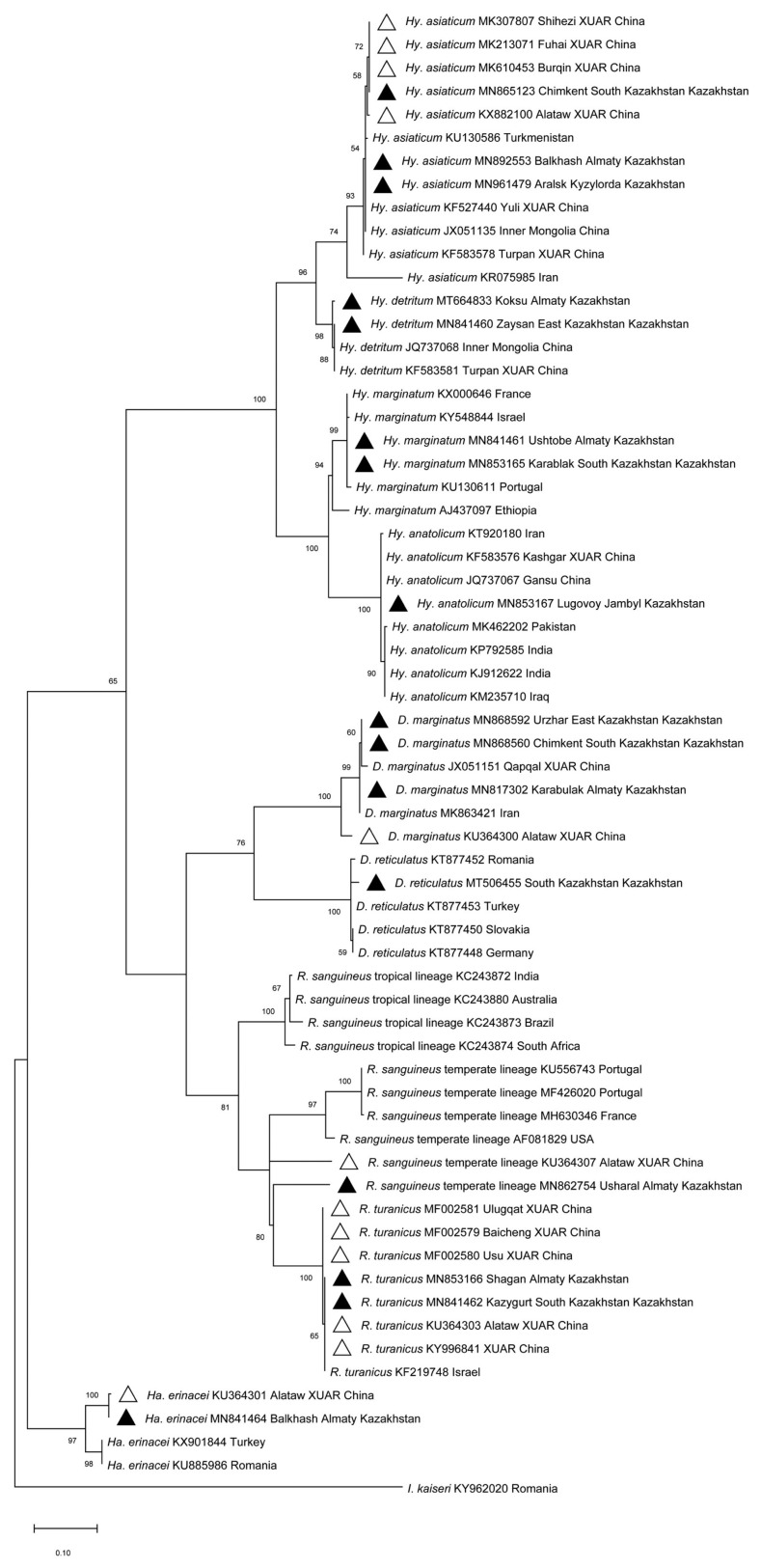
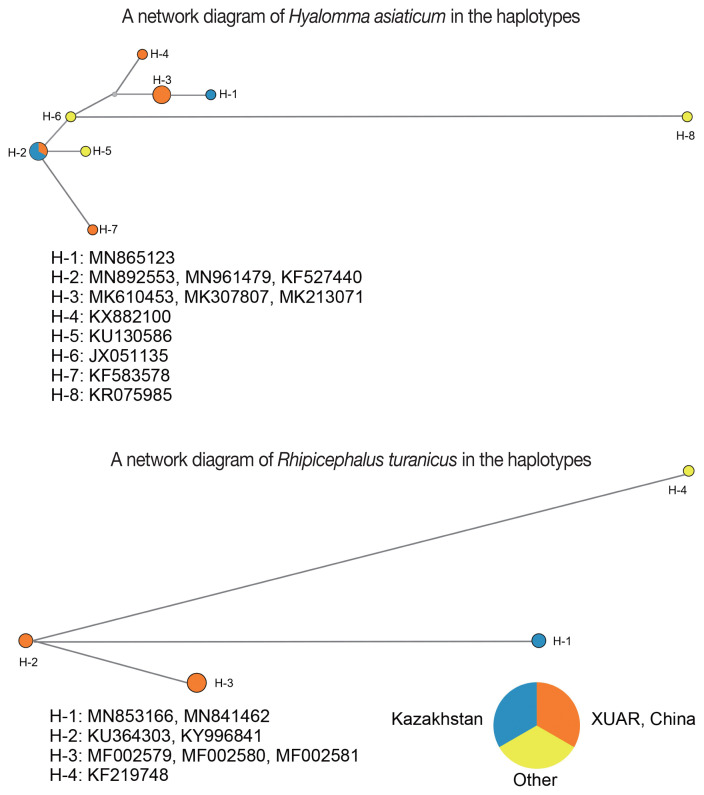
To date, there is no report on the genetic diversity of ticks in these regions. A total of 370 representative ticks from the south and east regions of Kazakhstan (SERK) and Xinjiang Uygur Autonomous Region (XUAR) were selected for molecular comparison. A fragment of the mitochondrial cytochrome c oxidase subunit I (cox1) gene, ranging from 631 bp to 889 bp, was used to analyze genetic diversity among these ticks. Phylogenetic analyses indicated 7 tick species including Hyalomma asiaticum, Hyalomma detritum, Hyalomma anatolicum, Dermacentor marginatus, Rhipicephalus sanguineus, Rhipicephalus turanicus and Haemaphysalis erinacei from the SERK clustered together with conspecific ticks from the XUAR. The network diagram of haplotypes showed that i) Hy. asiaticum from Almaty and Kyzylorda Oblasts together with that from Yuli County of XUAR constituted haplogroup H-2, and the lineage from Chimkent City of South Kazakhstan was newly evolved; and ii) the R. turanicus ticks sampled in Israel, Almaty, South Kazakhstan, Usu City, Ulugqat and Baicheng Counties of XUAR were derivated from an old lineage in Alataw City of XUAR. These findings indicate that: i) Hy. asiaticum, R. turanicus and Ha. erinacei shared genetic similarities between the SERK and XUAR; and ii) Hy. marginatum and D. reticulatus show differences in their evolution.
Keywords: Genetic diversity; Kazakhstan; hard tick; northwestern China.
Conflict of interest statement
The authors declare that they have no conflict of interest.
Figures
References
-
- Cherednichenko A. Estimating agricultural adaptation to climate change through cloud activation for northern Kazakhstan. In: Qi J, Evered KT, editors. Environmental Problems of Central Asia and Their Economic, Social and Security Impacts. Tashkent, Uzbekistan: Springer; 2008. pp. 183–190. - DOI
-
- Yamanaka H, Murata K, Tabata R, Kawaguchi F, Sasazaki S, Yamamoto Y, Bakhtin M, Kazymbet P, Meldevekob A, Suleimenov MZ, Nishibori M, Mannen H. Kazakhstani Native Cattle Reveal Highly Divergent mtDNA From Bos Taurus and Bos Indicus Lineages With an Absence of Bos Indicus Y Chromosome. Anim Sci J. 2019;90:29–34. doi: 10.1111/asj.13128. - DOI - PubMed
-
- Bismil’din FB, Shapieva ZZ, Anpilova EN. Current malaria situation in the Republic of Kazakhstan. Med Parazitol (Mosk) 2001;181:24–33. (in Russian). - PubMed
-
- Zhou M, Cao S, Sevinc F, Sevinc M, Ceylan O, Moumouni PF, Jirapattharasate C, Liu M, Wang G, Iguchi A, Vudriko P, Suzuki H, Xuan X. Molecular detection and genetic identification of Babesia bigemina, Theileria annulata, Theileria orientalis and Anaplasma marginale in Turkey. Ticks Tick Borne Dis. 2016;7:126–134. doi: 10.1016/j.ttbdis.2015.09.008. - DOI - PubMed
-
- Mihailovich SS, Isaevna MG. Land border delimitation of Republic of Kazakhstan: practical knowledge of border policy formation. Eur Sci Rev. 2018;2018:202–204. doi: 10.29013/ESR-18-7.8-202-204. - DOI
MeSH terms
Substances
Grants and funding
- 2018ZX10101002-007/National Key Research & Development Program of China
- 2018ZX10101002-003/National Key Research & Development Program of China
- 81960379/National Natural Science Foundation of China
- 31960709/National Natural Science Foundation of China
- 18YJCZH220/Humanities and Social Sciences Research Projects
LinkOut - more resources
Full Text Sources
Other Literature Sources