


The Impact of Health Disparities on COVID-19 Outcomes: Early Findings from a High-Income Country and Two Middle-Income Countries
- PMID: 33686624
- PMCID: PMC7938881
- DOI: 10.1007/s40615-021-00999-5
The Impact of Health Disparities on COVID-19 Outcomes: Early Findings from a High-Income Country and Two Middle-Income Countries
Abstract
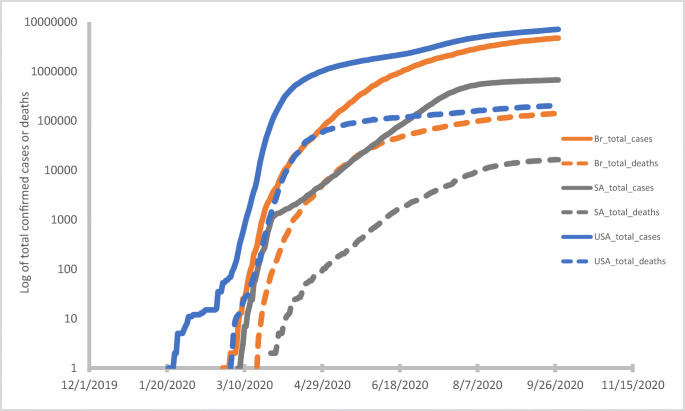
The SARS-CoV-2 infection, which causes the coronavirus disease (COVID-19), has affected lives, with very adverse outcomes in specific populations in the United States of America (USA), a high-income country, and two middle-income countries, Brazil and South Africa. This paper aims to discuss the relationship of race/ethnicity with COVID-19-associated factors in the three countries. The information is based on data collected from infectious disease/epidemiological centers in the USA, Brazil, and South Africa. Adverse COVID-19 outcomes have been associated with the burden of exposure and disease, linked to socioeconomic determinants, among specific ethnicities in all three countries. The prevalence of comorbidities before and the likelihood of work-related exposure in the context of COVID-19 infection puts ethnic minorities in the USA and some ethnic majorities and minorities in Brazil and South Africa at greater risk. We envisage that this work will contribute to ongoing discussions related to addressing socioeconomic determinants of health, and the need for stakeholders in various sectors to work on addressing observed health disparities for overall improvement in health and healthcare given the current pandemic.
Keywords: Brazil; COVID-19; Comorbidities; Racial/ethnic disparity; South Africa; United States of America.
© 2021. W. Montague Cobb-NMA Health Institute.
Conflict of interest statement
The authors declare that they have no conflicts of interest.
Figures
References
-
- World Health Organization (WHO). Coronavirus Disease (COVID-19). Available from: https://www.who.int/docs/default-source/coronaviruse/situation-reports/2.... Accessed 25 Sept 2020.
-
- Bucciferro RJ. Running in Place: Black-White Inequality in the United States and Brazil. 2017 (November):1–37. Available from: https://cbe.wwu.edu/files/Economics/Black White Ineq US Brazil-Bucciferr.... Accessed 21 May 2020.
-
- Assouad L, Chancel L, Morgan M. Extreme Inequality: Evidence from Brazil, India, the Middle East and South Africa. Working Paper N° 2018 (September). Available from: https://wid.world/document/extreme-inequality-evidence-brazil-india-midd.... Accessed 31 May 2020.
-
- Hamilton C, Huntley L, Alexander N, Guimarães ASA, James W. Beyond racism: race and inequality in Brazil, South Africa, and the United States. Contemp Sociol. 2004;33(2):162–163. doi: 10.1177/009430610403300209. - DOI
MeSH terms
LinkOut - more resources
Full Text Sources
Other Literature Sources
Medical
Miscellaneous