


Relative and Absolute Risk to Guide the Management of Pulse Pressure, an Age-Related Cardiovascular Risk Factor
- PMID: 33687055
- PMCID: PMC8457427
- DOI: 10.1093/ajh/hpab048
Relative and Absolute Risk to Guide the Management of Pulse Pressure, an Age-Related Cardiovascular Risk Factor
Abstract
Background: Pulse pressure (PP) reflects the age-related stiffening of the central arteries, but no study addressed the management of the PP-related risk over the human lifespan.
Methods: In 4,663 young (18-49 years) and 7,185 older adults (≥50 years), brachial PP was recorded over 24 hours. Total mortality and all major cardiovascular events (MACEs) combined were coprimary endpoints. Cardiovascular death, coronary events, and stroke were secondary endpoints.
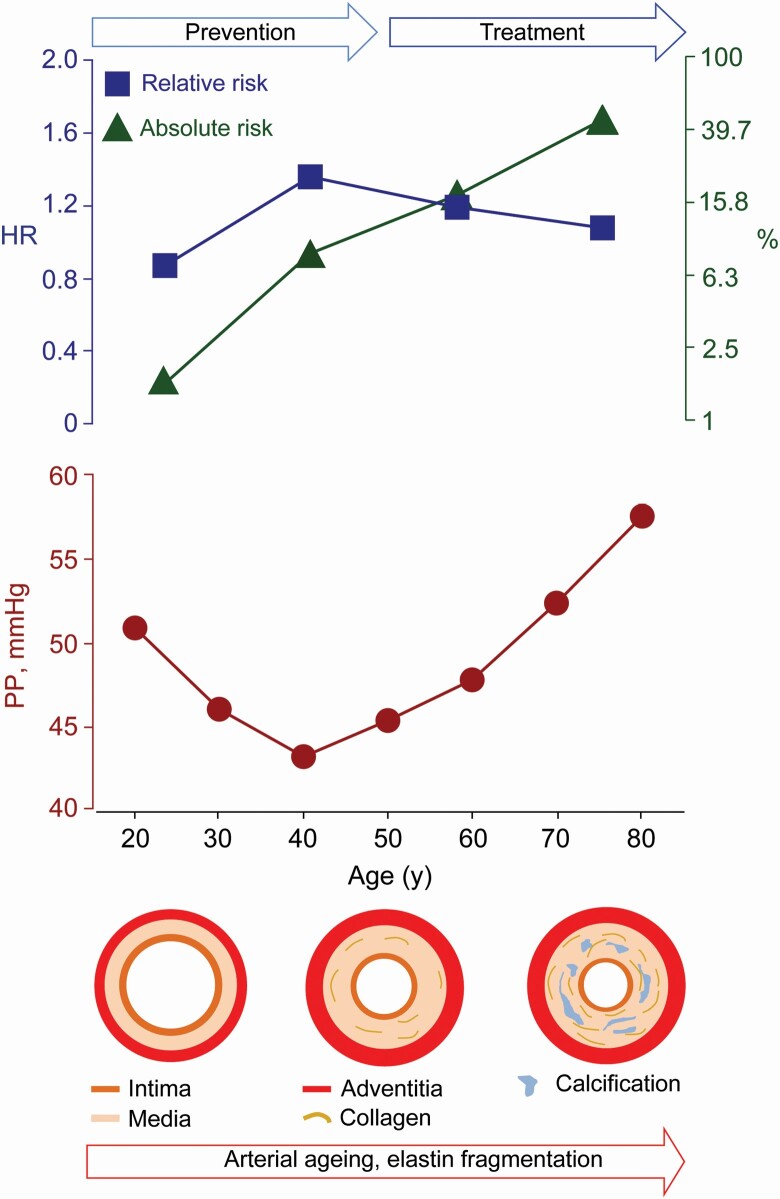
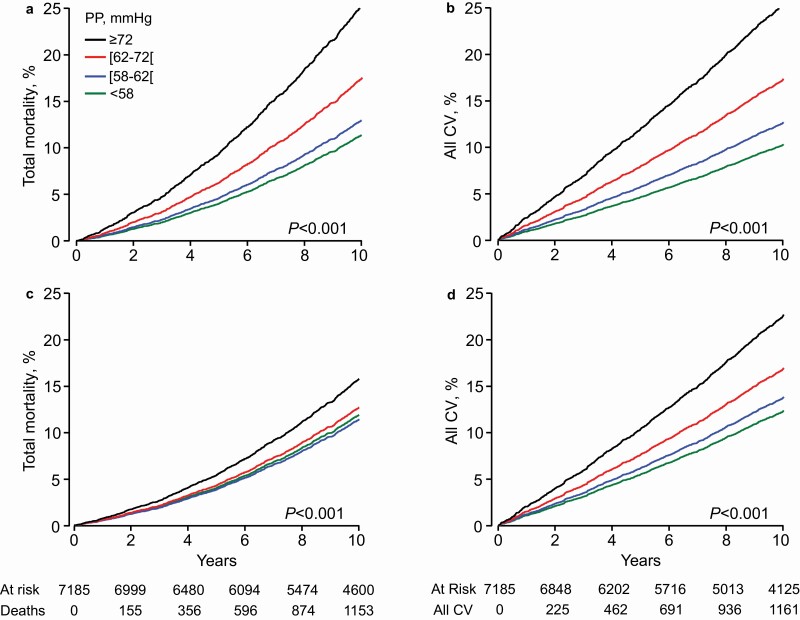
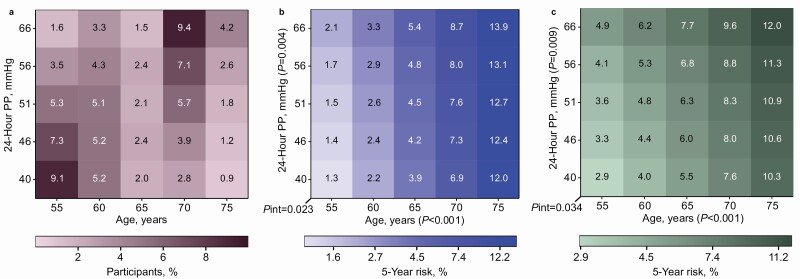
Results: In young adults (median follow-up, 14.1 years; mean PP, 45.1 mm Hg), greater PP was not associated with absolute risk; the endpoint rates were ≤2.01 per 1,000 person-years. The adjusted hazard ratios expressed per 10-mm Hg PP increments were less than unity (P ≤ 0.027) for MACE (0.67; 95% confidence interval [CI], 0.47-0.96) and cardiovascular death (0.33; 95% CI, 0.11-0.75). In older adults (median follow-up, 13.1 years; mean PP, 52.7 mm Hg), the endpoint rates, expressing absolute risk, ranged from 22.5 to 45.4 per 1,000 person-years and the adjusted hazard ratios, reflecting relative risk, from 1.09 to 1.54 (P < 0.0001). The PP-related relative risks of death, MACE, and stroke decreased >3-fold from age 55 to 75 years, whereas absolute risk rose by a factor 3.
Conclusions: From 50 years onwards, the PP-related relative risk decreases, whereas absolute risk increases. From a lifecourse perspective, young adulthood provides a window of opportunity to manage risk factors and prevent target organ damage as forerunner of premature death and MACE. In older adults, treatment should address absolute risk, thereby extending life in years and quality.
Keywords: arterial stiffness; blood pressure; cardiovascular disease; hypertension; mortality; population science; pulse pressure.
© The Author(s) 2021. Published by Oxford University Press on behalf of American Journal of Hypertension, Ltd.
Figures
References
-
- Staessen J, Amery A, Fagard R. Isolated systolic hypertension in the elderly. J Hypertens 1990; 8:393–405. - PubMed
-
- Verdecchia P, Schillaci G, Borgioni C, Ciucci A, Pede S, Porcellati C. Ambulatory pulse pressure: a potent predictor of total cardiovascular risk in hypertension. Hypertension 1998; 32:983–988. - PubMed
-
- Blacher J, Staessen JA, Girerd X, Gasowski J, Thijs L, Liu L, Wang JG, Fagard RH, Safar ME. Pulse pressure not mean pressure determines cardiovascular risk in older hypertensive patients. Arch Intern Med 2000; 160:1085–1089. - PubMed
-
- Khattar RS, Swales JD, Dore C, Senior R, Lahiri A. Effect of aging on the prognostic significance of ambulatory systolic, diastolic, and pulse pressure in essential hypertension. Circulation 2001; 104:783–789. - PubMed
Publication types
MeSH terms
Grants and funding
LinkOut - more resources
Full Text Sources
Other Literature Sources
Medical
Miscellaneous
