


Cognitive and Neural Correlates of Loneliness and Wisdom during Emotional Bias
- PMID: 33687437
- PMCID: PMC8196261
- DOI: 10.1093/cercor/bhab012
Cognitive and Neural Correlates of Loneliness and Wisdom during Emotional Bias
Abstract
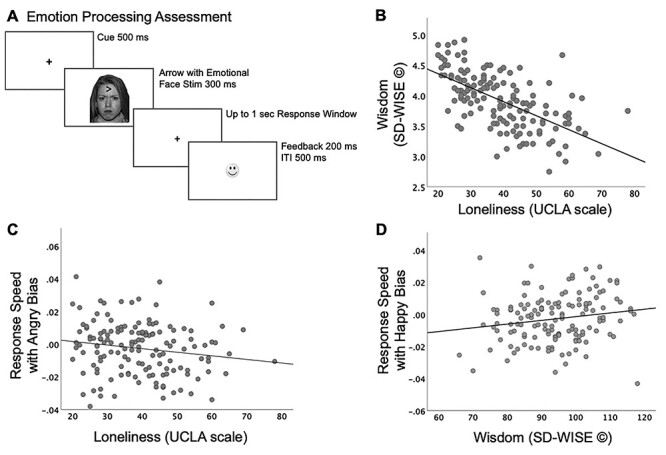
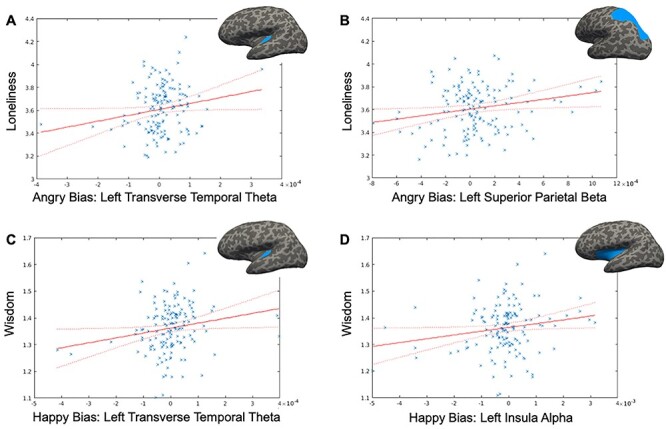
Loneliness and wisdom have opposing impacts on health and well-being, yet their neuro-cognitive bases have never been simultaneously investigated. In this study of 147 healthy human subjects sampled across the adult lifespan, we simultaneously studied the cognitive and neural correlates of loneliness and wisdom in the context of an emotion bias task. Aligned with the social threat framework of loneliness, we found that loneliness was associated with reduced speed of processing when angry emotional stimuli were presented to bias cognition. In contrast, we found that wisdom was associated with greater speed of processing when happy emotions biased cognition. Source models of electroencephalographic data showed that loneliness was specifically associated with enhanced angry stimulus-driven theta activity in the left transverse temporal region of interest, which is located in the area of the temporoparietal junction (TPJ), while wisdom was specifically related to increased TPJ theta activity during happy stimulus processing. Additionally, enhanced attentiveness to threatening stimuli for lonelier individuals was observed as greater beta activity in left superior parietal cortex, while wisdom significantly related to enhanced happy stimulus-evoked alpha activity in the left insula. Our results demonstrate emotion-context driven modulations in cognitive neural circuits by loneliness versus wisdom.
Keywords: EEG; emotion bias; happiness; insula; social threat; temporo-parietal junction.
© The Author(s) 2021. Published by Oxford University Press. All rights reserved. For permissions, please e-mail: journals.permission@oup.com.
Figures
References
-
- Adolphs R. 2002. Neural systems for recognizing emotion. Curr Opin Neurobiol. 12:169–177. - PubMed
-
- Anderson T, Darling D. 1952. Asymptotic theory of certain “goodness of fit” criteria based on stochastic processes. Ann Math Stat. 23:193–212.
-
- Ardelt M. 2000. Intellectual versus wisdom-related knowledge: the case for a different kind of learning in the later years of life. Educ Gerontol. 26:771–789.
-
- Ardelt M, Edwards CA. 2016. Wisdom at the end of life: an analysis of mediating and moderating relations between wisdom and subjective well-being. J Gerontol B Psychol Sci Soc Sci. 71:502–513. - PubMed
-
- Ardelt M, Ferrari M. 2019. Effects of wisdom and religiosity on subjective well-being in old age and young adulthood: exploring the pathways through mastery and purpose in life. Int Psychogeriatrics. 31:477–489. - PubMed
Publication types
MeSH terms
Grants and funding
LinkOut - more resources
Full Text Sources
Other Literature Sources
