The Preventable Productivity Burden of Kidney Disease in Australia
- PMID: 33687979
- PMCID: PMC8017534
- DOI: 10.1681/ASN.2020081148
The Preventable Productivity Burden of Kidney Disease in Australia
Abstract
Background: Kidney disease is associated with impaired work productivity. However, the collective effect of missed work days, reduced output at work, and early withdrawal from the workforce is rarely considered in health-economic evaluations.
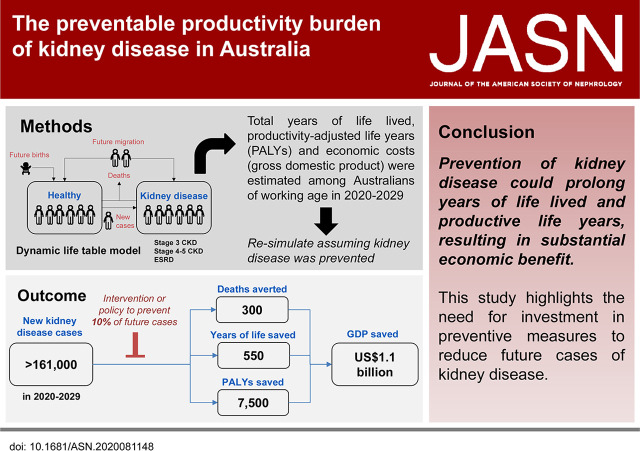
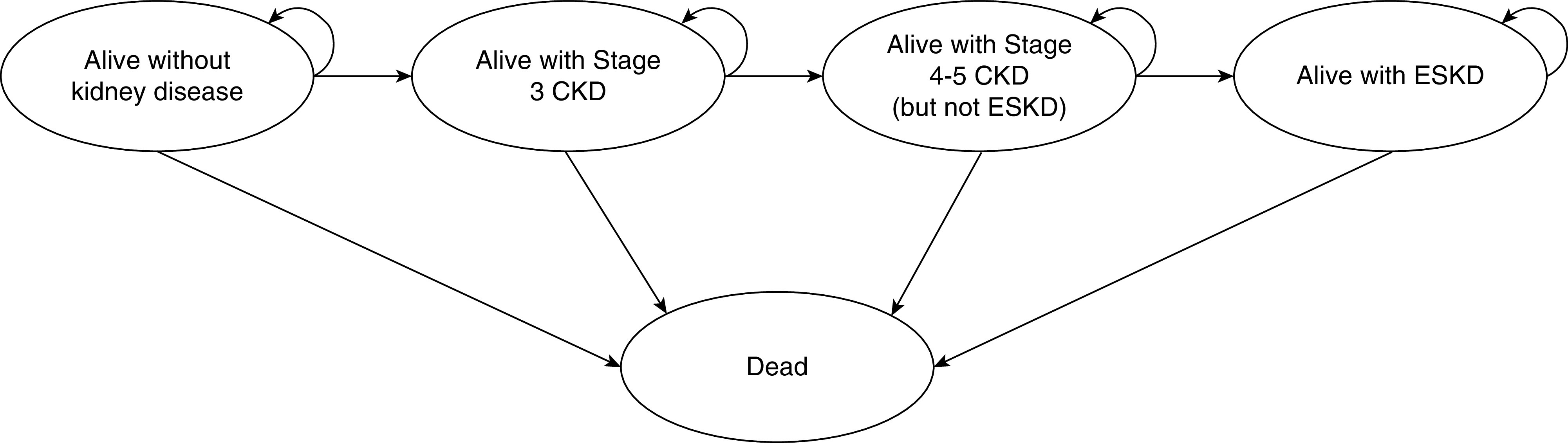
Methods: To determine the effect on work productivity of preventing incident cases of kidney disease, using the novel measure "productivity-adjusted life year" (PALY), we constructed a dynamic life table model for the Australian working-age population (aged 15-69 years) over 10 years (2020-2029), stratified by kidney-disease status. Input data, including productivity estimates, were sourced from the literature. We ascribed a financial value to the PALY metric in terms of gross domestic product (GDP) per equivalent full-time worker and assessed the total number of years lived, total PALYs, and broader economic costs (GDP per PALY). We repeated the model simulation, assuming a reduced kidney-disease incidence; the differences reflected the effects of preventing new kidney-disease cases. Outcomes were discounted by 5% annually.
Results: Our projections indicate that, from 2020 to 2029, the estimated number of new kidney-disease cases will exceed 161,000. Preventing 10% of new cases of kidney disease during this period would result in >300 premature deaths averted and approximately 550 years of life and 7600 PALYs saved-equivalent to a savings of US$1.1 billion in GDP or US$67,000 per new case avoided.
Conclusions: Pursuing a relatively modest target for preventing kidney disease in Australia may prolong years of life lived and increase productive life years, resulting in substantial economic benefit. Our findings highlight the need for investment in preventive measures to reduce future cases of kidney disease.
Keywords: burden; chronic kidney disease; dynamic life table model; end stage kidney disease; incidence; productivity.
Copyright © 2021 by the American Society of Nephrology.
Figures
Comment in
-
QALYs, DALYs and Now PALYs: Strengthening the Argument for Prevention of CKD.J Am Soc Nephrol. 2021 Apr;32(4):771-773. doi: 10.1681/ASN.2021020208. Epub 2021 Mar 9. J Am Soc Nephrol. 2021. PMID: 33687978 Free PMC article. No abstract available.
References
-
- Cockwell P, Fisher L-A: The global burden of chronic kidney disease. Lancet 395: 662–664, 2020. 10.1016/S0140-6736(19)32977-0 - PubMed
-
- Kidney Health Australia: National Strategic Action Plan for Kidney Disease. Canberra, Australia, Kidney Health Australia and Australian Government Department of Health, 2019
-
- Australian Institute of Health and Welfare: Chronic kidney disease. Available at: https://www.aihw.gov.au/reports/heart-stroke-vascular-diseases/cardiovas.... Accessed May 25, 2020
LinkOut - more resources
Full Text Sources
Other Literature Sources