


Reasons for Permanent Teeth Extractions and Related Factors among Adult Patients in the Eastern Province of Saudi Arabia
- PMID: 33688305
- PMCID: PMC7920728
- DOI: 10.1155/2021/5534455
Reasons for Permanent Teeth Extractions and Related Factors among Adult Patients in the Eastern Province of Saudi Arabia
Abstract
Objective: To evaluate the reasons for permanent teeth extractions and related factors among adult patients visiting dental clinics in the Eastern Province of Saudi Arabia.
Materials and methods: This retrospective cross-sectional study included data of patients who underwent teeth extractions. Data were collected from public and private dental clinics in different cities of the Eastern Province of Saudi Arabia (January-March 2020). The demographic information of patients and their reasons for teeth extractions were obtained from participating dentists.
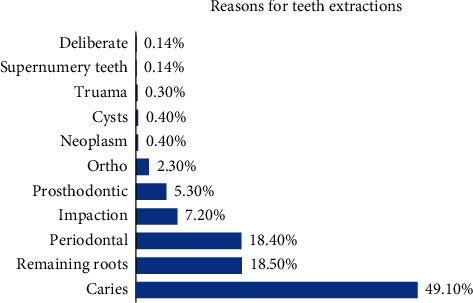
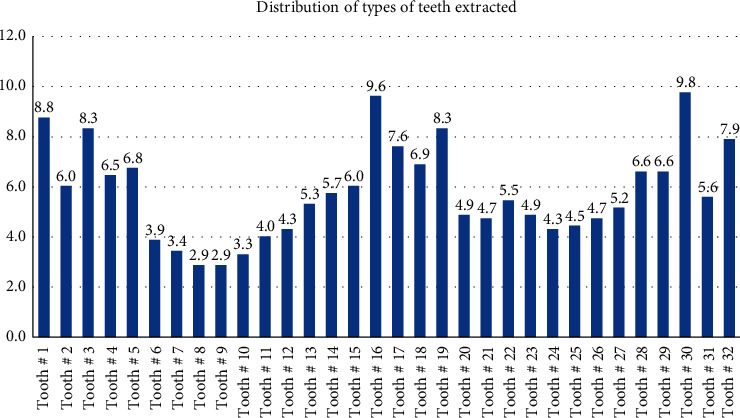
Results: The study included data of 696 patients with 55.9% of males and 44.1% of females. The mean number of teeth extractions in the sample was 1.86 ± 1.8, and it increased significantly with advancing age (P ≤ 0.001). Saudi (1.97 ± 1.98) versus non-Saudi patients (1.55 ± 1.11) (P=0.02) and patients in public practice (2.03 ± 1.95) versus patients in private practice (1.50 ± 1.38) (P ≤ 0.001) showed significantly higher teeth extractions. Dental caries was the most common reason for teeth extractions (49.1%), followed by remaining roots (18.5%), periodontal disease (18.4%), and impactions (7.2%). Most commonly extracted teeth included tooth # 30 (9.8%), followed by tooth #16 (9.6%), tooth # 1 (8.8%), tooth # 19 (8.3%), and tooth # 4 (8.3%). On the other hand, upper incisors were the least commonly extracted teeth.
Conclusions: Dental caries, remaining roots, periodontal disease, and impactions were the most common reasons for teeth extractions in our sample of patients. The extractions increased significantly with increasing age. Saudis and patients in public clinics underwent significantly higher teeth extractions. Measures aimed at the prevention and treatment of oral conditions can help reduce teeth extractions and improve the quality of life of patients.
Copyright © 2021 Abdullah Aljafar et al.
Conflict of interest statement
The authors declare that there are no conflicts of interest regarding the publication of this paper.
Figures
References
-
- Kassebaum N. J., Smith A. G. C., Bernabé E., et al. Global, regional, and national prevalence, incidence, and disability-adjusted life years for oral conditions for 195 countries, 1990–2015: a systematic analysis for the global burden of diseases, injuries, and risk factors. Journal of Dental Research. 2017;96(4):380–387. doi: 10.1177/0022034517693566. - DOI - PMC - PubMed
MeSH terms
LinkOut - more resources
Full Text Sources
Other Literature Sources
Medical
