This is a preprint.
Unraveling COVID-19: a large-scale characterization of 4.5 million COVID-19 cases using CHARYBDIS
- PMID: 33688639
- PMCID: PMC7941629
- DOI: 10.21203/rs.3.rs-279400/v1
Unraveling COVID-19: a large-scale characterization of 4.5 million COVID-19 cases using CHARYBDIS
Update in
-
Unraveling COVID-19: A Large-Scale Characterization of 4.5 Million COVID-19 Cases Using CHARYBDIS.Clin Epidemiol. 2022 Mar 22;14:369-384. doi: 10.2147/CLEP.S323292. eCollection 2022. Clin Epidemiol. 2022. PMID: 35345821 Free PMC article.
Abstract
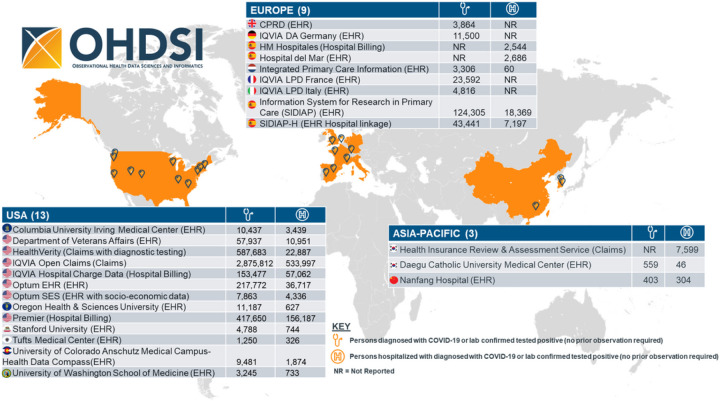
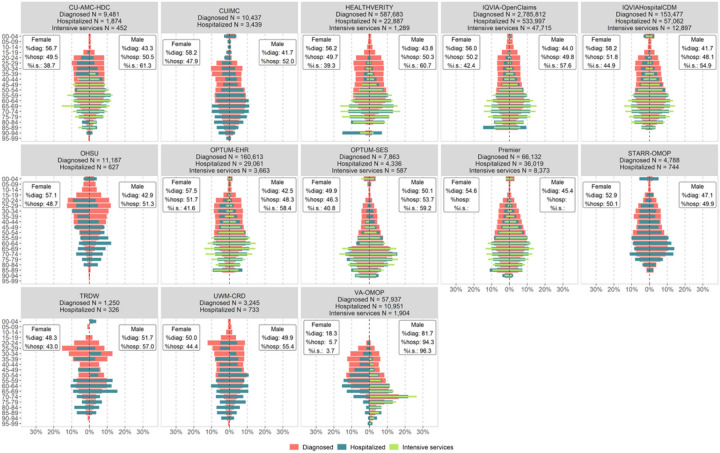
Background: Routinely collected real world data (RWD) have great utility in aiding the novel coronavirus disease (COVID-19) pandemic response [1,2]. Here we present the international Observational Health Data Sciences and Informatics (OHDSI) [3] Characterizing Health Associated Risks, and Your Baseline Disease In SARS-COV-2 (CHARYBDIS) framework for standardisation and analysis of COVID-19 RWD. Methods: We conducted a descriptive cohort study using a federated network of data partners in the United States, Europe (the Netherlands, Spain, the UK, Germany, France and Italy) and Asia (South Korea and China). The study protocol and analytical package were released on 11 th June 2020 and are iteratively updated via GitHub [4]. Findings: We identified three non-mutually exclusive cohorts of 4,537,153 individuals with a clinical COVID-19 diagnosis or positive test, 886,193 hospitalized with COVID-19 , and 113,627 hospitalized with COVID-19 requiring intensive services . All comorbidities, symptoms, medications, and outcomes are described by cohort in aggregate counts, and are available in an interactive website: https://data.ohdsi.org/Covid19CharacterizationCharybdis/. Interpretation: CHARYBDIS findings provide benchmarks that contribute to our understanding of COVID-19 progression, management and evolution over time. This can enable timely assessment of real-world outcomes of preventative and therapeutic options as they are introduced in clinical practice.
Conflict of interest statement
Competing interest statement
All authors have completed the ICMJE uniform disclosure form at
Ms. Kostka is an employee of IQVIA. Mr. Sena is an employee and holds stock at Janssen Research & Development, a Johnson and Johnson family of companies. Dr. Golozar reports personal fees from Regeneron Pharmaceuticals, outside the submitted work. She is a full-time employee at Regeneron Pharmaceuticals. This work was not conducted at Regeneron Pharmaceuticals. Dr. Nyberg reports other funding from AstraZeneca, outside the submitted work. Dr. Wilcox reports grants from Bill and Melinda Gates Foundation, grants from National Institute of Health, during the conduct of the study Mr. Andryc is an employee of Janssen Research & Development, a subsidiary of Johnson & Johnson. Dr. Reich is an employee of IQVIA. Dr. Blacketer reports she is an employee and holds stock at Janssen Research & Development, a Johnson and Johnson family of companies. Dr. Morales is supported by a Wellcome Trust Clinical Research Development Fellowship (Grant 214588/Z/18/Z) and reports grants from Chief Scientist Office (CSO), grants from Health Data Research UK (HDR-UK), grants from National Institute of Health Research (NIHR), outside the submitted work. Mr. DeFalco reports he is an employee and holds stock at Janssen Research & Development, a Johnson and Johnson family of companies. Jason Thomas reports grants from Bill and Melinda Gates Foundation, grants from National Institute of Health, during the conduct of the study. Dr. Posada reports grants from National Library of Medicine, during the conduct of the study. Dr. Natarajan reports grants from US NIH, during the conduct of the study. Dr. Matheny reports grants from US NIH, grants from US VA HSR&D, during the conduct of the study. Dr. Weiskopf reports personal fees from Merck, outside the submitted work. Dr. Shah reports grants from National Library of Medicine, during the conduct of the study. Dr. Park reports grants from Ministry of Trade, Industry & Energy, Republic of Korea, grants from Ministry of Health & Welfare, Republic of Korea, grants from Bill & Melinda Gates Foundation, during the conduct of the study. Ms. Seager is an employee of IQVIA. Dr. DuVall reports grants from Anolinx, LLC, grants from Astellas Pharma, Inc, grants from AstraZeneca Pharmaceuticals LP, grants from Boehringer Ingelheim International GmbH, grants from Celgene Corporation, grants from Eli Lilly and Company, grants from Genentech Inc., grants from Genomic Health, Inc., grants from Gilead Sciences Inc., grants from GlaxoSmithKline PLC, grants from Innocrin Pharmaceuticals Inc., grants from Janssen Pharmaceuticals, Inc., grants from Kantar Health, grants from Myriad Genetic Laboratories, Inc., grants from Novartis International AG, grants from Parexel International Corporation through the University of Utah or Western Institute for Veteran Research outside the submitted work. Dr. Fortin is an employee of Janssen R&D, a subsidiary of Johnson and Johnson. Dr. Vignesh reports grants from State of Arizona; Arizona Board of Regents, during the conduct of the study; grants from National Science Foundation, grants from Agency for Healthcare Research and Quality, grants from National Institutes of Health, outside the submitted work; .Dr. Subbian reports grants from State of Arizona; Arizona Board of Regents, during the conduct of the study; grants from National Science Foundation, grants from Agency for Healthcare Research and Quality, grants from National Institutes of Health, outside the submitted work. Dr. Rijnbeek reports grants from Innovative Medicines Initiative, from Janssen Research and Development, during the conduct of the study. Dr. Hripcsak reports grants from US NIH, during the conduct of the study. Dr. Ryan reports and is employee of Janssen Research and Development and shareholder of Johnson & Johnson. Dr. Suchard reports grants from US National Institutes of Health, grants from Department of Veterans Affairs, during the conduct of the study; grants from IQVIA, personal fees from Janssen Research and Development, grants from US Food and Drug Administration, personal fees from Private Health Management, outside the submitted work. Dr. Prieto-Alhambra reports grants and other from AMGEN, grants, non-financial support and other from UCB Biopharma, grants from Les Laboratoires Servier, outside the submitted work; and Janssen, on behalf of IMI-funded EHDEN and EMIF consortiums, and Synapse Management Partners have supported training programmes organised by DPA’s department and open for external participants.
The views expressed are those of the authors and do not necessarily represent the views or policy of the Department of Veterans Affairs or the United States Government. No other relationships or activities that could appear to have influenced the submitted work.
Figures
References
-
- Hripcsak G, Duke JD, Shah NH, Reich CG, Huser V, Schuemie MJ, et al. Observational Health Data Sciences and Informatics (OHDSI): Opportunities for Observational Researchers. Stud Health Technol Inform. 2015;216: 574–578. Available: https://www.ncbi.nlm.nih.gov/pubmed/26262116 - PMC - PubMed
-
- Sena A, Kostka K, Schuemie M, jdposada. ohdsi-studies/Covid19CharacterizationCharybdis: Charybdis v1.1.1 - Publication Package. 2020. doi: 10.5281/zenodo.4033034 - DOI
-
- WHO Director-General’s opening remarks at the media briefing on COVID-19 – 11 March 2020. [cited 23 Jan 2021]. Available: https://www.who.int/director-general/speeches/detail/who-director-genera...
Publication types
Grants and funding
LinkOut - more resources
Full Text Sources
Other Literature Sources
Miscellaneous