


Online Gambling Activity, Pay-to-Win Payments, Motivation to Gamble and Coping Strategies as Predictors of Gambling Disorder Among e-sports Bettors
- PMID: 33689100
- PMCID: PMC8572820
- DOI: 10.1007/s10899-021-10015-4
Online Gambling Activity, Pay-to-Win Payments, Motivation to Gamble and Coping Strategies as Predictors of Gambling Disorder Among e-sports Bettors
Abstract
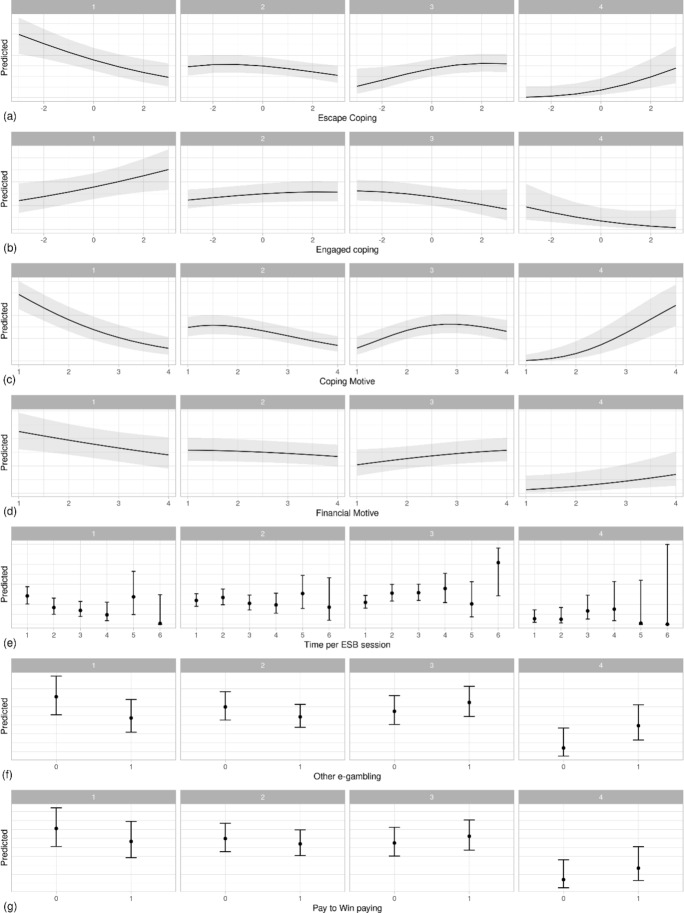
Research on esports activity usually captures it from the perspective of involvement in gaming. This study presents the results of the first research in Poland (N = 438) on esports betting (ESB). ESB is compared to other forms of e-gambling and involvement in pay-to-win games. The aim was to build a predictive model of gambling disorder among people betting on esports. A predictive model of gambling disorder based on ordinal regression was built, including sociodemographic variables, involvement in esports betting, involvement in other Internet activities connected to ESB, as well as psychological variables-motivation to gamble and coping strategies. The results showed that gambling disorder among esports bettors is associated with time spent on one game session, placing other forms of online gambling bets once a week or more often, and paying in pay-to-win games. Gambling disorder was also predicted by escape coping strategies and lower engaged strategies as well as financial and coping motivation to bet on esports results. The results show the crucial role of psychological factors (motivation, coping) in the development of esports betting addiction. Esports betting is an activity associated with both gambling and gaming-involvement in both activities explains the development of ESB addiction. There is a need for further research focused on the specificity of esports betting behavior to discover the direction of links among gaming, gambling, and esports gambling.
Keywords: Coping; Esports betting; Gambling disorder; Gambling motivation; Pay-to-win games.
© 2021. The Author(s).
Conflict of interest statement
The authors report no financial or other relationship relevant to the subject of this article.
Figures
References
-
- Abanazir C. Institutionalisation in e-sports. Sport, Ethics and Philosophy. 2019;13(2):117–131. doi: 10.1080/17511321.2018.1453538. - DOI
-
- Adamus, T. (2012). Playing computer games as electronic sport: In search of a theoretical framework for a new research field. In J. Fromme & A. Unger (Eds.), Computer games and new media cultures: A handbook of digital games studies. Springer
MeSH terms
Grants and funding
LinkOut - more resources
Full Text Sources
Other Literature Sources
Medical
Miscellaneous
