


Review
doi: 10.1016/j.cell.2021.02.028.
Epub 2021 Mar 9.
The neural circuitry of social homeostasis: Consequences of acute versus chronic social isolation
Affiliations
- PMID: 33691140
- PMCID: PMC8580010
- DOI: 10.1016/j.cell.2021.02.028
Item in Clipboard
Review
The neural circuitry of social homeostasis: Consequences of acute versus chronic social isolation
Cell.
.
Erratum in
-
The neural circuitry of social homeostasis: Consequences of acute versus chronic social isolation.Cell. 2021 May 13;184(10):2794-2795. doi: 10.1016/j.cell.2021.04.044. Cell. 2021. PMID: 33989550 No abstract available.
Abstract
Social homeostasis is the ability of individuals to detect the quantity and quality of social contact, compare it to an established set-point in a command center, and adjust the effort expended to seek the optimal social contact expressed via an effector system. Social contact becomes a positive or negative valence stimulus when it is deficient or in excess, respectively. Chronic deficits lead to set-point adaptations such that reintroduction to the previous optimum is experienced as a surplus. Here, we build upon previous models for social homeostasis to include adaptations to lasting changes in environmental conditions, such as with chronic isolation.
Copyright © 2021. Published by Elsevier Inc.
Figures
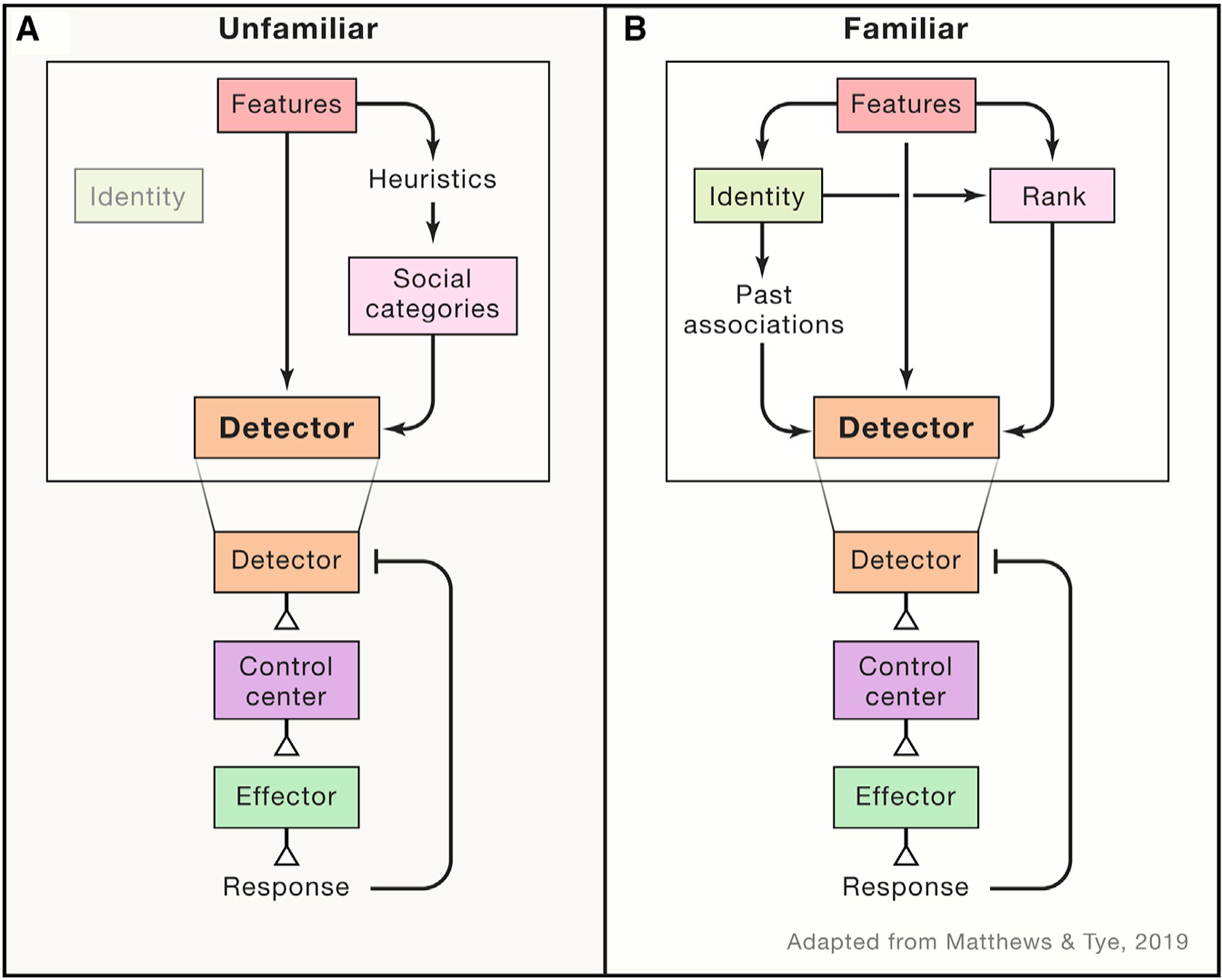
(A and B) Schematic of social information detection from (A) unfamiliar individuals and (B) familiar individuals. The first step of a social homeostatic system is detection, which integrates many social variables such as social features, rank, and identity to determine the overall quality of a social interaction. (A) When an individual first interacts with an unfamiliar conspecific, the individual primarily relies on the social features of the unfamiliar individual, such as age, sex, etc. These social features provide a heuristic to assess a social agent and determine an appropriate behavioral response. (B) When interacting with a familiar individual, information from social features and the learned identity of the other individual feed into the detector node as well as provide information on the relative rank of the individual. The detector integrates all of this information in evaluating social interactions, which is then fed forward to subsequent nodes in the social homeostatic system.
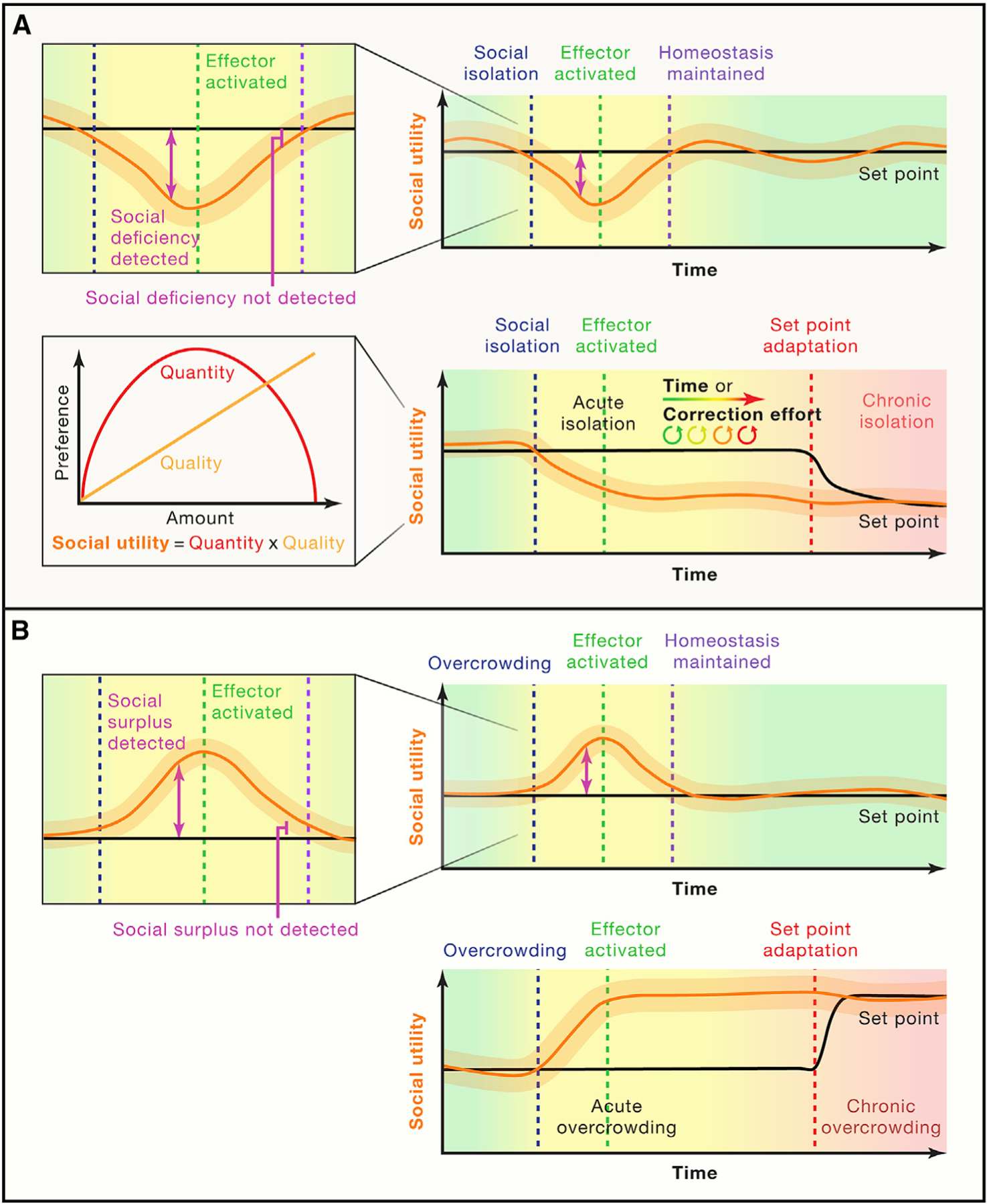
The detector node of the social homeostatic system determines the social utility of a social interaction. The detected social utility is a multiplicative function that integrates both the quantity and quality of social interactions (callout). (A) When a social utility deficit is detected due to social isolation, the effector system activates and drives motivated behavior in an individual to seek social contact. If the effector system is successful in bringing the detected social utility to the set-point encoded by the control center, homeostasis is ultimately maintained and the effector system inactivates (top). In the case where the effector system fails to bring the detected social utility to the encoded set-point, the individual will experience a transition from acute to chronic social isolation (bottom), indicated by a compensatory set-point adjustment that we hypothesize to occur due to time or repeated correction effort by the effector system. (B) When a social surplus is detected due to overcrowding, the effector system drives antisocial behavior to rescue the discrepancy. If the effector system is successful in bringing the detected social utility to the set-point encoded by the control center, homeostasis is ultimately maintained and the effector system inactivates (top). In the case where the effector system fails to bring the detected social utility to the encoded set-point, the individual will experience a transition from acute to chronic social overcrowding (bottom).
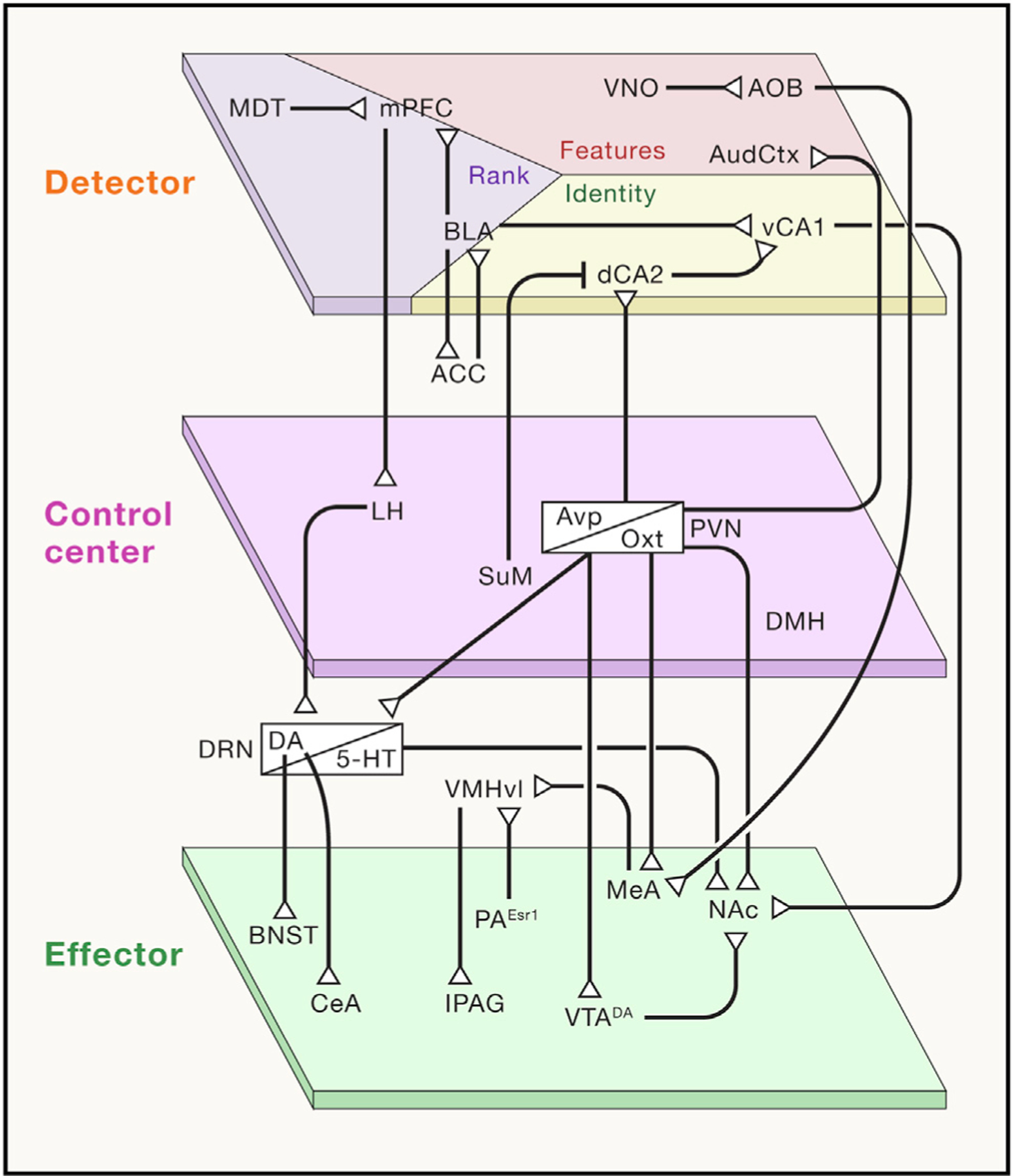
Proposed neural circuits involved in each social homeostatic node. Note: we acknowledge that there are dynamic states that allow flexibility in the positioning of each of the regions and circuits that we speculate to be functionally representing each node of the social homeostatic system. We also acknowledge that there will likely be functional heterogeneity among neurons in any brain region and that many functions are indeed distributed across both local and long-range circuits. ACC, anterior cingulate cortex; AOB, accessory olfactory bulb; AudCtx, auditory cortex; BLA, basolateral amygdala; BNST, bed nucleus of the stria terminalis; CeA, central nucleus of the amygdala; dCA2, dorsal hippocampal CA2; DMH, dorsomedial hypothalamus; DRN, dorsal raphe nucleus (DA: dopamine; 5-HT: serotonin); LH, lateral hypothalamus; lPAG, lateral periaqueductal gray; MDT, mediodorsal thalamus; MeA, medial amygdala; mPFC, medial prefrontal cortex; NAc, nucleus accumbens; PA, posterior amygdala (Esr1: estrogen 1 receptor); PVN, paraventricular nucleus of the hypothalamus (Oxt: oxytocin; Avp: vasopressin); SuM, supramammillary nucleus; vCA1, ventral hippocampal CA1; VMHvl, ventrolateral portion of the ventromedial hypothalamus; VNO, vomeronasal organ; VTA, ventral tegmental area (DA).
References
-
- Adolphs R, Tranel D, Hamann S, Young AW, Calder AJ, Phelps EA, Anderson A, Lee GP, and Damasio AR (1999). Recognition of facial emotion in nine individuals with bilateral amygdala damage. Neuropsychologia 37, 1111–1117. - PubMed
-
- Anpilov S, Shemesh Y, Eren N, Harony-Nicolas H, Benjamin A, Dine J, Oliveira VEM, Forkosh O, Karamihalev S, Hüttl R-E, et al. (2020). Wireless Optogenetic Stimulation of Oxytocin Neurons in a Semi-natural Setup Dynamically Elevates Both Pro-social and Agonistic Behaviors. Neuron 107, 644–655.e7. - PMC - PubMed
-
- Arnetz BB, Theorell T, Levi L, Kallner A, and Eneroth P (1983). An experimental study of social isolation of elderly people: psychoendocrine and metabolic effects. Psychosom. Med 45, 395–406. - PubMed
Publication types
MeSH terms
Grants and funding
LinkOut - more resources
Full Text Sources
Other Literature Sources
