


Effects of mouth breathing on facial skeletal development in children: a systematic review and meta-analysis
- PMID: 33691678
- PMCID: PMC7944632
- DOI: 10.1186/s12903-021-01458-7
Effects of mouth breathing on facial skeletal development in children: a systematic review and meta-analysis
Abstract
Background: Mouth breathing is closely related to the facial skeletal development and malocclusion. The purpose of this systematic review and meta-analysis was to assess the effect of mouth breathing on facial skeletal development and malocclusion in children.
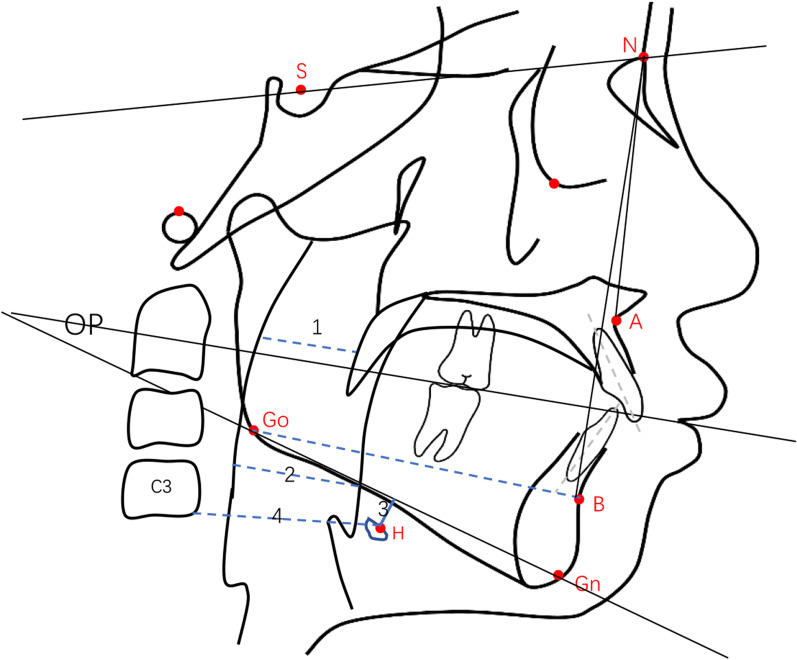
Methods: An electronic search in PubMed, the Cochrane Library, Medline, Web of Science, EMBASE and Sigle through February 23rd, 2020, was conducted. Inclusion criteria were children under 18 years of age with maxillofacial deformities due to mouth breathing. The risk of bias in nonrandomized studies of interventions (ROBINS-I) tool for controlled clinical trials. The Grading of Recommendation, Assessment, Development and Evaluation (GRADE) approach was used for the quality assessment. The included indicators were SNA, SNB, ANB, SN-OP, SN-PP, PP-MP, SNGoGn, MP-H, 1-NA, 1. NA, 1. NB, 1-NB, Overjet, Overbite, SPAS, PAS, and C3-H. Data concerning the mean difference in mesial molar movement and extent of canine retraction were extracted for statistical analysis. The mean differences and 95% confidence intervals were analyzed for continuous data. Review Manager 5.3, was used to synthesize various parameters associated with the impact of mouth breathing on facial skeletal development and malocclusion.
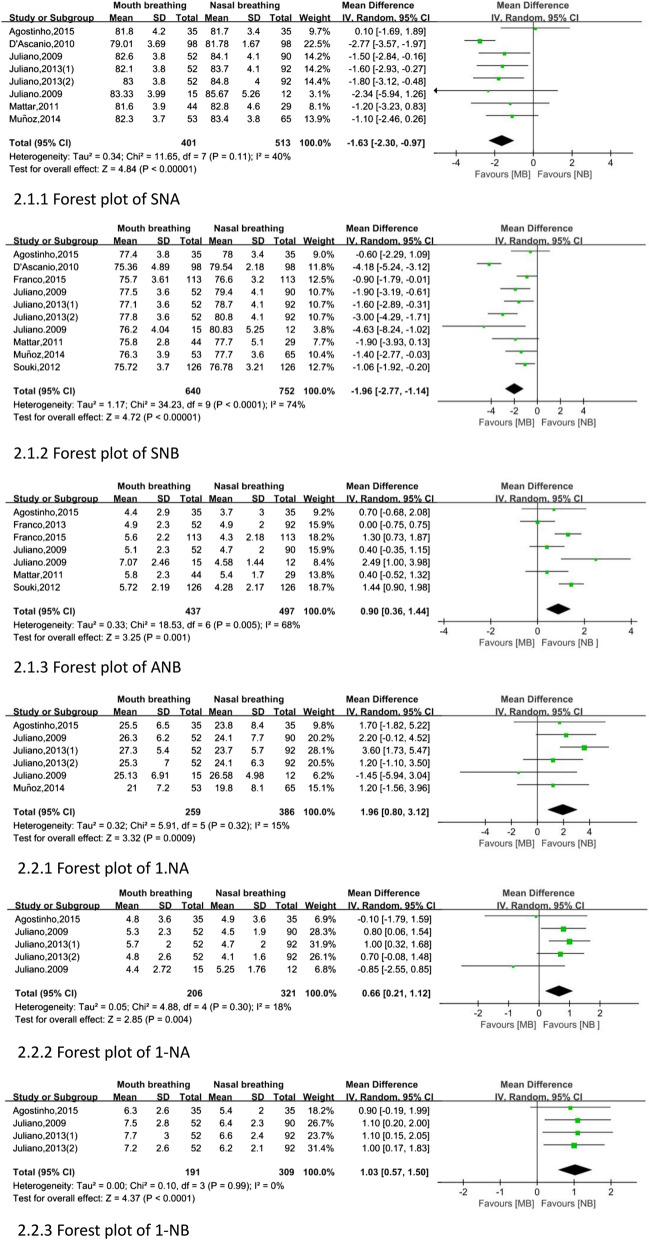
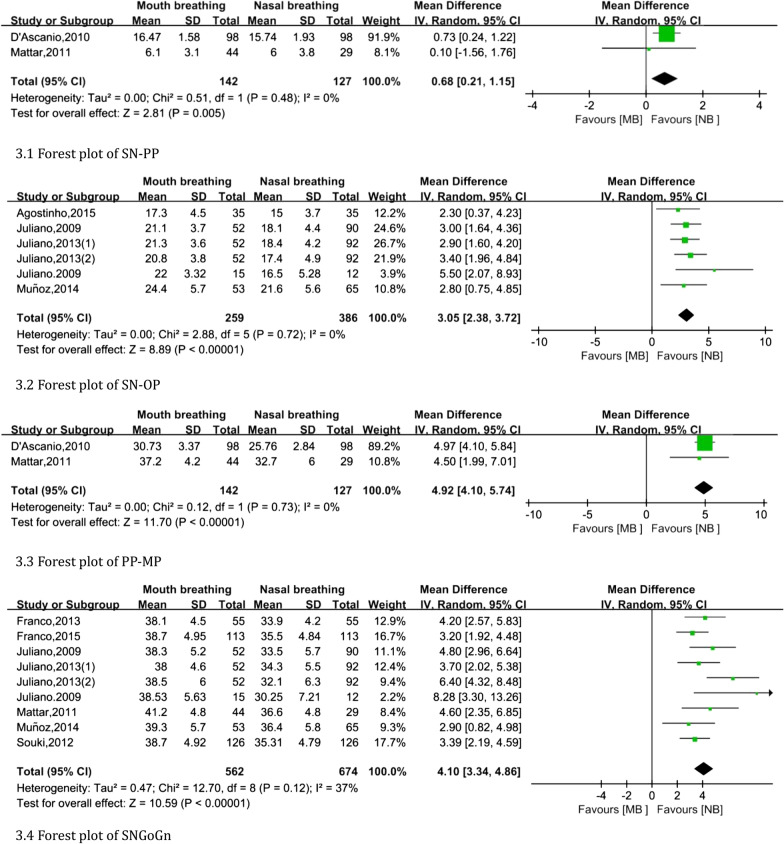
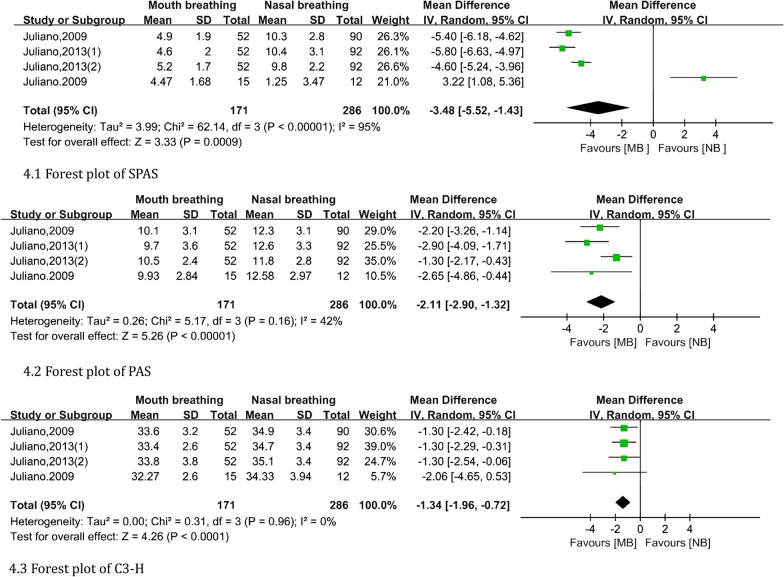
Results: Following full-text evaluations for eligibility, 10 studies were included in the final quantitative synthesis. In Sagittal direction, SNA (MD: - 1.63, P < 0.0001), SNB (MD: - 1.96, P < 0.0001) in mouth-breathing children was lower than that in nasal-breathing children. ANB (MD: 0.90, P < 0.0001), 1. NA (MD: 1.96, P = 0.009), 1-NA (MD: 0.66, P = 0.004), and 1-NB (MD: 1.03, P < 0.0001) showed higher values in children with mouth breathing. In vertical direction, SN-PP (MD: 0.68, P = 0.0050), SN-OP (MD: 3.05, P < 0.0001), PP-MP (MD: 4.92, P < 0.0001) and SNGoGn (MD: 4.10, P < 0.0001) were higher in mouth-breathing individuals. In airway, SPAS (MD: - 3.48, P = 0.0009), PAS (MD: - 2.11, P < 0.0001), and C3-H (MD: - 1.34, P < 0.0001) were lower in mouth breathing group.
Conclusions: The results showed that the mandible and maxilla rotated backward and downward, and the occlusal plane was steep. In addition, mouth breathing presented a tendency of labial inclination of the upper anterior teeth. Airway stenosis was common in mouth-breathing children. Trial registration crd-register@york.ac.uk, registration number CRD42019129198.
Keywords: Children; Facial skeletal development; Meta-analysis; Mouth breathing; Systematic review.
Conflict of interest statement
The authors declare that they have no competing interests.
Figures
References
-
- Jimenez EL, Barrios R, Calvo JC, de la Rosa MT, Campillo JS, Bayona JC, Bravo M. Association of oral breathing with dental malocclusions and general health in children. Minerva Pediatr. 2017;69(3):188–193. - PubMed
-
- Occasi F, Perri L, Saccucci M, Di Carlo G, Ierardo G, Luzzi V, De Castro G, Brindisi G, Loffredo L, Duse M, et al. Malocclusion and rhinitis in children: an easy-going relationship or a yet to be resolved paradox? A systematic literature revision. Ital J Pediatr. 2018;44(1):100. doi: 10.1186/s13052-018-0537-2. - DOI - PMC - PubMed
Publication types
MeSH terms
LinkOut - more resources
Full Text Sources
Other Literature Sources
Research Materials
Miscellaneous
