


Association of CAG Repeat Length in the Huntington Gene With Cognitive Performance in Young Adults
- PMID: 33692166
- PMCID: PMC10508647
- DOI: 10.1212/WNL.0000000000011823
Association of CAG Repeat Length in the Huntington Gene With Cognitive Performance in Young Adults
Abstract
Objective: To investigate the relationships between CAG repeat length in the huntingtin gene and cognitive performance in participants above and below the disease threshold for Huntington disease (HD), we performed a cross-sectional analysis of the Enroll-HD database.
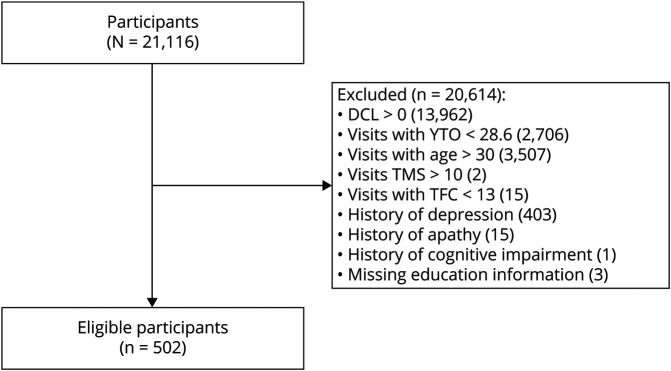
Methods: We analyzed data from young, developing adults (≤30 years of age) without a history of depression, apathy, or cognitive deficits. We included participants with and without the gene expansion (CAG ≥36) for HD. All participants had to have a Total Functional Capacity Score of 13, a diagnostic confidence level of zero, and a total motor score of <10 and had to be >28.6 years from their predicted motor onset. We performed regression analyses to investigate the nonlinear relationship between CAG repeat length and various cognitive measures controlling for age, sex, and education level.
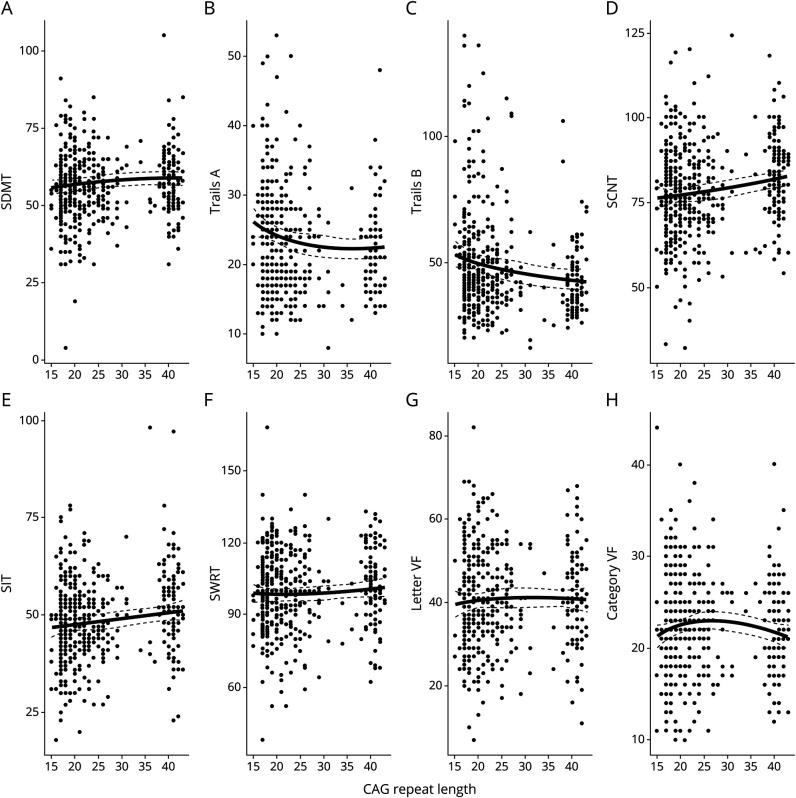
Results: There were significant positive relationships between CAG repeat length and the Symbol Digit Modalities, Stroop Color Naming, and Stroop Interference test scores. There were significant negative relationships between CAG repeat length and scores on Parts A and B of the Trails Making Test (p < 0.05), indicating that longer CAG repeat lengths were associated with better performance.
Discussion: An increasing number of CAG repeats in the huntingtin gene below disease threshold and low pathologic CAG ranges were associated with some improvements in cognitive performance. These findings outline the relationship between CAG repeats within the huntingtin gene and cognitive development.
Classification of evidence: This study provides Class IV evidence that CAG repeat length is positively associated with cognitive function across a spectrum of CAG repeat lengths.
© 2021 American Academy of Neurology.
Conflict of interest statement
Dr. Schultz, Dr. Saft, and Dr. Nopoulos report no disclosures. Go to
Figures
References
-
- A novel gene containing a trinucleotide repeat that is expanded and unstable on Huntington's disease chromosomes: the Huntington's Disease Collaborative Research Group. Cell. 1993;72:971–983. - PubMed
-
- Tartari M, Gissi C, Lo Sardo V, et al. Phylogenetic comparison of huntingtin homologues reveals the appearance of a primitive polyQ in sea urchin. Mol Biol Evol. 2008;25:330–338. - PubMed
-
- Hannan AJ. Tandem repeat polymorphisms: modulators of disease susceptibility and candidates for “missing heritability”. Trends Genet. 2010;26:59–65. - PubMed
-
- Nithianantharajah J, Hannan AJ. Dynamic mutations as digital genetic modulators of brain development, function and dysfunction. Bioessays. 2007;29:525–535. - PubMed
MeSH terms
Substances
Grants and funding
LinkOut - more resources
Full Text Sources
Other Literature Sources
Medical
Research Materials
