


Cell-Free DNA: Hope and Potential Application in Cancer
- PMID: 33693004
- PMCID: PMC7938321
- DOI: 10.3389/fcell.2021.639233
Cell-Free DNA: Hope and Potential Application in Cancer
Abstract
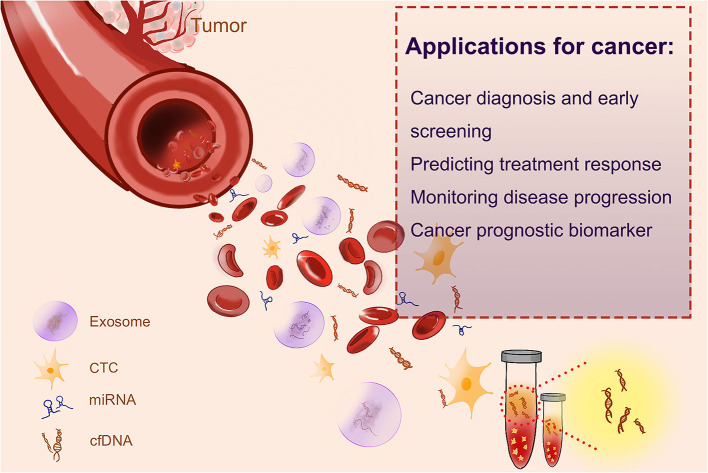
Cell-free DNA (cfDNA) is easily accessible in peripheral blood and can be used as biomarkers for cancer diagnostics, prognostics, and therapeutics. The applications of cfDNA in various areas of cancer management are attracting attention. In this review article, we discuss the potential relevance of using cfDNA analysis in clinical oncology, particularly in cancer screening, early diagnosis, therapeutic evaluation, monitoring disease progression; and determining disease prognosis.
Keywords: cancer; cell-free DNA (cfDNA); diagnosis; liquid biopsy; therapeutic effect evaluation.
Copyright © 2021 Yan, Guo, Wang, Adhikari, Zhu, Zhang, Zhou, Yu, Li and Zhang.
Conflict of interest statement
The authors declare that the research was conducted in the absence of any commercial or financial relationships that could be construed as a potential conflict of interest.
Figures
References
-
- Agostini M., Pucciarelli S., Enzo M. V., Del Bianco P., Briarava M., Bedin C., et al. (2011). Circulating cell-free DNA: a promising marker of pathologic tumor response in rectal cancer patients receiving preoperative chemoradiotherapy. Ann. Surg. Oncol. 18, 2461–2468. 10.1245/s10434-011-1638-y - DOI - PubMed
-
- Almodovar K., Iams W. T., Meador C. B., Zhao Z., York S., Horn L., et al. (2018). Longitudinal cell-free DNA analysis in patients with small cell lung cancer reveals dynamic insights into treatment efficacy and disease relapse. J. Thorac. Oncol. 13, 112–123. 10.1016/j.jtho.2017.09.1951 - DOI - PMC - PubMed
-
- Alunni-Fabbroni M., Ronsch K., Huber T., Cyran C. C., Seidensticker M., Mayerle J., et al. (2019). Circulating DNA as prognostic biomarker in patients with advanced hepatocellular carcinoma: a translational exploratory study from the SORAMIC trial. J. Transl. Med. 17:328. 10.1186/s12967-019-2079-9 - DOI - PMC - PubMed
Publication types
LinkOut - more resources
Full Text Sources
Other Literature Sources
Medical
