


Association of Intensity of Antipseudomonal Antibiotic Therapy With Risk of Treatment-Emergent Organisms in Children With Cystic Fibrosis and Newly Acquired Pseudomonas Aeruginosa
- PMID: 33693586
- PMCID: PMC9034203
- DOI: 10.1093/cid/ciab208
Association of Intensity of Antipseudomonal Antibiotic Therapy With Risk of Treatment-Emergent Organisms in Children With Cystic Fibrosis and Newly Acquired Pseudomonas Aeruginosa
Abstract
Background: While Pseudomonas aeruginosa (Pa) eradication regimens have contributed to a decline in Pa prevalence in people with cystic fibrosis (CF), this antibiotic exposure might increase the risk of acquisition of drug-resistant organisms. This study evaluated the association between antipseudomonal antibiotic exposure intensity and acquisition risk of drug-resistant organisms among children with CF and new Pa infection.
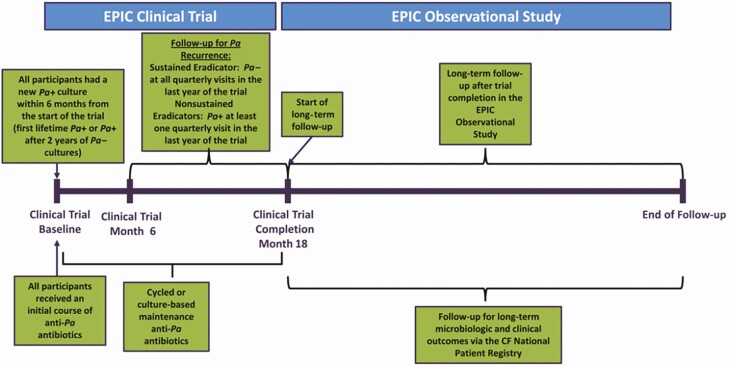
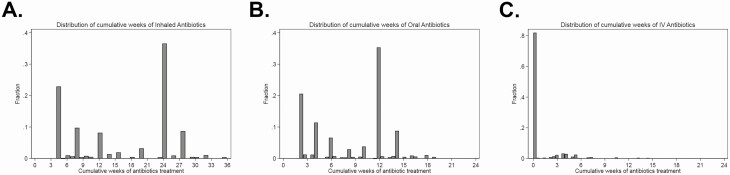
Methods: We utilized data from the Early Pseudomonas Infection Control Clinical Trial (EPIC CT), a randomized controlled trial comparing Pa eradication strategies in children with CF and new Pa. The exposure was the number of weeks of oral or inhaled antipseudomonal antibiotics or ever versus never treatment with intravenous antipseudomonal antibiotics during the 18 months of EPIC CT participation. Primary outcomes were risks of acquisition of several respiratory organisms during 5 years of follow-up after EPIC CT estimated using Cox proportional hazards models separately for each specific organism.
Results: Among 249 participants, there was no increased acquisition risk of any organism associated with greater inhaled antibiotic exposure. With each additional week of oral antibiotics, there was an increased hazard of Achromobacter xylosoxidans acquisition (HR, 1.24; 95% CI: 1.02-1.50; P = .03). Treatment with intravenous antibiotics was associated with an increased hazard of acquisition of multidrug-resistant Pa (HR, 2.47; 95% CI: 1.28-4.78; P = .01) and MRSA (HR, 1.57; 95% CI: 1.03-2.40; P = .04).
Conclusions: Results from this study illustrate the importance of making careful antibiotic choices to balance the benefits of antibiotics in people with CF while minimizing risk of acquisition of drug-resistant organisms.
Keywords: Pseudomonas aeruginosa; antibiotics; cystic fibrosis; pulmonary exacerbations.
© The Author(s) 2021. Published by Oxford University Press for the Infectious Diseases Society of America. All rights reserved. For permissions, e-mail: journals.permissions@oup.com.
Figures
References
-
- Cantina AM, Hart D, Konstan MW, Chmiel JF. Inflammation in cystic fibrosis lung disease: pathogenesis and therapy. J Cyst Fibros 2015; 14:419–30. - PubMed
-
- Emerson J, Rosenfeld M, McNamara S, Ramsey B, Gibson RL. Pseudomonas aeruginosa and other predictors of mortality and morbidity in young children with cystic fibrosis. Pediatr Pulmonol 2002; 34:91–100. - PubMed
-
- Murray TS, Egan M, Kazmierczak BI. Pseudomonas aeruginosa chronic colonization in cystic fibrosis patients. Curr Opin Pediatr 2007; 19:83–8. - PubMed
Publication types
MeSH terms
Substances
Grants and funding
LinkOut - more resources
Full Text Sources
Other Literature Sources
Medical
