


Longitudinal Changes in Human Milk Oligosaccharides (HMOs) Over the Course of 24 Months of Lactation
- PMID: 33693851
- PMCID: PMC8030713
- DOI: 10.1093/jn/nxaa427
Longitudinal Changes in Human Milk Oligosaccharides (HMOs) Over the Course of 24 Months of Lactation
Abstract
Background: Human milk oligosaccharides (HMOs) are complex glycans that are highly abundant in human milk. While over 150 HMOs have been identified, it is unknown how individual HMOs change in concentration over 24 months of lactation.
Objectives: To understand how HMO concentrations change over 24 months of lactation.
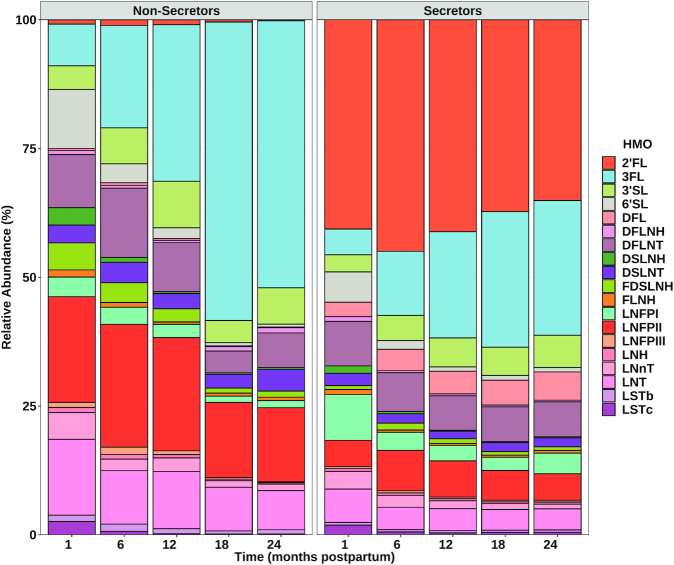
Methods: Breast milk samples were collected from participants in a longitudinal cohort study of Hispanic mother-infant pairs at 1, 6, 12, 18, and 24 months postpartum. Concentrations of 19 of the most abundant HMOs were measured using HPLC. Because the parent study is ongoing and not all participants have finished all time points yet, the sample sizes ranged per time point (n = 207 at 1 month; n = 109 at 6 months; n = 83 at 12 months; n = 59 at 18 months; and n = 28 at 24 months). Approximately 88% of participants were classified as HMO secretors-a genetic factor that affects concentrations of HMOs such as 2'fucosyllactose (2'FL) and lacto-N-fucopentaose I-while the remaining 12% were classified as nonsecretors. Mixed models were used to examine changes in HMO concentrations and relative abundances over the course of lactation.
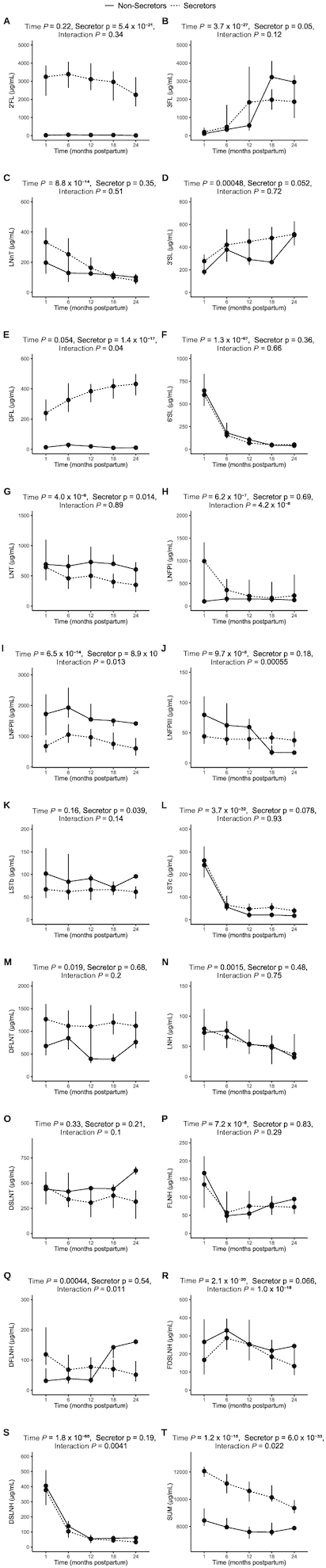
Results: The majority of HMOs significantly decreased in concentration over the course of lactation. The exceptions were 2'FL, sialyl-lacto-N-tetraose b, and disialyl-lacto-N-tetraose, which did not change with time, and 3-fucosyllactose (3FL) and 3'-sialyllactose (3'SL), which significantly increased. The concentration of 3FL increased 10-fold, from 195 (IQR 138-415) μg/mL at 1 month to 1930 (1100-2630) μg/mL at 24 months, while 3'SL increased 2-fold, from 277 (198-377) μg/mL to 568 (448-708) μg/mL over the same time period.
Conclusions: These results indicate that HMOs do not decrease in concentration uniformly across lactation. In particular, 3FL and 3'SL increased over the course of lactation in this cohort. Future studies are required to fully understand the functions of these HMOs.
Keywords: breast milk; changes; human milk oligosaccharides; lactation; milk.
© The Author(s) 2021. Published by Oxford University Press on behalf of the American Society for Nutrition.
Figures
References
-
- Chaturvedi P, Warren CD, Altaye M, Morrow AL, Ruiz-Palacios G, Pickering LK, Newburg DS. Fucosylated human milk oligosaccharides vary between individuals and over the course of lactation. Glycobiology. 2001;11:365–72. - PubMed
-
- Thurl S, Munzert M, Henker J, Boehm G, Müller-Werner B, Jelinek J, Stahl B. Variation of human milk oligosaccharides in relation to milk groups and lactational periods. Br J Nutr. 2010;104:1261–71. - PubMed
-
- Azad MB, Vehling L, Chan D, Klopp A, Nickel NC, McGavock JM, Becker AB, Mandhane PJ, Turvey SE, Moraes TJet al. Infant feeding and weight gain: separating breast milk from breastfeeding and formula from food. Pediatrics. 2018;142:e20181092. - PubMed
Publication types
MeSH terms
Substances
Grants and funding
LinkOut - more resources
Full Text Sources
Other Literature Sources
