Case Reports
. 2021 Dec;10(1):612-618.
doi: 10.1080/22221751.2021.1902754.

Pre-optimized phage therapy on secondary Acinetobacter baumannii infection in four critical COVID-19 patients

Affiliations
Case Reports

Pre-optimized phage therapy on secondary Acinetobacter baumannii infection in four critical COVID-19 patients

Nannan Wu et al. Emerg Microbes Infect. 2021 Dec.

Abstract

Phage therapy is recognized as a promising alternative to antibiotics in treating pulmonary bacterial infections, however, its use has not been reported for treating secondary bacterial infections during virus pandemics such as coronavirus disease 2019 (COVID-19). We enrolled 4 patients hospitalized with critical COVID-19 and pulmonary carbapenem-resistant Acinetobacter baumannii (CRAB) infections to compassionate phage therapy (at 2 successive doses of 109 plaque-forming unit phages). All patients in our COVID-19-specific intensive care unit (ICU) with CRAB positive in bronchoalveolar lavage fluid or sputum samples were eligible for study inclusion if antibiotic treatment failed to eradicate their CRAB infections. While phage susceptibility testing revealed an identical profile of CRAB strains from these patients, treatment with a pre-optimized 2-phage cocktail was associated with reduced CRAB burdens. Our results suggest the potential of phages on rapid responses to secondary CRAB outbreak in COVID-19 patients.

Keywords: COVID-19; Phage therapy; carbapenem-resistant Acinetobacter baumannii; nosocomial infections.


Conflict of interest statement

No potential conflict of interest was reported by the author(s).

Figures
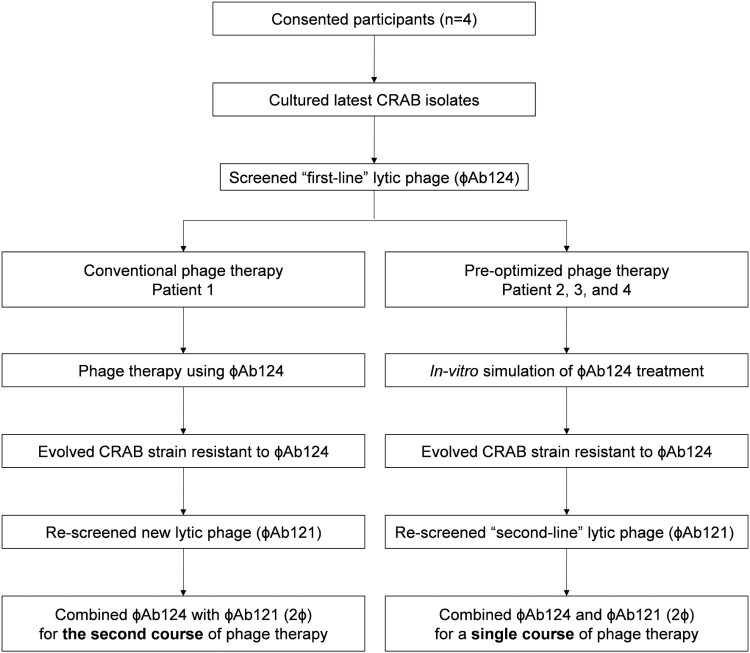
Figure 1.
Figure 1.
Study diagram. Flow diagram of the conventional phage therapy procedure for Patient 1 and the pre-optimized procedure (via next evolution phage-typing, NEPT) for the rest 3 patients.
Figure 2.
Figure 2.
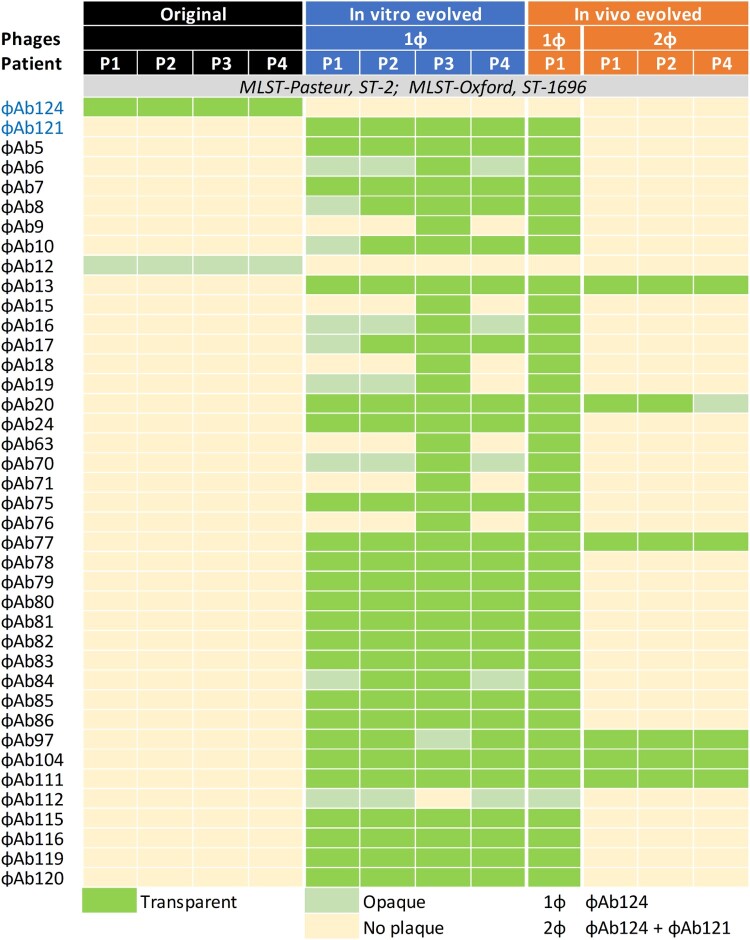
Changes of bacterial phage susceptibility profiles upon in-vivo and in-vitro phage challenges. Representative CRAB isolates and their phage-resistant derivates induced by phage therapy or in-vitro next evolution phage-typing (NEPT) were analysed by Phage-typing and multilocus-sequence typing (MLST) using both the Pasteur and the Oxford schemes.
Figure 3.
Figure 3.
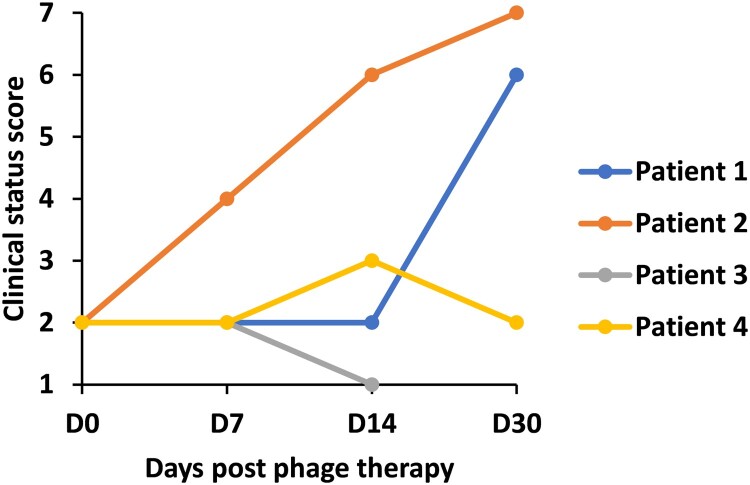
Changes of clinical status within 30 days post phage therapy. Clinical status on a 7-point ordinal scale (1. dead, 2. hospitalized, on extracorporeal membrane oxygenation or invasive mechanical ventilation, 3. hospitalized, on noninvasive ventilation or high flow oxygen devices, 4. hospitalized, requiring supplemental oxygen, 5. hospitalized, not requiring supplemental oxygen, 6. not hospitalized, but unable to resume normal activities, 7. not hospitalized, with resumption of normal activities) was measured at baseline, 7, 14 and 30 days after treatment.

References

    1. Aslam S, Courtwright AM, Koval C, et al. . Early clinical experience of bacteriophage therapy in 3 lung transplant recipients. AJTMBR. 2019 Sep;19(9):2631–2639. DOI:10.1111/ajt.15503. PubMed PMID: 31207123; PubMed Central PMCID: PMCPMC6711787. eng. - DOI - PMC - PubMed
    1. Maddocks S, Fabijan AP, Ho J, et al. . Bacteriophage therapy of ventilator-associated pneumonia and empyema caused by pseudomonas aeruginosa. Am J Respir Crit Care Med. 2019 Nov 1;200(9):1179–1181. DOI:10.1164/rccm.201904-0839LE. PubMed PMID: 31437402; eng. - DOI - PubMed
    1. Dedrick RM, Guerrero-Bustamante CA, Garlena RA, et al. . Engineered bacteriophages for treatment of a patient with a disseminated drug-resistant mycobacterium abscessus. Nat Med. 2019 May;25(5):730–733. DOI:10.1038/s41591-019-0437-z. PubMed PMID: 31068712; PubMed Central PMCID: PMCPMC6557439. eng. - DOI - PMC - PubMed
    1. Verroken A, Scohy A, Gerard L, et al. . Co-infections in COVID-19 critically ill and antibiotic management: a prospective cohort analysis. Crit Care. 2020 Jul 9;24(1):410), DOI:10.1186/s13054-020-03135-7. PubMed PMID: 32646494; PubMed Central PMCID: PMCPMC7347259. - DOI - PMC - PubMed
    1. Zhang H, Zhang Y, Wu J, et al. . Risks and features of secondary infections in severe and critical ill COVID-19 patients. Emerg Microbes Infect. 2020 Dec;9(1):1958–1964. DOI:10.1080/22221751.2020.1812437. PubMed PMID: 32815458. - DOI - PMC - PubMed

Publication types