. 2021 Mar 1;62(3):17.
doi: 10.1167/iovs.62.3.17.

NCX 667, a Novel Nitric Oxide Donor, Lowers Intraocular Pressure in Rabbits, Dogs, and Non-Human Primates and Enhances TGFβ2-Induced Outflow in HTM/HSC Constructs

Affiliations

NCX 667, a Novel Nitric Oxide Donor, Lowers Intraocular Pressure in Rabbits, Dogs, and Non-Human Primates and Enhances TGFβ2-Induced Outflow in HTM/HSC Constructs

Elena Bastia et al. Invest Ophthalmol Vis Sci. .

Abstract

Purpose: NCX 667, a novel nitric oxide (NO) donor with an isomannide core, was characterized for its IOP-lowering ability in animal models of ocular hypertension and glaucoma. Bioengineered human trabecular meshwork/Schlemm's canal (HTM/HSC) constructs were used to explore the mode of action.

Methods: Ocular normotensive New Zealand white (NZW) rabbits (ONT-rabbits), spontaneously ocular hypertensive pigmented Dutch-belted rabbits (sOHT-rabbits), hypertonic saline (5%)-induced transient ocular hypertensive NZW rabbits (tOHT-rabbits), ocular normotensive Beagle dogs (ONT-dogs), and laser-induced ocular hypertensive cynomolgus monkeys (OHT-monkeys) were used. NCX 667 or vehicle (30 µL) was instilled in a crossover, masked fashion and intraocular pressure (IOP) measured before dosing (baseline) and for several hours thereafter. The ONT-rabbits were used for cyclic guanosine monophosphate (cGMP) determination in ocular tissues after ocular dosing with NCX 667. Transforming growth factor-beta2 (TGFβ2) (2.5 ng/mL, six days)-treated HTM/HSC constructs were used to address changes in outflow facility.

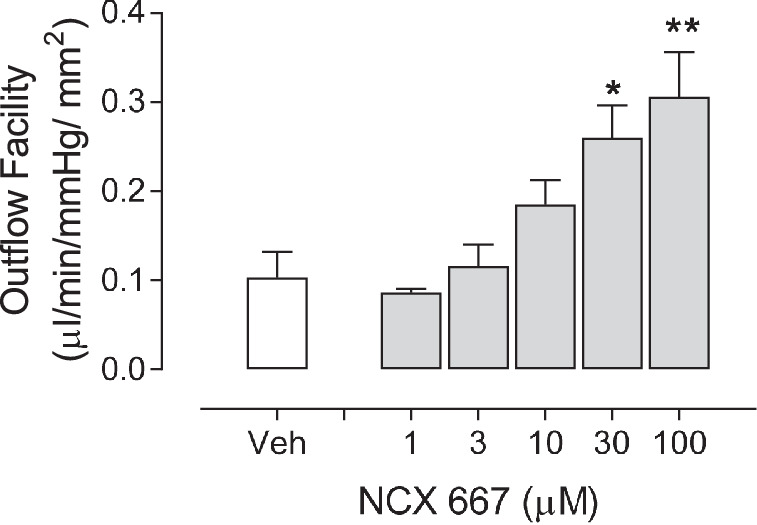
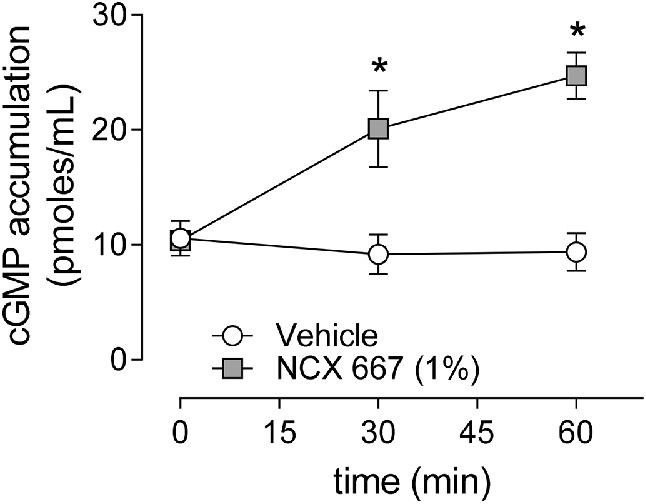
Results: NCX 667 resulted in robust and dose-dependent IOP decrease in all models used. Maximal IOP-lowering efficacy at 1% was -4.1 ± 0.6, -12.2 ± 2.7, -10.5 ± 2.0, -5.3 ± 0.8, and -6.6 ± 1.9 mmHg, respectively, in ONT-dogs, sOHT-rabbits, tOHT-rabbits, ONT-rabbits, and OHT-monkeys. In ONT-rabbits NCX 667 (1%) increased cGMP in aqueous humor (AH) but not in retina and iris/ciliary body. NCX 667 concentration-dependently increased outflow facility in TGFβ2-treated HTM/HSC constructs (outflow facility, 0.10 ± 0.06 and 0.30 ± 0.10 µL/min/mmHg/mm2, respectively, in vehicle- and NCX 667-treated constructs).

Conclusions: NCX 667 leads to robust IOP lowering in several animal models. Evidence in HTM/HSC constructs indicate that the IOP reduction likely results from NO-mediated increase of the conventional outflow pathway. Other mechanisms including changes in AH production and episcleral vein pressure may not be excluded at this time.


Conflict of interest statement

Disclosure: E. Bastia, Nicox (E); C.B. Toris, Nicox (F); S. Brambilla, Nicox (E); C. Galli, Nicox (E); N. Almirante, Nicox (E); M.V.W. Bergamini, Nicox (C); E. Masini, Nicox (F); S. Sgambellone, (N); A.M. Unser, Glauconix (E), F. Ahmed, Glauconix (E), Nicox (F); K.Y. Torrejon, Glauconix (E), Nicox (F); T. Navratil, Nicox, (E); F. Impagnatiello, Nicox (E)

Figures

Figure 1.
Figure 1.
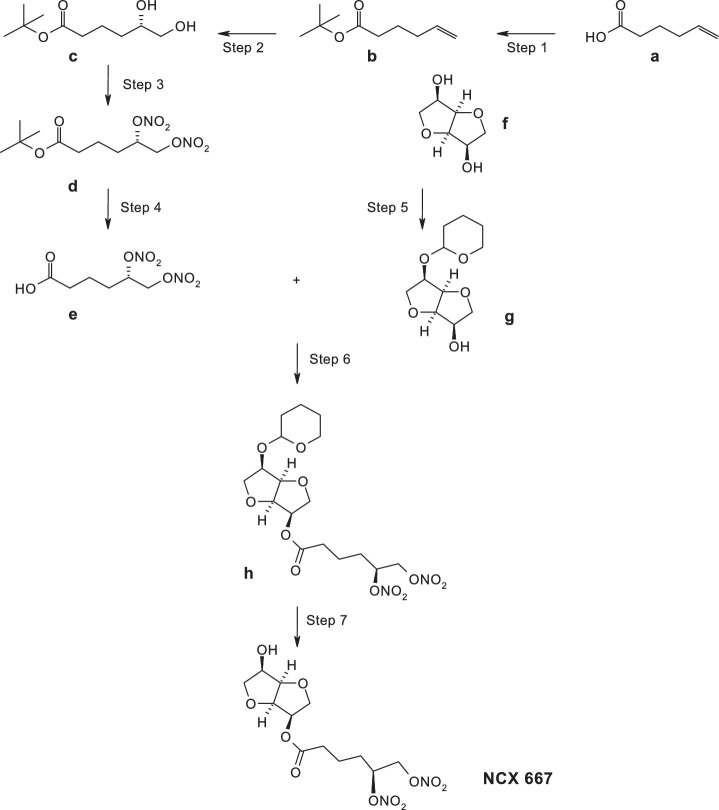
Synthetic pathway for NCX 667 ((S)-((3R,3aR,6R,6aR)-6-hydroxyhexahydrofuro[3,2-b]furan-3-yl) 5,6-bis(nitrooxy)hexanoate). Final yield of 10.7% (calculated on isomannide).
Figure 2.
Figure 2.
Concentration-dependent changes in outflow facility in 3D-HTM/HSC constructs. The “outflow facility” of the bioengineered 3D-HTM/HSC model was calculated mathematically from the flow rate and pressure data collected during the perfusion study. For each concentration n = 4–6 individual perfusion studies were conducted, and the data are shown as mean ± SEM. Differences between samples were analyzed using one-way analysis of variance followed by Tukey post-tests.
Figure 3.
Figure 3.
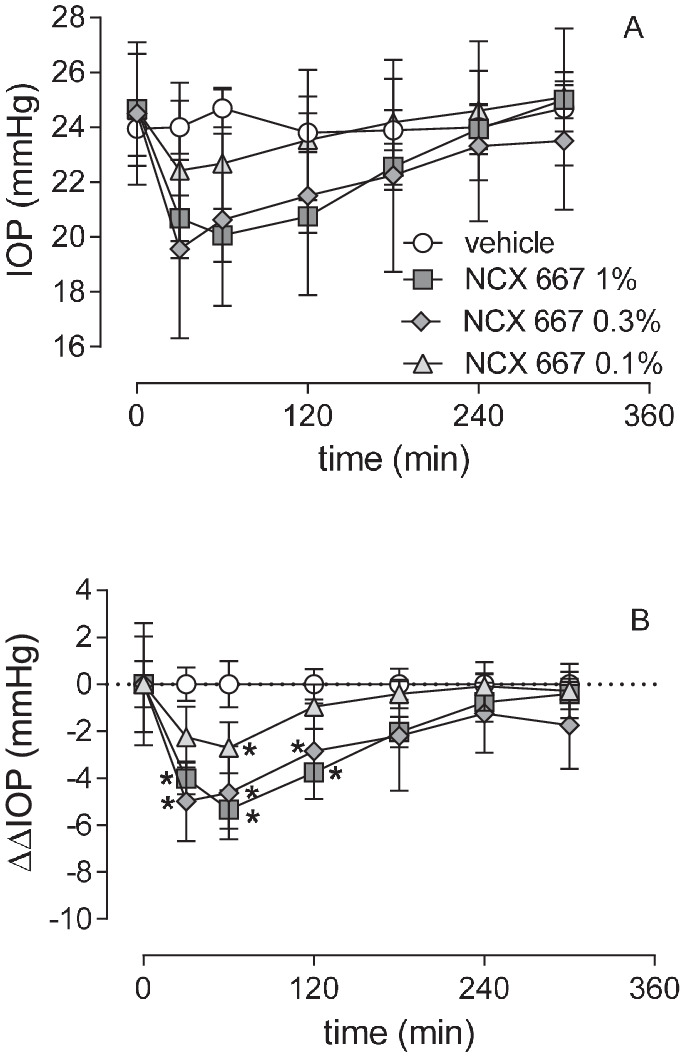
IOP-lowering effect of NCX 667 in ONT-rabbits. Intraocular pressures (A) and differences from vehicle (B) after instillation of NCX 667 (0.1%, N = 8; 0.3%, N = 8; 1%, N = 7) and the respective vehicle (phosphate buffer pH 6.0, Kolliphor EL 5%, DMSO 0.3%, BAC 0.02%, N = 5) were determined in ONT-rabbits. IOPs were determined using a pneumatonometer. Values reported at each time point result from two consecutive measurements taken one minute apart and averaged. The ΔΔIOP were calculated as follows: (Drug IOPTx − Drug IOPT0) − (Veh IOPTx − Veh IOPT0) where IOPTx and IOPT0 are, respectively, the IOP at the time of interest and at baseline. Data are reported as mean ± SEM. *P < 0.05 versus the respective vehicle group, t-test multiple comparisons.
Figure 4.
Figure 4.
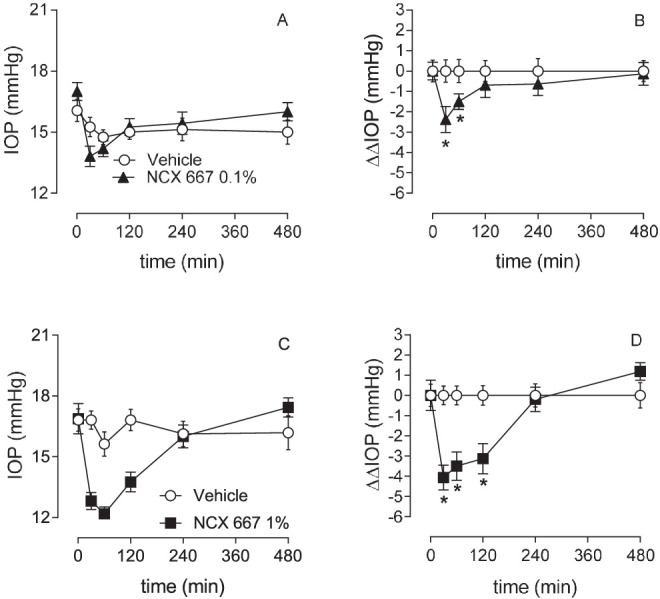
IOP-lowering effect in ONT-dogs. Intraocular pressure (A, C) and changes from vehicle and baseline (B, D) after instillation of NCX 667 (0.1%, and 1%) and the respective vehicle (phosphate buffer pH 6.0, Kolliphor EL 5%, DMSO 0.3%, BAC 0.02%) were determined in ONT-dogs (N = 8, four females and four males). ΔΔIOPs were calculated as follows: (Drug IOPTx − Drug IOPT0) − (Veh IOPTx − Veh IOPT0) where IOPTx and IOPT0 are, respectively, the IOP at the time of interest and at baseline. Data are reported as mean ± SEM. *P < 0.05 versus the respective vehicle group, t-test multiple comparisons.
Figure 5.
Figure 5.
Changes in cGMP in ocular tissues after NCX 677 topical dosing in ONT-rabbits. The cGMP levels after topical dosing of NCX 667 (1%) were monitored in AH (A) or iris/ciliary body and retina (B) of ONT-rabbits at the indicated time points. Data are reported as mean ± SEM, n = 3 eyes/time point. *P < 0.05 versus respective vehicle; two-way analysis of variance followed by Dunnett's multiple comparisons test.

References

    1. Calkins DJ. Critical pathogenic events underlying progression of neurodegeneration in glaucoma. Prog Retin Eye Res . 2012; 31: 702–719. - PMC - PubMed
    1. Heijl A, Leske MC, Bengtsson B, et al.. Reduction of intraocular pressure and glaucoma progression: results from the Early Manifest Glaucoma Trial. Arch Ophthalmol . 2002; 120: 1268–1279. - PubMed
    1. Anderson DR. Normal Tension Glaucoma Study. Collaborative normal tension glaucoma study. Curr Opin Ophthalmol . 2003; 14: 86–90. - PubMed
    1. Stamer WD, Acott TS.. Current understanding of conventional outflow dysfunction in glaucoma. Curr Opin Ophthalmol. 2012; 23: 135–143. - PMC - PubMed
    1. Bucolo C, Platania CB, Reibaldi M, et al.. Controversies in glaucoma: current medical treatment and drug development. Curr Pharm Des . 2015; 21: 4673–4681. - PubMed

MeSH terms

Substances